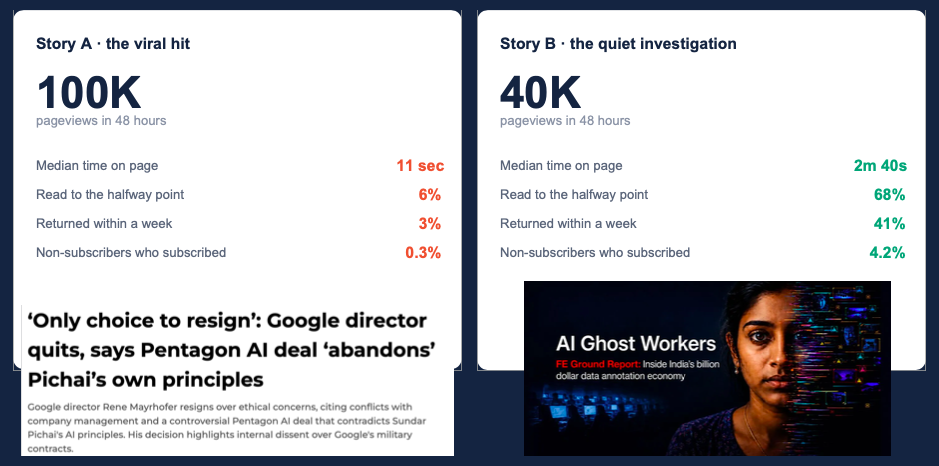
The financial press loves a good morality play. Lately, the favorite sermon features a tired binary: the noble, "disciplined" publisher who crafts slow, meticulous journalism versus the cheap, "dopamine-chasing" traffic hack who peddles clickbait. The consensus is as comfortable as it is wrong. Mainstream media analysts tell you that building a sustainable media asset in the page-view era requires starving the dopamine loop, ignoring raw traffic signals, and relying on rigid editorial systems.
They are wrong. They are broke. And they are fundamentally misunderstanding human biology.
I have spent fifteen years managing digital publishing pipelines, optimizing distribution algorithms, and watching legacy boardrooms burn through tens of millions of dollars trying to force-feed audiences what they "should" want. The cold truth? Discipline without dopamine is just expensive silence. The publishers winning the market right now do not fight the human brain. They don't view dopamine as a flaw in the reader; they view it as the energy source of the internet.
The lazy consensus treats dopamine like a dirty word, synonymous with low-grade sensationalism. This is a scientific and strategic failure.
To win the current media war, you have to weaponize the biological mechanics of attention.
The Biomechanical Lie of Slow Content
Let's clear up the neuroscience that editorial boards love to butcher. Dopamine is not the molecule of pleasure. It is the molecule of anticipation.
Neurologist Wolfram Schultz demonstrated this through years of primate tracking. When a subject receives an unexpected reward, dopamine spikes. But once a habit forms, the spike shifts. It occurs when the subject sees the cue that predicts the reward, not the reward itself.
[Cue / Anticipation] ----> Dopamine Spike
[Action / Consumption] --> Baseline Return
When media theorists tell you to focus on "discipline," they usually mean creating highly predictable, formulaic, and heavy-handed analysis. They want you to publish the editorial equivalent of boiled vegetables at exactly 8:00 AM every Tuesday.
The problem? Predictability kills dopamine.
If your audience knows exactly what you are going to say, how you are going to say it, and when you are going to publish it, the anticipation drops to zero. You have eliminated the biological trigger that causes a human being to move their finger two millimeters to click a link.
Imagine a scenario where a business publication spends three weeks auditing a logistics firm. They produce a 10,000-word, dry, impeccably cited white paper. The discipline is immaculate. The budget was massive. They publish it behind a hard paywall with zero hook, zero tension, and zero narrative rhythm. It sits there, pristine and unread.
Meanwhile, an independent solo operator on a newsletter platform notices a weird anomaly in global shipping containers, drops a highly volatile, narrative-driven breakdown full of sharp hooks, and captures the entire industry's attention in six hours.
The legacy publisher calls the solo operator a "dopamine merchant" as a slur. The solo operator calls the legacy publisher a bankruptcy risk.
The Flawed Premise of People Also Ask
If you look at public search data, the questions people ask about modern media consumption reveal a deep cultural anxiety:
- Does clickbait destroy media trust?
- How do legacy publishers survive the algorithmic era?
- Is high-quality journalism incompatible with page views?
Every single one of these questions is built on a flawed premise. They assume a zero-sum game where "high quality" must mean boring, and "engaging" must mean deceptive.
Let's answer them brutally.
Clickbait does not destroy trust because it uses dopamine hooks. It destroys trust because it breaks the promise of the hook. If your title creates a massive dopamine spike via anticipation, and your content delivers a wet noodle of an answer, the reader feels cheated. The sin isn't the hook; the sin is the bad product at the end of it.
High-quality journalism is completely compatible with rapid page views, provided you stop writing like an academic text from 1984. If your investigative piece on corporate fraud reads like a thriller, you aren't cheapening the work; you are optimizing it for human consumption.
The Cost of the Purist Approach
Let's look at the actual casualties of the "discipline over dopamine" mindset.
Look at the financial trajectory of traditional prestige media over the past decade. The outlets that refused to adapt their packaging to modern distribution networks have either been swallowed by tech billionaires as vanity projects, or they have shriveled into highly insular echo chambers serving an aging, dwindling subscriber base.
When you ignore the dopamine loop, you incur massive hidden costs:
- Prohibitive Acquisition Costs: If your content doesn't generate its own viral velocity through anticipation and curiosity, you must pay for every single pair of eyeballs via advertising.
- Talent Deserts: High-performing creators and investigative minds want impact. They want their work read. When you trap sharp ideas inside an intentionally dull format in the name of "editorial discipline," your best writers leave to start their own media properties.
- The Echo Chamber Trap: By relying solely on a small, hyper-disciplined core audience, you lose the ability to speak to the broader market. Your editorial viewpoint hardens, turns stale, and eventually becomes irrelevant to mainstream culture.
The Counter-Intuitive Alternative: Engineered Tension
The alternative is not to turn your media asset into a garbage mill of celebrity rumors and AI-generated listicles. That is the amateur's view of dopamine.
The sophisticated view is Engineered Tension.
Instead of choosing between rigid discipline and cheap dopamine, you use operational discipline to create high-octane content loops. You apply rigorous reporting to subjects packaged with intense narrative hooks.
To implement this, you must change how you structure information. The traditional journalism inverted pyramid—where you give the conclusion away in the first sentence and spend twenty paragraphs trailing off into minor details—is dead. It kills curiosity.
Instead, you use the open-loop methodology. You introduce a critical tension or an systemic anomaly in the first three sentences. You explain the stakes. You build the anticipation. Then, you systematically resolve that tension over the course of the piece, creating smaller sub-loops along the way.
Traditional Inverted Pyramid:
[Conclusion] -> [Secondary Context] -> [Minor Details] -> (Boredom)

Engineered Tension Loop:
[Tension/Anomaly] -> [The Stakes] -> [Deep Data Analysis] -> [Resolution]
The Dark Side of the Dopamine Strategy
Let's be intensely transparent about the risks here. If you commit to running a media engine powered by curiosity and anticipation, your team will face intense pressure to cheat.
It is incredibly easy to juice short-term metrics by sliding from Engineered Tension into outright deception. The moment your packaging promises something your reporting cannot deliver, your long-term asset value starts evaporating. It takes years to build an audience that trusts your hooks; it takes one deceptive headline to make them tune out forever.
Furthermore, managing this loop requires constant editorial calibration. It requires writers who understand data analytics and deep narrative structure. Those people are rare, they are difficult to manage, and they cost a fortune. It is much easier to hire a compliance-minded writer to churn out predictable industry summaries than it is to find someone who can make a regulatory filing look like a financial crime thriller.
How to Weaponize Attention Now
Stop running away from the reality of the human brain. If you want your ideas, your reporting, or your business analysis to actually shift the market, stop hiding behind the excuse of pure editorial discipline.
- Kill the predictable schedule. If you have nothing explosive to say on Thursday at 9:00 AM, do not publish. Shock your audience with irregular, high-impact drops rather than anesthetizing them with expected mediocrity.
- Audit your hooks with brutality. The first 50 words of your piece dictate whether the remaining 2,000 words exist to the world. If your opening doesn't establish a clear anomaly or high-stakes question, scrap it and start over.
- Invest in data, package for adrenaline. Keep your research pristine. Double-source your facts. Keep your methodology unassailable. But when it comes time to write, leave the academic language in the drawer. Write with pacing, momentum, and sharp corners.
The media properties that survive the next decade will not be the ones that scolded their readers for having short attention spans. It will be the ones that understood that attention is the only real currency on earth, and dopamine is the gatekeeper.
Stop writing for the imaginary reader who reads out of civic duty. Write for the biological animal staring at a glass screen, looking for a reason to care.