Every financial pundit on Wall Street has the exact same Pavlovian response whenever a generational tech founder steps down. They panic. They draw lazy comparisons to Apple after Steve Jobs, declare the innovation engine dead, and advise retail investors to dump their shares before the inevitable decline.
That narrative is intellectually bankrupt.
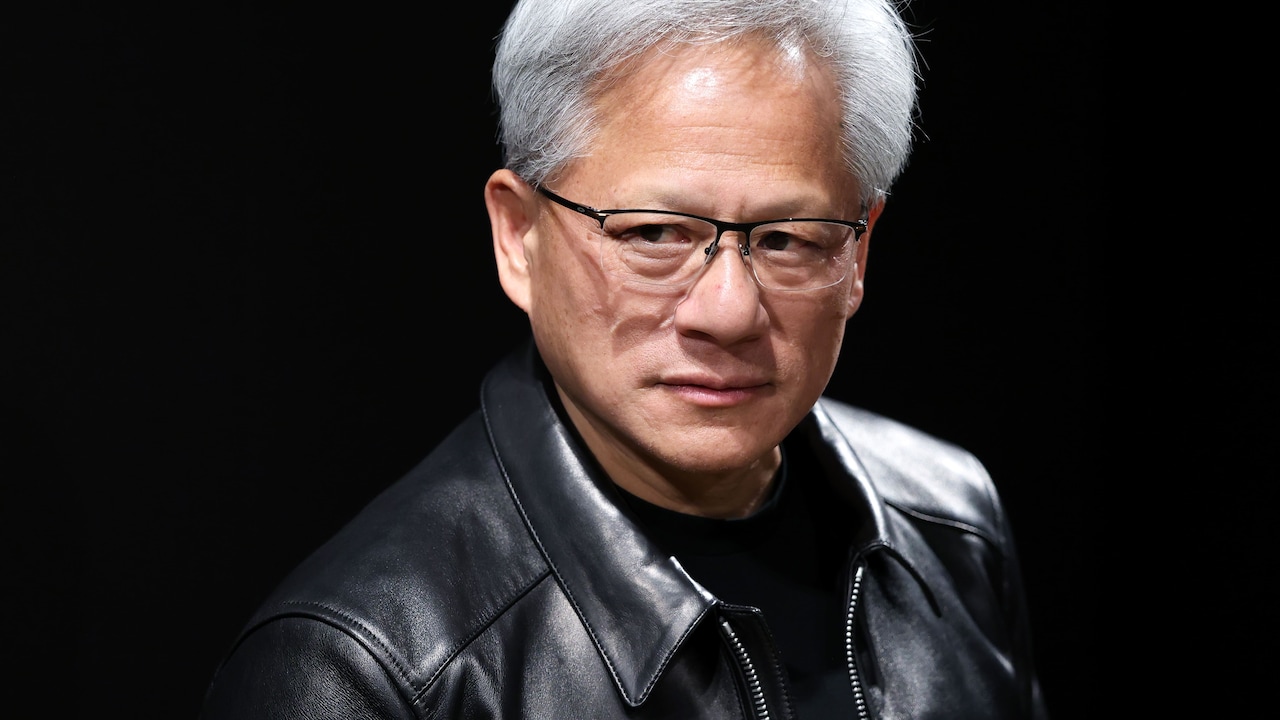
Imagine a scenario where Jensen Huang actually walked away from Nvidia tomorrow, hung up the leather jacket for good, and handed the keys to a successor. The mainstream tech press would treat it like a funeral. Headlines would scream about the end of the AI boom, competitors like AMD and Intel would pop champagne, and analysts would spend months dissecting whether Nvidia can survive without its singular visionary.
They are asking the entirely wrong question. The real story isn't whether Nvidia survives without Jensen. The real story is that Jensen Huang spent the last twenty years building an architectural moat so deep that his own departure wouldn't even slow the company down for half a decade.
The Great Man Fallacy in Silicon Valley
Wall Street loves a hero myth because it simplifies complex engineering into a neat narrative. It is much easier for a television anchor to talk about a charismatic CEO than it is to explain parallel computing architecture or compiler optimization.
Because of this obsession with personality, analysts confuse founder-led direction with founder-dependent execution.
I have watched dozens of enterprise tech companies burn through hundreds of millions of dollars trying to replicate Nvidia’s market dominance. They hire brilliant executives. They poach top hardware engineers. They throw money at foundry capacity. And they fail every single time. They fail because they think they are competing against Jensen Huang, when they are actually competing against a two-decade-old software ecosystem that has calcified into an industry standard.
When Steve Jobs left Apple, the company risked losing its taste—an intangible, aesthetic instinct that cannot be documented in a manual. When Jensen Huang leaves Nvidia, the company loses its chief evangelist, not its engineering physics. The roadmap for the next four years of silicon is already taped out, verified, and sitting in TSMC’s production queues. You cannot cancel physics with a resignation letter.
CUDA Is the Real CEO
If you want to understand why a post-Jensen Nvidia remains an absolute juggernaut, stop looking at the hardware and start looking at CUDA (Compute Unified Device Architecture).
Most casual observers think Nvidia sells chips. That is a fundamental misunderstanding of the business. Nvidia gives away software to sell you an addiction, and the hardware is just the delivery mechanism.
Introduced in 2006, CUDA is a parallel computing platform and programming model that allows developers to use Nvidia GPUs for general-purpose processing. For nearly twenty years, every university researcher, every quantitative hedge fund, and every AI lab on earth has written their foundational code in CUDA.
Think about what this means in practice:
- Sunk Cost Reality: Millions of developers know CUDA inside and out. Retraining an entire engineering organization to use AMD’s ROCm or custom ASIC toolchains isn't a weekend project; it is a multi-year capital drain that kills product velocity.
- Library Lock-In: Nvidia didn't just build a compiler. They built cuDNN for deep neural networks, TensorRT for inference, and thousands of domain-specific libraries for everything from molecular dynamics to computational fluid dynamics.
- The Networking Chokehold: Through the 2019 acquisition of Mellanox, Nvidia locked down InfiniBand and high-speed Ethernet interconnects. Even if you build a faster chip, you still have to network ten thousand of them together without latency bottlenecks. Nvidia owns the pipes.
A new CEO stepping into the corner office in Santa Clara does not need to invent this moat. They just have to collect the tolls.
What Everyone Gets Wrong About Founder Transitions
Let’s dismantle the most common questions investors ask when a titan steps down.
Will Nvidia’s innovation slow down without Jensen’s paranoia?
Jensen Huang famously ran Nvidia with the mantra that the company is always thirty days from going out of business. That culture of extreme urgency is real, and yes, a traditional corporate manager would soften it.
However, institutional paranoia doesn't vanish overnight. Nvidia’s flat organizational structure—where dozens of vice presidents report directly to the CEO without layers of middle-management bureaucracy—is baked into the company’s operating rhythm. An internal successor like Jeff Fisher, Jay Puri, or Ian Buck wouldn't suddenly start holding committee meetings to approve a chip architecture. The machine runs on momentum.
Isn't custom silicon from Google, Amazon, and Microsoft going to eat their lunch anyway?
This is the favorite talking point of every bear on FinTwit. They point to Google’s TPUs, Amazon’s Trainium, and Microsoft’s Maia as proof that hyperscalers will eventually ditch Nvidia.
They miss the economics of hyperscale computing. Cloud providers build custom chips for internal, predictable workloads—like running search algorithms or serving a specific, static model. They cannot rely solely on custom silicon because their enterprise cloud customers demand Nvidia GPUs. If AWS stops buying Nvidia hardware, those enterprise customers simply migrate their workloads to Azure or Google Cloud. Hyperscalers are trapped in a prisoner's dilemma, and Jensen’s departure doesn't change the game theory one bit.
Won't a new CEO ruin the company by chasing short-term margins?
This is the one legitimate risk, and anyone pretending otherwise is selling you something.
Jensen Huang famously sacrificed short-term gross margins for over a decade to fund CUDA development when Wall Street screamed at him to stop wasting money on software nobody was using. A standard MBA-trained executive, obsessed with quarterly earnings per share, might be tempted to cut R&D spending on speculative platforms like Omniverse or robotics to juice the stock price.
If the board hires a bean counter, Nvidia dies a slow, profitable death over ten years. If they promote an engineer, the juggernaut rolls on.
The Structural Advantage of NVLink and Full-Stack Dominance
To see why competitors are still years behind, look at the physical reality of a modern AI data center. It is no longer a collection of servers; it is a single, massive computer.
Nvidia’s true architectural masterstroke wasn't the individual GPU. It was NVLink and NVSwitch—proprietary high-speed interconnects that allow hundreds of GPUs to communicate with each other as if they were a single unified processor with shared memory.
Competitors constantly publish benchmarks showing their new chip beating Nvidia’s flagship on isolated math operations (FLOPs). Those benchmarks are marketing theater. In the real world, training a frontier model is bottlenecked by memory bandwidth and inter-chip communication, not raw compute.
When you buy from Nvidia today, you aren't buying a graphics card. You are buying the GPU, the CPU (Grace), the DPU (BlueField), the networking switches, the transceivers, the cables, and the orchestration software. Nvidia designs the entire rack.
Competitors are selling carburetors while Nvidia is selling the entire Formula 1 car, the pit crew, and the racetrack. A change in team principal doesn't invalidate the engineering blueprint of the vehicle.
How to Actually Position Yourself for a Post-Jensen World
If you are an investor, an enterprise buyer, or a tech strategist, stop reacting to executive headlines and start tracking structural metrics.
- Watch Developer Mindshare, Not Chip Benchmarks: Ignore press releases touting theoretical teraflops. Go to GitHub. Check which frameworks are getting native day-one support. As long as open-source AI researchers write their code for Nvidia hardware first, the moat is intact.
- Track R&D as a Percentage of Revenue: The moment a post-Jensen leadership team slashes R&D spending to fund stock buybacks, sell everything. Nvidia’s dominance relies entirely on out-spending every competitor on next-generation architecture before the current generation even ships.
- Monitor the Interconnect Ecosystem: Keep your eyes on Ultra Ethernet Consortium developments. Nvidia’s biggest vulnerability isn't a better GPU; it is an open-source networking standard that breaks their InfiniBand and NVLink lock-in, allowing data centers to mix and match chips from different vendors seamlessly.
- Ignore the "Next Nvidia" Hype: Every six months, financial media crowns a new startup as the "Nvidia killer." Almost all of them are building inference-only ASICs that become obsolete the moment AI model architectures shift—like the transition from standard transformers to mixture-of-experts or state-space models. Programmability always beats fixed-function silicon in a fast-moving field.
The Uncomfortable Truth About Tech Monopolies
We like to believe that great companies are fragile organisms held together by the sheer willpower of a singular genius. It makes for great biographies and dramatic podcasts.
The reality of industrial-scale computing is far colder. Once a technology platform achieves true vertical integration and developer lock-in, it becomes an infrastructure utility. Microsoft survived the departure of Bill Gates and the disastrous tenure of Steve Ballmer because Windows and Office were deeply embedded in global enterprise workflows. Apple thrived under Tim Cook—a supply chain master rather than a product visionary—because the iOS ecosystem had already captured the consumer.
Nvidia has crossed that exact threshold. The architecture is locked in. The software stack is the industry standard. The supply chain is cornered.
Stop obsessing over who wears the leather jacket and start looking at the silicon underneath it.