Every travel blogger and local tourism aggregation site currently pushing guides on how to view upcoming total solar eclipses from Guernsey is selling you a comfortable, marketable fantasy. They hand you a cute itinerary, point you toward coastal cliffs like Pleinmont or L'Ancresse, and pretend you are about to witness the crowning glory of celestial mechanics.
They are wrong.
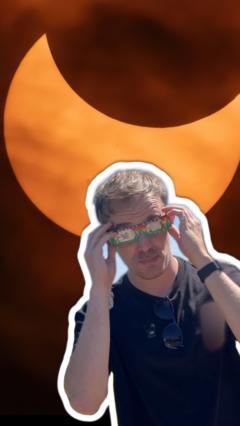
If you stay in Guernsey for the big celestial events, you will not see totality. You will get a partial eclipse. You will get a heavily obscured sun—about ninety-four percent covered during the August 2026 event—and you will get a chilly drop in light that feels more like an overcast Tuesday than a cosmic awakening. Calling this a viewing guide for a total solar eclipse is like reading a manual on how to experience a hurricane by standing comfortably indoors twenty miles away from the coast while it drizzles.
The Geography of Disappointment
Let us define terms clearly. A total solar eclipse only happens along a very narrow shadow path known as the path of totality, where the Moon completely blocks the disk of the sun. Guernsey sits comfortably outside that path.
When travel articles tell you to grab your certified ISO 12312-2 safety glasses and head to St. Peter Port to watch the show, they skip the optical physics. During a partial eclipse, even when ninety-five percent of the sun is blocked, that remaining five percent emits blinding photosphere light.
You cannot take your glasses off for a single second. If you do, you risk permanent retinal damage. In a total eclipse, totality allows observers in the path to remove eye protection safely for a brief window to see the corona. In Guernsey, the entire event requires protective filters. Treat it casually because some glossy blog called it a must-see local spectacle, and you will burn your eyes out.
Why the Lazy Consensus Fails
The lazy consensus in travel writing relies on proximity bias. Writers see that an eclipse is happening in Europe or the Atlantic region, look at a regional map, and assume every adjacent landmass needs a dedicated SEO-optimized landing page telling people to book local hotels.
I have seen companies blow marketing budgets and travelers spend small fortunes booking weekend getaways to island outposts for partial events, expecting the dramatic drop into twilight, the sudden freezing wind, and the corona bursting into the afternoon sky. They get none of it. They get a dimming sun low on the western horizon, dipping toward the sea at an altitude of just a few degrees, easily blocked by a passing cloud bank or local topography.
Imagine a scenario where you travel specifically for the dramatic sensory shock of a total solar eclipse—the 360-degree sunset, the stars popping out at mid-day, the drop in temperature that makes birds fall silent. Now, imagine standing on a windy Guernsey headland at 7:17 PM, watching a slightly crescent-shaped sun sink into the ocean haze while wearing dark cardboard glasses because the local coverage maxed out at ninety-four percent. It is an interesting astronomical curiosity. It is not a total solar eclipse experience.
The Unspoken Physics of Low-Altitude Sunsets
Timing matters as much as location. The upcoming August 2026 partial event peaks late in the evening for the Channel Islands, right around 7:17 PM local time, with the sun sitting barely ten degrees above the western horizon.
Most writers forget to factor in atmospheric extinction. When celestial bodies sit low to the horizon, their light must travel through a much thicker slice of Earth's atmosphere. This scatters the light, dims the contrast, and makes sharp viewing nearly impossible unless you have an entirely unobstructed marine horizon. High ground, cliffs, and buildings inland will ruin your view long before maximum eclipse occurs.
If you want the real event, you have to go to where the shadow actually falls—such as parts of northern Spain or Iceland for the 2026 path—instead of settling for a diluted regional shadow and pretending it counts as bucket-list travel.
Stop treating every celestial alignment as a local tourist festival. Physics does not care about your travel itinerary.