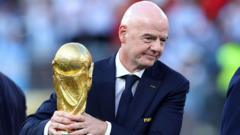
Every time FIFA hits a rough patch, the sports media industrial complex runs the exact same script. Editorial boards clutch their pearls. Pundits demand reform. Columns churn out variations of the same exhausted panic attack about the future of Gianni Infantino.
The lazy consensus says Infantino is a beleaguered executive hanging on by a thread, fighting a losing battle against the moral outrage of global football.
They are wrong. They are missing the entire point of modern sports governance.
Infantino is not under pressure because he is failing. He is untouchable because he is succeeding wildly at the only metric that actually matters to the institution he runs: perpetual, frictionless monetization.
I have watched sports federations burn through millions in compliance budgets while missing the structural reality of how global power works. The media treats FIFA like a corrupt charity organization that occasionally hosts a tournament. That is a child's view of the world. FIFA is a sovereign financial cartel masking as a sporting body.
Let us dismantle the mythology surrounding the FIFA presidency and look at why the constant outrage machine misses the target entirely.
The Myth of the Moral Mandate
The foundational error of every critic calling for Infantino's head is the belief that FIFA answers to public opinion, fan sentiment, or Western journalistic morality.
It does not.
FIFA operates as a direct democracy of 211 member associations. Each nation gets one vote. Whether that vote belongs to a football powerhouse like Germany or a micro-state with a single synthetic pitch, the math is identical. Infantino understood this mechanics-first reality long before his predecessor, Sepp Blatter, was forced out.
While European sports writers spend hours hyperventilating over governance reports, human rights records, and calendar congestion, Infantino spends his time where power actually lives: in the capitals of Africa, Asia, and Oceania.
To a delegate from a developing football federation, Infantino is not a controversial autocrat. He is the man who expanded the World Cup, flooded their local development funds with cash, and gave their national teams a realistic shot at playing on the global stage.
When you ask people what is next for FIFA and an under-pressure Infantino, they assume a reckoning is coming. They assume the pressure from European leagues will force a structural collapse. This is pure fantasy. The European clubs can grumble about fixture burnout all they want, but when the television rights checks clear, they fall in line.
The Economics of Expansion
Criticism of Infantino always centers on bloat. The expanded Club World Cup, the forty-eight-team men's World Cup, the endless tinkering with tournament formats. The narrative frames these moves as reckless greed driven by an ego-maniacal president.
Look at the balance sheet instead of the editorial pages.
Sport is transitioning away from traditional broadcast subscriptions toward fragmented, globalized attention economies. Traditional domestic leagues are hitting a saturation ceiling in Europe. Growth requires reaching new demographics in emerging markets.
By widening the tournament funnels, FIFA locks in long-term broadcast commitments and sovereign sponsorship dollars years in advance. Infantino has diversified FIFA's revenue base away from its traditional European core. That is not mismanagement. That is brilliant risk mitigation for an organization whose sole product is quadrennial attention.
Imagine a scenario where FIFA listens to the critics, shrinks the World Cup back to thirty-two teams, curtails the calendar, and prioritizes European sporting purism. Revenue plummets by billions. Development grants to smaller federations dry up. The voting coalition that keeps Infantino in power fractures instantly.
Infantino's job security relies precisely on the expansion strategies that make European pundits foam at the mouth.
The Trap of Institutional Reform
Whenever external pressure mounts, governance experts call for independent oversight, transparent committees, and ethical resets.
This is where well-meaning observers misunderstand systemic design. FIFA is structurally immune to traditional corporate governance models because it cannot be bought, sold, or liquidated. It holds a natural monopoly over the international game.
When you introduce independent oversight into an organization designed around political patronage, you do not fix corruption. You simply shift the locus of backroom bargaining. Infantino has consolidated power not by bypassing governance, but by mastering the internal legislative machinery. He knows which palms need greasing with development funding and which federations need a stadium upgrade.
The media wants a dramatic courtroom drama where transparency triumphs over cronyism. Real life is messier. Power belongs to whoever controls the distribution of capital to the voting majority. Infantino controls the spigot.
The European Blind Spot
The loudest demands for Infantino's resignation originate in London, Paris, and Madrid. This creates a distorted echo chamber.
European football views itself as the center of the universe. To European eyes, a president who diminishes the prestige of the traditional European domestic calendar must be on his way out.
This ignores the geopolitical shift of global wealth. The epicenter of sports investment has moved eastward and southward. Sovereign wealth funds, Gulf state partnerships, and emerging Asian markets do not view FIFA through the lens of twentieth-century European sporting traditions. They view it as a high-yield asset class.
Infantino aligned FIFA with this new reality. While European clubs complain about player fatigue, Infantino is securing financial cushions that will insulate FIFA against any regional economic downturn.
To bet against him because a few high-profile managers complain about too many matches is to misread the power dynamics entirely.
The Uncomfortable Truth About the Future
What happens next for FIFA under Infantino? More of the same.
More tournaments. More expansion. More monetization of every square inch of green grass on the planet.
The pressure the media reports is real, but it is superficial. It exists in headlines, press conferences, and social media outrage cycles. It does not exist inside the congress hall where the votes are cast.
If you want to understand why Infantino remains secure, stop listening to what people write about him and start looking at who benefits from his ledger.
The reformists are playing chess with rules they invented. Infantino is playing poker with a stacked deck, and he owns the casino.