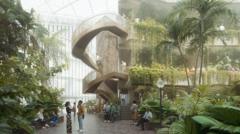
Every spring, the internet loses its collective mind over a promotional stunt disguised as horticultural generosity. The headlines declare that the Barbican Conservatory is handing out thousands of free plant cuttings, and suddenly, thousands of people with zero botanical competence swarm a brutalist concrete bunker like locusts. They wait in hours-long queues for a soggy piece of stem wrapped in damp paper towel, convinced they have secured a priceless piece of botanical treasure.
It is a mass delusion.
You do not want a Barbican cutting. You want the aesthetic associated with owning it. You want an Instagram post featuring a monstera node sitting proudly in a trendy amber glass bottle. What you actually possess is a high-mortality biological specimen that requires stable humidity, precise light spectrums, and a level of attentive discipline that your current lifestyle cannot support.
Let us dismantle the romantic nonsense surrounding free urban plant handouts and look at why this giveaway culture is bad for your home, bad for your wallet, and mostly, fatal for the plants.
The Propagation Fantasy Versus Biological Reality
The lazy consensus in modern horticulture content is that propagation is free and easy. Social media creators love to show a time-lapse of a root shooting out of a pothos clipping in a kitchen window, making it look as effortless as boiling water.
Nature does not work that way. When you take a cutting from a mature plant like the ones thriving in the microclimate of the Barbican Conservatory, you are essentially performing open-heart surgery on a living organism without an anesthetic. You have severed its vascular system. You have cut off its nutrient supply chain.
To survive, that cutting must perform a massive metabolic pivot. It has to stop growing leaves and start generating entirely new root tissue from undifferentiated cells called callus tissue. This process requires three non-negotiable variables:
- Stable ambient temperatures between 20 and 24 degrees Celsius.
- High relative humidity to prevent transpirational collapse while the plant has no roots to drink water.
- Bright, indirect light sufficient to fuel photosynthesis without scorching the tender, unshielded epidermis.
If your apartment drops to 16 degrees at night because you are trying to save money on your heating bill, your free Barbican cutting is going to rot before Friday. The ambient conditions of a brutalist concrete greenhouse with climate control bear zero resemblance to a drafty rented flat in Zone 3.
Why Urban Foraging for Plants is a Mug's Game
Queuing for free flora taps into a cognitive bias known as zero-price effect. When something is free, our brain shuts down its cost-benefit analysis. We assign immense value to worthless items simply because no money changed hands.
I have watched otherwise rational adults stand in line for two hours to get a clipping of a tradescantia that they could buy fully rooted, potted, and thriving at a local garden centre for four pounds. Let's do the math on that transaction:
- Time invested: 2 hours of queuing plus travel time.
- Opportunity cost: Valuing your time at minimum wage makes that free cutting cost you at least twenty-five pounds.
- Failure rate: Industry data suggests casual propagators lose roughly 70% of raw stem cuttings to root rot, fungal infections, or neglect within the first month.
- Total financial outcome: You spent two hours of your life trading zero dollars for a rotting stick of green matter that will end up in your food waste bin.
This is not urban gardening. This is emotional hoarding disguised as a conservation hobby.
The Brutal Truth About Conservatory Microclimates
The Barbican Conservatory is an architectural marvel. It is a massive, humid, glass-enclosed bubble designed to replicate a subtropical ecosystem inside a fortress of concrete. The plants living inside it are not hardy house pets; they are apex survivors of a hyper-specific, highly controlled ecosystem.
When you remove a clipping from that environment and place it into standard household air, you are exposing it to an arid desert. Central heating and double glazing create an indoor humidity level that routinely drops below 30%. Tropical plants experience this shock as a form of cellular trauma.
Imagine taking a deep-sea fish and dropping it into a puddle on the pavement. That is essentially what you are doing when you take a pristine conservatory specimen and place it on a dusty Bookshelf next to your television.
If you genuinely want to succeed with houseplants, stop hunting for publicity stunts and start with species that have been bred to endure human incompetence. Buy a Sansevieria. Buy a Cast Iron Plant. Buy something that actively forgives your propensity to forget to water it for three weeks.
Leave the conservatory specimens where they belong. Let the professionals handle the humidity controls, and admit to yourself that your apartment is a cemetery for greenery, not a botanical garden.
Stop standing in line for plants you cannot keep alive. Buy a pothos from a supermarket, leave it in soil where it belongs, and save yourself the heartbreak of watching a free cutting slowly turn into brown mush on your windowsill.