Every Tuesday night during the fall, local sports desks across the country crank out the exact same cookie-cutter dispatch. Team A beat Team B by two touchdowns. Quarterback X threw three interceptions. The defensive secondary held firm in the red zone. It reads like a high school varsity football recap from 1955, just with different pronouns plugged into the template.
Here is the lazy consensus of youth and scholastic sports journalism: treating girls' flag football as a quaint, adorable novelty that deserves participation trophies and boilerplate box scores.
We are missing the entire plot.
Reducing the fastest-growing scholastic sport in America to a list of Tuesday night scores insults the athletes, misreads the athletic pipeline, and completely ignores the massive tectonic shift happening beneath the pads and flags. Flag football is not just a spring or fall diversion to keep track of wins and losses. It is a violent, beautiful, highly technical laboratory for spatial geometry, biomechanics, and quarterback reads.
When you publish a raw score of twenty-four to twelve without context, you erase the actual sport. You treat it like a gym class scrimmage rather than what it truly is: a surgical evolution of American football stripped of its padding and forced to rely entirely on speed, deception, and precise vector physics.
The Myth of the Soft Contact Sport
For decades, the cultural gatekeepers of football whispered the same tired lie. Without full-contact helmet-to-helmet collisions, football loses its competitive edge. It becomes touch football in the park.
I spent ten years breaking down film for collegiate and developmental programs, and I can tell you right now that this belief is born of pure laziness. Removing the blocker and the helmet does not soften the game. It accelerates it.
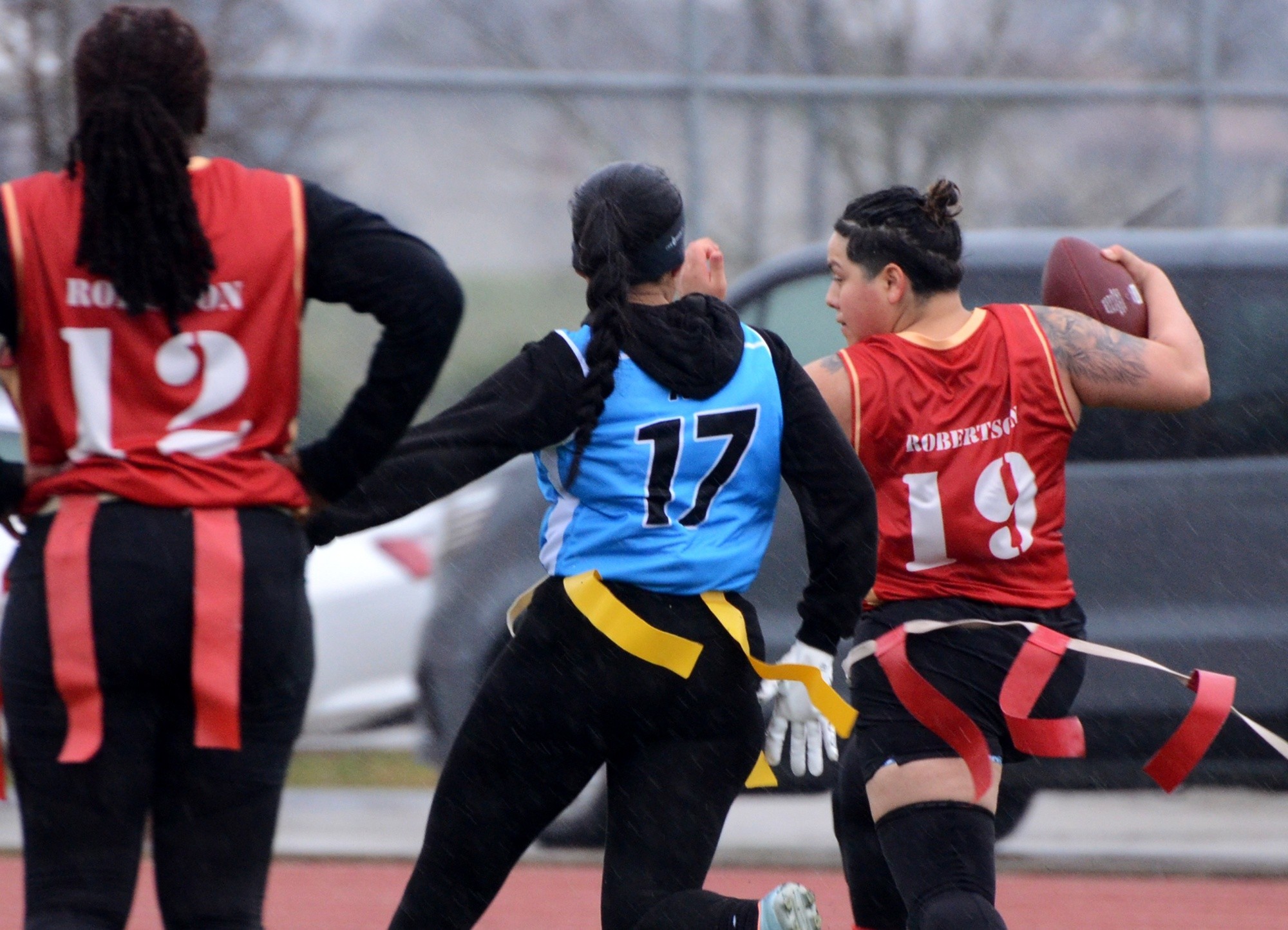
Imagine a scenario where a cornerback cannot rely on a heavy shove downfield to disrupt a receiver's route. In traditional tackle football, physical contact allows for sloppy technique. A defender who gets beat can clutch, grab, and lean to recover. In flag football, that luxury vanishes. You have to run stride-for-stride with a slot receiver who is operating at maximum velocity, and your only reward for a good defensive play is snatching a piece of plastic cloth off a moving target.
The technique required to defend the pass in girls' flag football is exponentially harder than what we coach on Friday nights under the Friday Night Lights. The angles are tighter. The spatial awareness has to be immaculate. When local papers print Tuesday's scores with a shrug and a casual mention of the final tally, they ignore that these athletes are mastering coverage schemes that would give an average college defensive coordinator a headache.
Why the Traditional Box Score is Dead
Let us look at how the data is being tracked. Or rather, how poorly it is being tracked.
A standard box score tells you passing yards, touchdowns, and interceptions. It is a relic of the 1970s. In modern flag football, traditional metrics fail because they do not account for the coin of the realm: separation and flag-pull efficiency.
"If you judge a flag football offense by raw yardage alone, you are looking at a shadow on the cave wall."
Consider what actually dictates a win on a Tuesday night. It is not raw arm strength. It is the ability of the slot receiver to execute a sharp angle change at twenty miles per hour without slipping. It is the quarterback's internal clock ticking down to two point four seconds because the pass rush, unencumbered by heavy offensive linemen holding blocks, is collapsing the pocket from every conceivable angle.
When a media outlet simply posts that the Wildcats defeated the Tigers thirty to six, they do a disservice to the offensive coordinator who schemed three different levels of distraction to clear out the safety. They ignore the defensive end who forced an intentional grounding by maintaining outside leverage.
We need to stop writing about these games as if they are rec-league soccer matches where everyone gets a juice box afterward. These are hyper-competitive, high-IQ environments where elite basketball guards and track sprinters are converting their athletic gifts into a masterclass of gridiron chess.
The Economics of the Flag Revolution
Let us address the elephant in the room. The push for girls' flag football is not just about inclusion or ticking a compliance box for Title IX. It is a massive economic disruption.
Universities from the NAIA to the NCAA are waking up to the reality that flag football is an emerging championship sport with serious scholarship money attached. The International Olympic Committee added flag football to the 2028 Summer Games in Los Angeles for a reason. It is globally digestible, incredibly fast-paced, and wildly entertaining.
Yet, local coverage remains stuck in the dark ages. Editors look at the schedule, assign a stringer to call the coach for a three-sentence quote, and drop a sterile list of scores at the bottom of the page next to junior varsity volleyball.
This approach patronizes the players. These athletes are not playing for fun; they are competing for tape, for college looks, and for a spot on national development squads. Treating their games like a local bake sale diminishes the grinding work they put in during practice all week.
What Actually Matters on Tuesday Nights
If you want to understand why a team won or lost on a Tuesday, throw away the final score and look at the situational efficiency.
- Red Zone Conversion on Fourth Down: Without the luxury of a power-run game up the middle to punch it in from the one-yard line, teams must design pick-and-rub concepts in tight spaces.
- Flag-Pull Integrity: Watch the hips. The teams that win consistently are the ones that break down early, drop their center of gravity, and attack the waist rather than reaching for the ribbons.
- Cover-2 Disguises: High school quarterbacks are seeing sophisticated zone drops that mimic professional defenses because coaches realize that man-to-man coverage is a death sentence against elite speed.
Stop asking for the final score. Start asking how many explosive plays were generated off pre-snap motion.
The sport has outgrown the journalists covering it. If we keep treating girls' flag football as a cute little alternative to the real thing, the sport will leave us behind in a cloud of turf pellets.
Next time Tuesday rolls around, look past the numbers on the scoreboard. That is where the real game is being played.