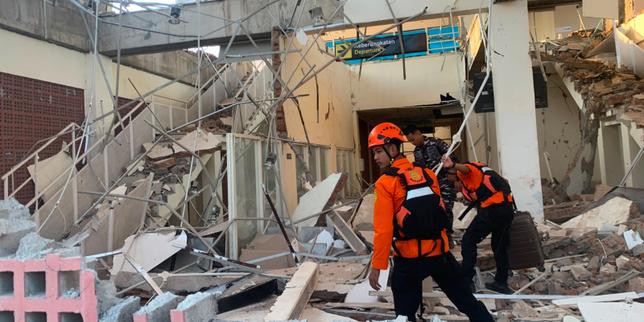
The media treats tectonic violence like prime-time spectator sport. Another headline drops about a 7.7-magnitude tremor striking eastern Indonesia, another casualty count rolls in, and the digital news cycle floods with drone shots of pulverized concrete, weeping survivors, and panicked crowds fleeing coastlines.
The lazy consensus from mainstream desks points a finger squarely at nature. We get the standard, tired narrative about the Pacific Ring of Fire, the fury of the earth, and the tragic inevitability of living on a shifting archipelago.
It is a comfortable lie. It absolves planners, builders, and policy-makers of absolute systemic failure.
Stop blaming the tectonic plates. Earthquakes do not kill people; weak building codes, corrupt permitting processes, and non-existent structural engineering kill people.
When a magnitude 7.7 event flattens regional infrastructure across Flores and triggers landslides that cut off entire regencies, pointing at the Richter scale is a coward's excuse. Japan routinely shrugs off much stronger subterranean jolts with minimal structural loss because their built environment is engineered for survival. Indonesia builds out of hope and cheap mortar. Until the discourse shifts from grieving disaster imagery to prosecuting structural negligence, the death toll will remain an annual recurring fee paid in blood.
The Myth of Sudden Panic
Another favorite trope of crisis journalism is the focus on human panic. Headlines scream about thousands fleeing to higher ground, implying that chaotic masses worsen the crisis.
The data says otherwise. When the early morning tremor struck off Ende, thousands of residents evacuated on their own feet. That is not irrational panic; that is hardwired survival instinct developed through generations of living in a high-risk zone.
The real breakdown does not happen on the ground among fleeing villagers. It happens inside government logistics chains. Within hours of the 2026 Flores quake, disaster mitigation agencies were scrambling because landslides blocked the Trans-Flores Highway and communications failed due to basic power grid vulnerabilities.
Imagine a scenario where disaster response budgets are spent on hardening arterial roads and decentralizing emergency power supplies before the ground shakes, instead of scrambling helicopters for photo-ops after the morgues fill up.
Resilience is not a buzzword; it is an upfront capital expenditure. Indonesia's regional governments have spent decades treating disaster preparedness as an emergency reaction rather than a core infrastructure metric.
The Tsunami Warning Trap
Look at how the coastal evacuations were handled. The moment the tremor hit, automated systems fired off tsunami alerts, sending thousands scrambling away from beaches. Three hours later, the warning was lifted because sea-level monitors showed no displacement threat.
Critics love to claim that false alarms exhaust the public. They argue that crying wolf breeds complacency. That is patronizing nonsense.
In a zone where the 1992 Flores tsunami wiped out thousands, an over-cautious warning system is infinitely superior to a silent one. The failure is not that authorities warned people too quickly; the failure is that coastal zoning laws allow dense population centers to sit on vulnerable, low-lying alluvial plains in the first place.
We zone for commercial convenience, ignore elevation data, and then blame the ocean when it knocks on the front door.
The Real Fix
If you want to stop writing obituaries for eastern Indonesia, dismantle the current paradigm of post-disaster charity. Stop sending boxes of instant noodles three days too late.
Enforce mandatory seismic retrofitting for public facilities, schools, and clinics. If a hospital operating room collapses during a standard subduction zone quake, the contractor and the local official who signed off on the blueprint should face criminal negligence charges.
Cut the sympathy. Start enforcing engineering standards.