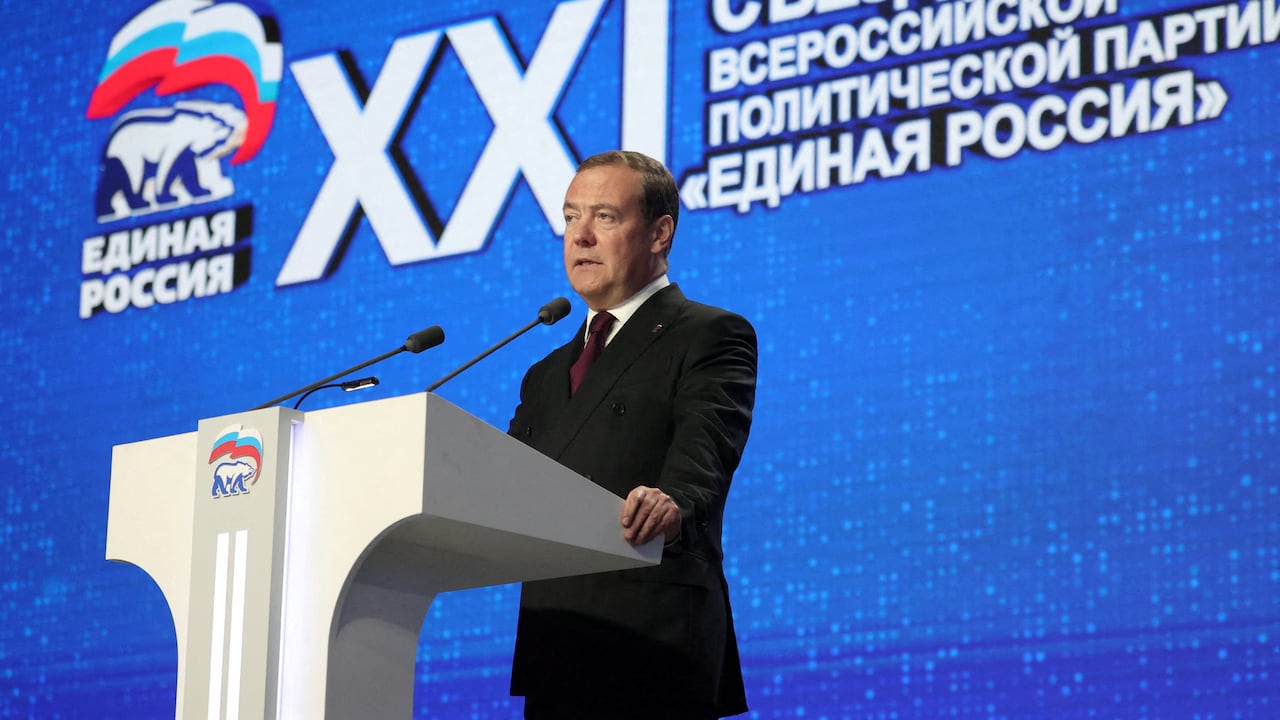
Every time Washington drops a heavy sanctions package on Moscow, the media playbook writes itself. Within hours, headlines flash across screens worldwide warning of apocalyptic retaliation. Dmitry Medvedev takes to his digital channels, slams Western policy as Russophobic filth, and invokes the sacred specter of military deterrence, nuclear doctrines, and nationalized assets. Analysts scramble onto television sets to debate whether the red button is about to be pushed.
It is professional wrestling for foreign policy junkies. And the entire West swallows it hook, line, and sinker.
The lazy consensus treats Medvedev's fiery pronouncements as direct operational directives from the Kremlin command bunker. This is an analytical error born of sheer laziness. If you want to understand why Western sanctions policy keeps missing its mark, you have to stop treating theatrical venting as a military blueprint and start looking at the structural panic it is engineered to obscure.
I have spent years tracking sanctions architecture, compliance loopholes, and the grinding realities of sovereign financial isolation. I have seen multi-billion-dollar compliance teams panic over blog posts written by men who haven't held operational executive authority in over a decade. The truth is far more mundane, far more cynical, and infinitely more revealing than the scaremongering suggests.
Let us dismantle the mechanics of this recurring geopolitical pantomime.
The Constitutional Mirage
To understand why Medvedev's threats of military deterrence are hollow structural noise, you first have to understand his actual institutional weight. Under the Russian Federation's constitutional framework, Dmitry Medvedev serves as the Deputy Chairman of the Security Council. It is a consultative, advisory body. It does not possess executive command authority over strategic missile forces, conventional army groups, or operational logistics networks.
He can write manifestos on messaging apps until his fingers cramp, but he cannot launch a battalion or alter nuclear release protocols. Conflating his rants with the actual command-and-control apparatus of the Russian military is like treating a retired backbencher's angry tweet as an official declaration of war from Downing Street.
Yet, mainstream journalism routinely elevates these posts to the level of doctrine. Why? Because fear sells clicks, and simplicity beats structural nuance every single time. It is much easier to quote a provocative soundbite about nuclear deterrence than it is to explain the tedious mechanics of secondary tariffs, maritime insurance tracking, or liquidity constraints within regional banking networks.
When Washington expands statutory sanctions—such as the aggressive measures targeting oil and gas buyers, financial intermediaries, and the shadow tanker fleet—Moscow faces a very real, very unglamorous economic squeeze. Cash flows tighten. Logistics costs spike. Secondary compliance pressure from major trading partners begins to bite.
Faced with these cold economic realities, the Kremlin needs an immediate deflection. Enter the nuclear megaphone.
The Economics of Apocalyptic Rhetoric
Watch the timing of these statements. They never arrive in a vacuum. They correlate precisely with structural economic choke points.
When international watchdogs close loopholes on maritime oil transport or when primary financial institutions are forced to sever correspondent banking lines, the domestic economic pressure mounts. The shadow fleet of tankers faces higher insurance premiums and constant surveillance. Major energy importers find themselves forced to weigh the cost of secondary penalties against discounted commodity purchases.
In that environment, economic vulnerability is the ultimate enemy. A government cannot project omnipotence if its currency valuation is wobbling or if key industrial sectors are quietly starving for imported microelectronics and specialized machine parts.
What is the cheapest, most effective way to change the subject? Threaten military deterrence. Shift the global discourse from ledger sheets, trade deficits, and tanker tracking data back to the high-stakes theater of global annihilation.
It works every time. Foreign policy desks abandon macroeconomic analysis and revert to existential panic. Analysts begin modeling worst-case kinetic scenarios. Meanwhile, the actual economic vulnerabilities—the leaky ports, the workaround supply chains, the quiet backchannel negotiations—continue operating behind the smoke screen.
By reacting with horror to every escalation threat, Western capitals hand Moscow a free public relations victory. They validate the premise that economic sanctions are so devastatingly effective that they leave the target with no alternative except military posturing. Ironically, treating these threats as existential warnings grants them a credibility they do not deserve on the merits.
The Danger of Over-Correction
Now, let us address the counter-argument, because intellectual honesty requires admitting the blind spots of any contrarian take.
Does ignoring Medvedev's rhetoric mean there is zero risk of escalation? Absolutely not. Dismissing all deterrence messaging as empty bluster invites strategic complacency. Geopolitical miscalculation happens when policymakers mistake genuine structural red lines for mere noise.
The danger lies in binary thinking. The foreign policy establishment swings wildly between two equally idiotic extremes: either treating every angry social media post as the prelude to World War III or assuming that deterrence theory is entirely dead.
Neither is true.
The real risk is not that Medvedev's threats will materialize into a coordinated tactical strike against Western capitals. The risk is that Western policymakers will become so desensitized to the noise—or alternatively, so terrified of it—that they fail to calibrate their economic pressure correctly. If sanctions are applied haphazardly without understanding where the real economic pain points lie, they fail to alter strategic behavior while generating immense collateral damage in global supply chains.
Conversely, if Western leaders allow themselves to be paralyzed by every round of nuclear posturing, they effectively grant nuclear-armed states an unconditional veto over international economic law. That is a dangerous precedent. It establishes a rule where any nation can violate sovereign borders, defy international norms, and then immunize its economy from consequences simply by turning up the volume on its deterrence rhetoric.
Reading the Signals That Actually Matter
If you want to survive and profit in an era of fractured globalization and permanent sanctions warfare, you have to stop watching the circus ring and start examining the balance sheet.
Ignore the daily diet of apocalyptic soundbites. Instead, track the metrics that move the needle:
- Bilateral Trade Flows with Non-Western Partners: Monitor how third-party intermediaries adapt to secondary tariff threats. Are major energy buyers finding alternative clearing mechanisms, or are compliance departments successfully freezing transactions?
- Industrial Bottlenecks and Substitution: Look at domestic production indices for critical components. Rhetoric cannot manufacture precision bearings, specialized chemicals, or advanced semiconductors.
- Shadow Fleet Economics: Track insurance costs, flagging changes, and port access restrictions for maritime transport. This is where the economic war is actually won or lost.
- Internal Liquidity and Fiscal Reserves: Watch sovereign fund drawdowns and domestic credit conditions. Budgets tell the truth that speeches attempt to hide.
When you look at these indicators, a very different picture emerges. It is a picture of grinding friction, slow adaptation, structural inefficiency, and quiet compromise. It is not a Hollywood thriller. It is a war of economic attrition fought in bureaucratic offices, customs checkpoints, and shipping registries.
The Real Agenda Behind the Sanctions
To grasp why these rhetorical flare-ups occur, we also have to interrogate the Western side of the equation. US and European sanctions architectures are rarely clean instruments of strategic logic. They are often messy compromises designed to project political resolve domestically while carving out backdoor exemptions for politically sensitive industries.
When lawmakers pass sweeping sanctions packages targeting financial institutions and energy networks, they are performing for their domestic electorates just as surely as Moscow's mouthpieces are performing for theirs. They need to demonstrate toughness without triggering catastrophic global energy shocks that could tank domestic approval ratings ahead of an election cycle.
This creates a permanent tension. The sanctions are designed to be loud enough to look devastating on paper, but porous enough to prevent total global market chaos.
Moscow recognizes this dynamic perfectly. That is why the response to Western sanctions is rarely asymmetric economic warfare of equal magnitude. Instead, it relies on asymmetric rhetoric. It exploits the West's internal anxieties against itself. Western media houses, desperate for engagement, amplify the threats. Financial markets jitter for forty-eight hours. Politicians issue clarifying statements. And the underlying economic reality grinds forward with minimal disruption.
We are caught in a self-sustaining loop of performative escalation. Every cycle reinforces the illusion that the world stands perpetually on the precipice of a kinetic abyss, distracting everyone from the unglamorous, bureaucratic reality of how these conflicts are actually managed.
Breaking the Cycle
It is time to grow up.
Geopolitics is not a comic book where villains monologue about global destruction before flipping a switch. It is a cold, calculating chess match played by actors who value self-preservation above all else.
Dmitry Medvedev serves a vital systemic purpose for Moscow, but not the one the headlines suggest. He is the pressure valve, the designated lightning rod whose job is to absorb external shocks and convert them into bombastic prose. Treating him as an oracle of doom is a category error of the highest order.
The next time a sanctions package drops and the inevitable threat of military deterrence follows, resist the urge to panic. Do not model the apocalypse. Do not clear your portfolio. Do not rewrite your strategic thesis based on a morning rant.
Look past the theater. Examine the ledgers, track the supply lines, and watch the capital flows. That is where the real story is happening. The rest is just noise designed to keep you from noticing how little has actually changed.