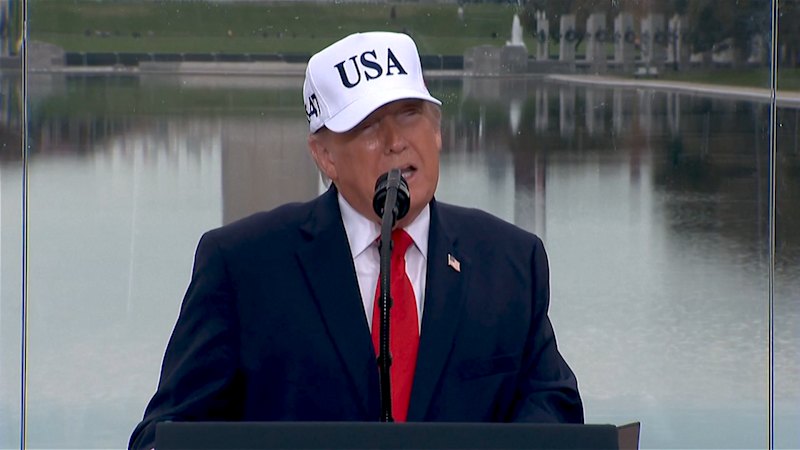
Every political pundit in Washington is currently hyperventilating over a rumor that Donald Trump wants to rename the Lincoln Memorial Reflecting Pool. They are clutching their pearls. They are writing breathless op-eds about historical erasure and constitutional norms.
They are also completely missing the point.
If you spend five minutes reading the mainstream coverage of this story, you will encounter the same lazy consensus. The narrative goes like this: Trump floats a provocative idea about a sacred American landmark, critics call it authoritarian narcissism, supporters cheer the disruption, and everyone argues about civics for seventy-two hours. It is predictable. It is exhausting. And it is entirely disconnected from how executive power and public branding actually function in the United States.
You are asking the wrong question if you are wondering whether Trump should rename the pool. The real question is why the political media class still falls for a basic strategic feint—and why the legal mechanics of federal monument naming make this entire outrage cycle an exercise in pure fiction.
The Anatomy of a Manufactured Outrage Cycle
I have spent twenty years watching political communications teams, media buyers, and crisis PR firms burn millions of dollars trying to manufacture organic attention. Most of them fail because they try to buy relevance with polished talking points.
Donald Trump does not buy relevance. He hijacks existing emotional real estate.
Think about the Lincoln Memorial Reflecting Pool. It is not just a rectangular basin of water stretching 2,029 feet between the Lincoln Memorial and the World War II Memorial. It is the visual centerpiece of the National Mall. It is the backdrop for Martin Luther King Jr.’s "I Have a Dream" speech. It is the site of Forrest Gump’s fictional reunion with Jenny. In the American subconscious, that strip of water represents civic sanctity.
When a political figure suggests altering the name of an untouchable cultural icon, the reaction is instantaneous. Cable news panels light up. Social media algorithms reward the highest-decibel outrage. Within hours, millions of people are debating a hypothetical plaque instead of discussing tax policy, judicial appointments, trade tariffs, or administrative rule changes happening quietly in the Federal Register.
This is a classic asymmetric attention play. It costs zero dollars to float a trial balloon about renaming a monument. Meanwhile, the opposition spends weeks of airtime, fundraising copy, and political capital fighting a phantom proposal that has not even been drafted into legislation.
The Legal Reality Nobody Mentions
If you want to dismantle a bad argument, start with the statute books. Most commentators treat the National Mall like a corporate office building where the incoming CEO can simply order a new sign for the lobby.
That is not how federal land works.
The Lincoln Memorial Reflecting Pool is managed by the National Park Service under the Department of the Interior. Under the Commemorative Works Act of 1986—and the broader framework of Title 54 of the United States Code—the executive branch does not possess unilateral, unchecked authority to slap new names onto existing Congressionally authorized memorials on the National Mall.
Here is what the pundits leave out when they panic over a headline:
- Congressional Jurisdiction: Major commemorative works in the Reserve—the central cross-axis of the National Mall—are strictly regulated by Congress. Changing the official designation of an established memorial feature requires statutory authorization, not just a stroke of a Sharpie in the Oval Office.
- The Twenty-Five-Year Rule: Under the Commemorative Works Act, Congress explicitly prohibited the naming of commemorative works after living individuals. A person must be deceased for at least twenty-five years before a major memorial work on the Mall can bear their name. Even if someone wanted to name the pool after a contemporary figure, federal law flatly bars it without repealing existing statutes.
- Administrative Friction: Even minor signage changes within National Capital Parks-Central trigger mandatory reviews by the National Capital Memorial Advisory Commission, the Commission of Fine Arts, and the National Capital Planning Commission. These bodies move at glacial speeds, bound by public comment periods and historical preservation mandates under Section 106 of the National Historic Preservation Act.
Imagine a scenario where an administration actually tried to force a name change through executive fiat. Within forty-eight hours, preservation groups and members of Congress would file an injunction in the U.S. District Court for the District of Columbia. A federal judge would freeze the order before a single engraving tool touched granite. The administration knows this. Their lawyers know this. Yet the press covers the rumor as if bulldozers are idling outside the Lincoln Memorial.
Why Monument Naming Is Always Political Theater
Let us strip away the selective amnesia surrounding American landmarks. Pundits love to pretend that the names on our buildings and parks are sacred, immutable truths handed down from on high.
They are not. They are the receipts of past political battles.
Look at the history of the National Mall itself. When Henry Bacon designed the Lincoln Memorial and the Reflecting Pool in the early twentieth century, the area was barely reclaimed swamp land. The pool was completed in 1923, nearly sixty years after Abraham Lincoln’s assassination, during a period when Northern and Southern politicians were actively negotiating how to frame the memory of the Civil War. The design was deliberate political messaging meant to project national unity at the expense of addressing ongoing racial segregation in the capital.
Or look at Washington National Airport. For decades, everyone called it National. In 1998, a Republican-led Congress passed legislation renaming it Ronald Reagan Washington National Airport—and they did it without providing a single dime of federal funding to pay for the new highway signs, forcing local transit authorities to foot the bill. Democrats screamed about partisan branding. Today, millions of travelers book flights to DCA without blinking.
Consider the Robert F. Kennedy Department of Justice Building, the J. Edgar Hoover Building, or the John F. Kennedy Center for the Performing Arts. Every single one of those names was the product of intense legislative lobbying, partisan leverage, and symbolic territory-marking.
| Landmark | Original / Previous Name | Year Renamed | Mechanism Used |
|---|---|---|---|
| Ronald Reagan Washington National Airport | Washington National Airport | 1998 | Act of Congress (Public Law 105-154) |
| Denali | Mount McKinley | 2015 | Secretarial Order by Dept. of the Interior |
| Bears Ears / Grand Staircase | Various boundary designations | 2017 / 2021 | Presidential Proclamations (Antiquities Act) |
| Fort Liberty | Fort Bragg | 2023 | Congressional Naming Commission Mandate |
Notice the pattern. Naming rights in Washington are a bipartisan sport. When the Obama administration restored the Alaska Native name Denali to Mount McKinley in 2015 via a Secretarial Order—bypassing decades of Congressional gridlock from the Ohio delegation—conservatives accused the White House of erasing American history. When the Pentagon renamed nine Army bases in 2023 to remove Confederate designations, critics called it woke revisionism, while supporters called it long-overdue justice.
The mechanism changes depending on who holds the gavel, but the underlying impulse is identical: whoever controls the symbols controls the story.
The Strategic Flaw in My Own Argument
I will give the pearl-clutchers one point, because intellectual honesty demands it. If you treat every rhetorical provocation as harmless theater, you run the risk of normalizing things that actually erode institutional trust.
There is a real cost to constant symbolic warfare. When public spaces become partisan billboards, citizens stop viewing national monuments as shared inheritance and start viewing them as conquered territory. If every incoming president tries to rebrand the physical landscape of the capital, the National Mall eventually stops being a civic commons and turns into a rotating corporate sponsorship deck.
That is a legitimate long-term danger. However, you do not prevent that danger by hyperventilating every time a politician floats a rumor to a reporter. Panic is not a strategy. Outrage is not resistance. In fact, predictable outrage is the exact fuel that keeps symbolic politics alive.
Answering the Questions People Actually Ask
When stories like this trend, search engines light up with variations of the same anxious queries. Let us dismantle the flawed premises behind them.
Can a president legally rename the Lincoln Reflecting Pool?
No. Not unilaterally. While a president can issue directives to the Secretary of the Interior regarding administrative operations, altering the official name of a Congressionally established commemorative feature on the National Mall runs headfirst into the Commemorative Works Act and Congressional appropriations riders. Without an Act of Congress, any attempt to rename the pool would be purely cosmetic, unenforceable on official maps, and dead on arrival in federal court.
Why would anyone want to rename a monument tied to Abraham Lincoln?
Because the target is never Abraham Lincoln. In modern political branding, floating a change to an iconic name is a loyalty test and an attention magnet. It forces allies to defend the disruption and forces opponents to look like rigid defenders of the bureaucratic status quo. It shifts the battlefield from complex, boring policy outcomes to simple, visceral identity politics.
What happens to the existing name if a landmark is rebranded?
In practice, almost nothing—at least for a generation. Look at Chicago’s Willis Tower. It was officially renamed from the Sears Tower in 2009. Nearly two decades later, locals still call it the Sears Tower. Look at New York’s Mario M. Cuomo Bridge; half the commuters in the Hudson Valley still call it the Tappan Zee. Cultural memory has far more inertia than government signage. You can change the bronze plaque, but you cannot legislate how people talk.
How to Read Political News Without Getting Played
If you work in media, public affairs, or simply want to stay sane while following national politics, you need a better filter for stories like the Lincoln Reflecting Pool rumor. Stop reacting to the headline and start auditing the mechanics behind it.
- Check for a Draft Bill or Executive Order: Until text exists on paper with a docket number or an Executive Order citation, it is not policy. It is chatter. Treat unverified trial balloons with the exact same seriousness you give to sports talk radio trade rumors.
- Follow the Calendar: Look at what else is happening in Washington the exact week a monument-naming rumor drops. Is a major budget deadline looming? Is an unpopular cabinet nominee facing a confirmation hearing? Is an economic report coming out on Friday morning? Symbolic controversies rarely appear in a vacuum; they are almost always deployed as chaff to jam the radar.
- Separate Rhetoric from Appropriations: In Washington, nothing is real until money is attached to it. Renaming a major federal site requires line-item funding for signage, digital infrastructure, security updates, and National Park Service archival revisions. If there is no budget request, there is no plan.
The competitor articles treating this rumor as an imminent constitutional crisis are selling you cheap adrenaline. They want you angry because angry readers click more links, watch more segments, and share more posts.
Meanwhile, the actual levers of power—regulatory rollbacks, judicial confirmations, tax code adjustments, and federal spending bills—are moving forward while everyone stares at a reflection in the water.
Stop staring at the pool. Look at who is picking your pocket while you do.