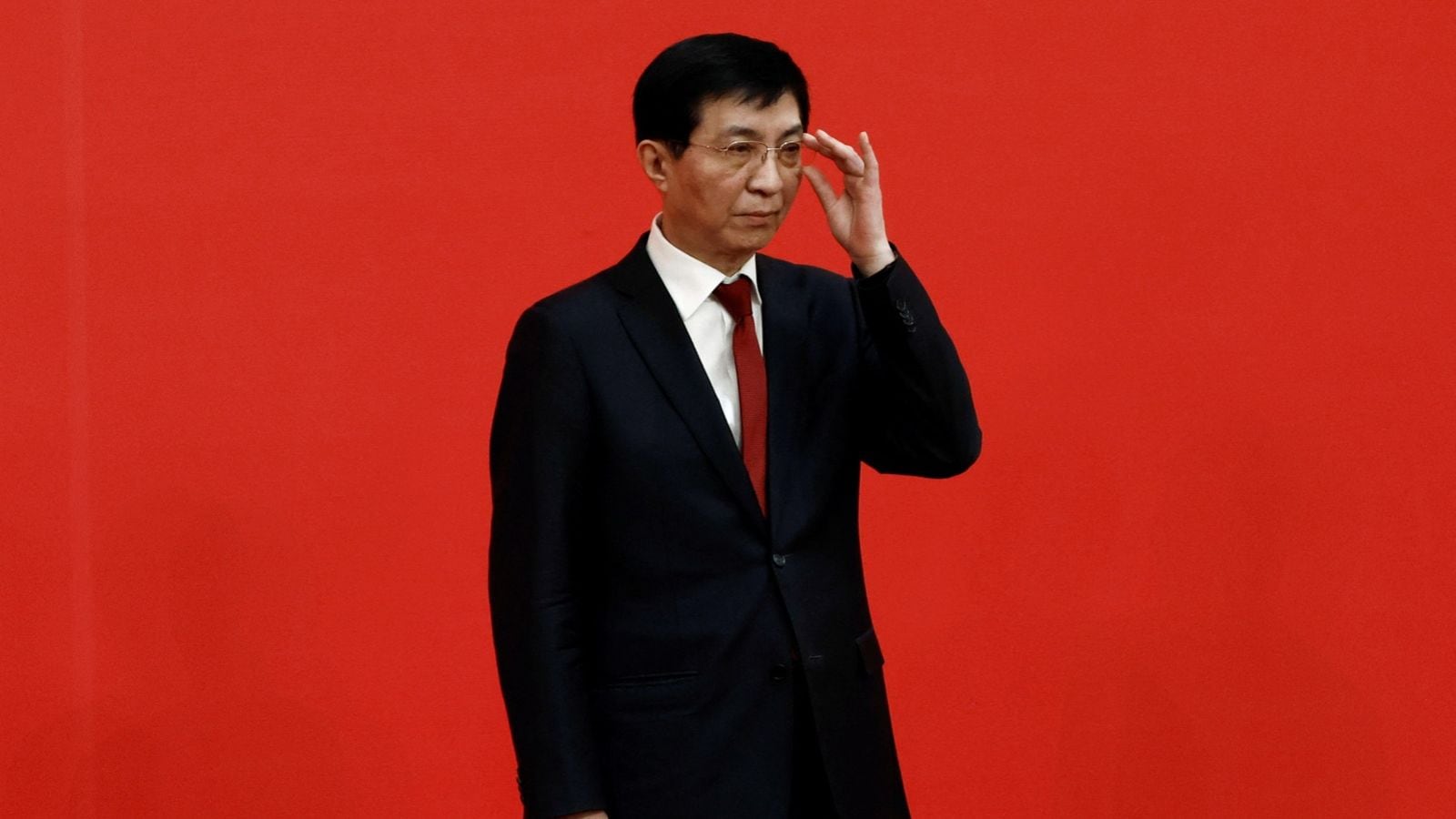
Western pundits love a simple villain. They love a shadowy whisperer in the ear of an absolute monarch. For the last decade, mainstream foreign policy journalism has sold you the exact same lazy story about Wang Huning: that he is China’s "hidden brain," the former Fudan University academic who quietly controls the ideological strings of Xi Jinping’s China from behind a velvet curtain.
That narrative makes for a great airport thriller. It also completely misunderstands how power actually operates inside Zhongnanhai.
If you look at the standard media profile—like the typical "Meet Wang Huning" explainer—you get a neat, linear biography. A shy bookworm from Shanghai writes a 1991 travelogue called America Against America, predicts the rot of Western democracy, gets plucked from academia by Jiang Zemin, survives Hu Jintao, and becomes the chief architect of Xi Jinping’s authoritarianism. The implication is obvious: remove or decode Wang Huning, and you decode the brain of the Chinese Communist Party (CCP).
Analysts who study elite Chinese politics and institutional history point to a much less romantic reality. Treating Wang Huning as the singular ideological puppet master of Beijing is like blaming the lead structural engineer for a billionaire’s decision to build a skyscraper. Wang did not invent Xi Jinping’s worldview, nor does he steer the ship. He is the ultimate institutional survivalist—a master synthesizer who gives coherent theoretical form to whatever political reality the paramount leader already demands.
The Myth of the "Hidden Brain"
To understand why the "puppet master" trope fails, you have to look at the timeline of Wang’s career. He did not serve one master; he served three wildly different ones.
Under Jiang Zemin in the late 1990s, Wang helped craft the "Three Represents," a doctrinal pivot designed to welcome private capitalists and entrepreneurs into the Communist Party. Under Hu Jintao in the 2000s, Wang pivoted smoothly to help formulate the "Scientific Outlook on Development," a technocratic framework focused on sustainable growth and social harmony. Then, when Xi Jinping consolidated power after 2012, Wang became the primary theoretical drafter behind "Xi Jinping Thought on Socialism with Chinese Characteristics for a New Era," alongside slogans like the "Chinese Dream."
Think about what those three doctrines represent. One opened the party to billionaires. The next emphasized technocratic consensus and collective leadership. The third centralized absolute authority, elevated ideological discipline, and reasserted state control over private capital.
A rigid ideological zealot does not survive—let alone thrive at the apex of power—across three diametrically opposed political eras. Political scientists who track CCP elite survival, such as Victor Shih and Joseph Fewsmith, have long emphasized that longevity in Beijing requires extreme adaptability, not dogmatic stubbornness. Wang Huning’s superpower isn't that he forces leaders to adopt his personal philosophy. His superpower is that he has no fixed faction, no independent power base, and an unmatched ability to translate a leader’s raw political instincts into airtight Marxist-Leninist orthodoxy.
When Xi Jinping wanted to break the entrenched bureaucratic fiefdoms of the Hu Jintao era and re-centralize authority, he didn't need a professor to tell him why. Xi’s worldview was forged in the fires of the Cultural Revolution, his father Xi Zhongxun’s political purges, and decades of governing in Fujian, Zhejiang, and Shanghai. Wang Huning’s job was to take Xi’s political imperatives and give them historical inevitability, constitutional permanence, and ideological polish.
What America Against America Actually Said
Every mainstream profile of Wang Huning treats his 1991 book, America Against America, as a smoking gun—a prophetic blueprint for Beijing’s current ideological war against the West.
Read the actual text, and a much more nuanced picture emerges.
Wang spent six months in the United States in 1988 as a visiting scholar, touring over thirty cities and dozens of universities. He wasn't writing a hit piece; he was conducting an earnest comparative political science inquiry into why the American system worked as well as it did, and where its structural contradictions lay.
In the book, Wang marveled at American economic dynamism, technological innovation, and institutional resilience. At the same time, drawing heavily on classical Western sociology and political theory, he observed how extreme individualism, rampant commodification, and racial and economic stratification were eroding social cohesion from within. He noted that in the United States, politics had become deeply entangled with money and media spectacle, warning that a system built purely on atomized individual rights struggles to maintain collective purpose when economic growth slows.
Mainstream commentators look at that 1991 book and say: Look! He predicted Trump, polarization, and American decline, and he convinced Xi Jinping that America is weak!
That gets the causality entirely backward. Chinese leaders didn't need a 1991 travelogue to notice the 2008 global financial crisis, the gridlock in the U.S. Congress, or the partisan fractures of the 2010s. Those events happened in plain sight on global television. What Wang’s early scholarship provided wasn't a secret revelation; it provided an academic vocabulary—specifically the concept of "neo-authoritarianism" (xin quanwei zhuyi)—that Wang had championed in the late 1980s.
In the 1980s, debates raged inside Chinese universities over whether China should democratize rapidly or maintain a strong, centralized state to push through market reforms while preserving social stability. Wang argued that a developing nation undergoing rapid economic modernization needed a powerful central authority to prevent social fragmentation and institutional collapse. When the Soviet Union disintegrated in 1991—an event that traumatized the entire CCP leadership—Wang’s neo-authoritarian thesis looked prescient to Beijing’s elders. He didn't brainwash the Party; he told the Party what its survival instincts were already screaming.
The Structural Role of Ideology in Beijing
Western observers routinely misread how ideology functions in modern China because they view it through a Western campaign lens—as either sincere personal belief or cynical public relations.
Inside the CCP, ideology is neither. It is an operating system for bureaucratic control.
China is a massive, sprawling party-state with roughly 100 million party members and millions of local officials spread across provinces with vastly different economic interests. Without a unified ideological language, local officials default to regional protectionism, rent-seeking, and passive resistance to central directives. During the late Hu Jintao era, corruption and bureaucratic fragmentation had reached a point where Beijing’s orders frequently died before reaching the county level.
This is where Wang Huning’s actual institutional value lies. As head of the Central Policy Research Office for nearly two decades, and later as a member of the Politburo Standing Committee overseeing ideology, propaganda, and party building, Wang redesigned the operating code of the Party.
Look at the mechanics of what he built:
- Doctrinal Standardization: By codifying Xi Jinping Thought into the Party Constitution and the state Constitution, Wang created a binding compliance mechanism. When every official must study and recite the exact same theoretical formulations—from "Common Prosperity" to "Dual Circulation"—ideology becomes a loyalty test and a diagnostic tool. If an official deviates from the phrasing, they signal political unreliability.
- Institutionalizing Campaigns: Under Wang’s organizational oversight, ideological education wasn't left to dusty textbooks. It was digitized and gamified through platforms like Xuexi Qiangguo ("Study Xi, Strong Nation"), turning daily political study into a measurable metric for civil servants, state-owned enterprise managers, and university faculty.
- Cultural and Historical Synthesis: Recognizing that pure Marxism-Leninism held limited emotional appeal for a post-reform generation raised on consumerism, Wang helped fuse traditional Confucian concepts of social harmony, moral governance, and national rejuvenation with Leninist party discipline.
None of this makes Wang the secret ruler of China. It makes him the chief systems architect of a Leninist party trying to prevent the fate of the Soviet Communist Party.
The Flawed Questions Observers Keep Asking
When analysts and readers search for answers about Wang Huning, they usually fall into three traps:
"Is Wang Huning really the most powerful man in China behind the scenes?"
No. In a Leninist system, real power rests with control over the military (the Central Military Commission), personnel appointments (the Organization Department), and internal security. Wang has never commanded troops, controlled provincial budgets, or built a patronage network of loyalists placed in key ministries. In fact, his total lack of a personal faction is the exact reason paramount leaders trust him with the pen. He poses zero threat to the throne."Did Wang Huning push Xi Jinping away from economic reform toward hardline nationalism?"
This assumes Xi Jinping was a closet liberal waiting to be radicalized by a professor. Historical records of Xi’s career show the exact opposite. Long before Wang became Xi’s top ideological lieutenant, Xi was deeply skeptical of unchecked private capital, Western cultural influence, and lax party discipline. Wang gave Xi’s instincts theoretical rigor and policy coherence; he did not reverse Xi’s trajectory."What happens to China’s trajectory when Wang Huning eventually retires?"
Western commentators often speculate that the departure of a key advisor signals an imminent ideological softening. When Wang moved from running the Party’s daily secretariat and ideological apparatus to chairing the Chinese People's Political Consultative Conference (CPPCC) in 2023—a largely ceremonial united-front advisory body—some observers wondered if his influence was waning or shifting toward Taiwan policy. Yet the ideological machinery he built remains deeply embedded in Party statutes, school curricula, and cadre evaluation systems. Removing the architect does not dismantle the building.
The Blind Spot in the Contrarian View
Dismantling the "puppet master" myth carries its own analytical risk: underestimating how deeply language shapes policy in Beijing.
If you dismiss Wang Huning as a mere stenographer, you miss how theoretical frameworks eventually constrain the leaders who commission them. Once a political doctrine is elevated to canonical status—enshrined in Party congress resolutions and taught as absolute truth—it narrows the room for tactical retreat.
For example, when Beijing frames technological self-reliance, state-led industrial policy, and ideological security not as temporary adjustments to U.S. tariffs, but as fundamental historical laws of socialist modernization, backing away from those policies becomes ideologically dangerous. A leader cannot easily abandon a doctrine that has been declared the crowning theoretical achievement of the era without looking weak.
In that sense, Wang’s synthesis doesn't dictate Xi’s choices, but it locks them in. It turns tactical decisions into permanent orthodoxy.
How to Actually Read Beijing’s Signals
If you want to understand where China is heading—whether you are analyzing geopolitical risk, supply chains, or diplomatic shifts—stop looking for a shadowy Rasputin pulling strings in the dark.
Instead, track how the CCP’s theoretical apparatus translates political problems into institutional rules:
- Watch the phrasing, not the personality. When Central Committee plenums or Party Congress reports shift a single adjective—such as elevating "security" (anquan) alongside "development" (fazhan), or shifting how the market’s role is described—that is the signal. Wang Huning’s career proves that every major policy shift in Beijing is telegraphed in dry theoretical jargon months or years before it hits corporate balance sheets.
- Separate the drafter from the decider. Treat ideological pronouncements not as the personal whims of an academic, but as the consensus priorities of the top leadership translated into bureaucratic instructions for millions of cadres.
- Recognize structural continuity. The core anxiety driving Wang Huning’s writing since the 1980s—how a massive, rapidly modernizing state maintains central authority and social cohesion without collapsing—is not unique to Wang or Xi. It is the permanent obsession of the Chinese Communist Party.
Wang Huning never needed to rule China from the shadows. His real achievement was far more durable: he built the ideological operating system that allows the ruler to command the machine.



