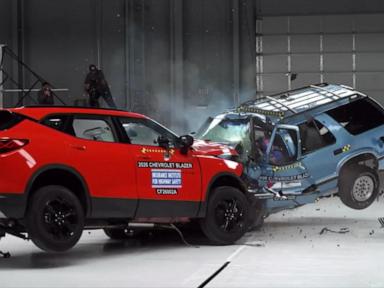
The modern automotive market is built on a collective lie, packaged neatly in an online video of a sedan slamming into a concrete block.
You watch the front end crumple exactly as engineered. You see the side-curtain airbags deploy like crisp white pillows. The announcer points out the pristine survival space of the cabin, and you breathe a sigh of relief. The car gets a shiny five-star rating from the National Highway Traffic Safety Administration (NHTSA) or a Top Safety Pick award from the Insurance Institute for Highway Safety (IIHS).
You buy the car. You think your family is safe.
You are being conned.
The entire apparatus of automotive safety testing has become an insular exercise in regulatory gaming. Car manufacturers do not build vehicles to keep you safe in the chaotic, multi-vector reality of a highway pileup. They build cars to pass highly predictable, hyper-specific laboratory tests. They are engineering to the test sheet, and the safety improvements celebrated by mainstream media are largely a statistical illusion that masks a deadlier reality on our roads.
The Illusion of the Fixed-Barrier Test
Every standard frontal crash test you watch relies on a foundational flaw: the vehicle is driven into a fixed, stationary barrier.
This setup is designed to simulate a head-on collision between two vehicles of identical weight and size. In a sterile lab, a 3,000-pound compact car hitting a wall at 40 mph looks remarkably secure. The crumple zones absorb the kinetic energy. The cabin remains intact. The crash test dummy registers minimal trauma.
Real life does not happen in a weight-matched vacuum.
When that 3,000-pound compact car meets a 6,000-pound electric SUV on a wet two-lane road, the clean physics of the laboratory wall shatter. Kinetic energy in a two-car collision is dictated by mass and velocity. The heavier vehicle transfers its massive momentum directly into the lighter one, physically pushing it backward.
The occupants of the lighter vehicle experience a catastrophic spike in deceleration forces that no five-star rating can prevent. The crash forces are not absorbed cleanly by your car’s perfectly engineered aluminum rails; they are violently transferred through the chassis and into your organs.
The industry has entered a terrifying prisoner's dilemma often called the vehicle arms race. Driven by consumer panic and the shift toward electrification, vehicles have ballooned in weight. A battery pack alone can add 1,500 pounds to a standard vehicle frame. Consumers buy massive, heavy trucks and SUVs under the assumption that bigger is always safer.
It isn't. A landmark study published by the IIHS in February 2025 systematically dismantled this assumption. Senior statistician Sam Monfort analyzed crash data for newer vehicles and found that the private safety benefits of vehicle mass top out quickly once a vehicle exceeds the fleet average weight of roughly 4,000 pounds.
For vehicles weighing less than 4,000 pounds, adding weight does protect the occupants. But for heavy SUVs and trucks climbing past that threshold, adding an extra 500 pounds provides virtually zero additional protection for the people inside. Instead, it vastly increases the lethality of that vehicle when it strikes anyone else. IIHS President David Harkey noted bluntly that choosing an extra-heavy vehicle does not make you any safer, but it transforms your vehicle into a massive threat to every other driver, pedestrian, and cyclist on the asphalt.
Engineering to the Test Sheet
I have spent years watching automotive design teams work behind closed doors. When a new vehicle is in development, engineers do not sit around mapping out every bizarre, infinite permutation of a real-world collision. They open up finite element analysis software and optimize the structural metal specifically for the exact coordinates of the IIHS small overlap test or the NHTSA side-impact barrier.
This is structural gaming.
When the IIHS introduced the small overlap frontal test—which simulates a vehicle's front corner clipping another car or a tree—most cars on the market failed miserably. The wheels were driven back into the footwells, crushing the legs of the dummies.
The industry response was telling. Manufacturers did not launch a systemic overhaul of vehicle structural integrity. Instead, they welded targeted steel reinforcements, often referred to as "cheater bars," exclusively into the specific front corner that the IIHS targeted in its laboratory test.
For a brief period, several major automakers were caught installing these reinforced structures only on the driver's side of the vehicle—because that was the side the IIHS tested. When researchers eventually ran the identical test on the passenger side, the vehicles collapsed. The structural safety was literally skin-deep, designed solely to secure a marketing badge for the showroom floor.
While automakers have gotten better at reinforcing both sides, the core philosophy remains unchanged. If a test specifies a barrier hitting a door at a 27-degree angle, the internal side-impact beams are optimized for a 27-degree angle. If a real-world drunk driver t-bones you at a 42-degree angle while braking, those optimized structural pathways miss the load entirely. The metal folds like an aluminum can, regardless of the five-star sticker on the window.
The Blind Spot Trap of Rollover Ratings
The systemic failure of modern car design is perfectly captured by the structural changes forced by roof-crush regulations. To achieve top marks in rollover safety, automakers were forced to massively beef up the structural pillars that support the roof—specifically the A-pillars flanking the windshield and the B-pillars between the front and rear doors.
On paper, this sounds like an undeniable win. If the car flips, the roof will not cave in on your skull.
In practice, this compliance fix created a far more pervasive, day-to-day hazard. The A-pillars on modern vehicles have become incredibly thick. To accommodate the high-strength steel and integrated side-curtain airbags required to ace the tests, these pillars have widened to the point of creating massive physical blind spots for the driver.
Imagine a typical urban intersection. A driver prepares to make a left-hand turn. A pedestrian steps into the crosswalk from the left. Because of the bloated, safety-rated A-pillar, the pedestrian is completely obscured within a blind zone that can easily swallow a full human body at a distance of twenty feet.
The driver accelerates, striking the pedestrian. The vehicle's high, blunt front hood—designed to look aggressive and protect the engine block—hits the pedestrian directly in the chest rather than the legs, throwing them underneath the wheels rather than onto the hood.
We have engineered cars that are spectacular at protecting their occupants during a rare, catastrophic rollover event, at the direct expense of making those same cars vastly more likely to run over a human being during a routine left turn. It is a cynical, short-sighted trade-off that prioritizes laboratory metrics over actual public safety.
The Fatal Flaw of active Systems
The newest frontier in the safety rating racket is active driver assistance technology. Agencies now hand out top marks based on whether a vehicle includes autonomous emergency braking, lane-keeping assistance, and pedestrian detection systems.
The industry treats these systems as infallible safety nets. They are not. They are brittle, software-reliant stopgaps that fail at the exact moments you need them most.
Most pedestrian detection systems rely heavily on optical cameras and radar modules mounted behind the rearview mirror and grille. These systems are calibrated under ideal conditions. When it is raining, when a low sun blindingly glares off wet pavement, or when a road lacks clearly painted lines, these systems frequently degrade or shut down entirely.
Worse, they breed driver complacency. When you tell a consumer their car has a five-star active safety suite that automatically brakes for hazards, the driver naturally disengages. They look at their phone. They let their mind wander. They rely on the machine to watch the road.
But when a chaotic real-world scenario unfolds—such as a child darting out from between parked cars at night—the software often fails to classify the object in time. The human driver, completely unready to take over, doesn't react. The resulting impact occurs at full speed, completely unmitigated by the technology that was supposed to prevent it.
How to Assess Real World Safety
If you want to protect your family, you must stop looking at the aggregated star ratings and marketing brochures. You need to look at raw, unadjusted data and the hard physical realities of automotive design.
Here is the unconventional blueprint for evaluating a vehicle's true safety profile before you sign a financing agreement:
1. Ignore the Star Count, Read the Component Data
Do not look at the final "Good" or "Five-Star" summary. Dig into the granular medical data from the crash test registries. Look specifically at the HIC (Head Injury Criterion) values and the chest deceleration metrics recorded by the dummies.
Two vehicles can both achieve a top rating, but one might have registered a chest compression value right on the razor's edge of human rib fracture, while the other kept forces well within a survivable threshold. Look for the vehicles that protect human physiology, not just those that scrape by the regulatory ceiling.
2. Prioritize Visibility Over Pillar Strength
Sit in the driver’s seat of the vehicle at the dealership. Do not look at the infotainment screen. Look at the A-pillars. Adjust your seating position and track how much of your peripheral field of view is blocked by the metal frame.
If a vehicle's pillars are so wide that they completely hide a cyclist or a small car at a standard intersection distance, walk away. Active safety is always superior to passive survival; a car that allows you to see and avoid an accident entirely is infinitely safer than a car that forces you to rely on an airbag because you couldn't see the threat coming.
3. Check the Real-World Fatality Rates per Model
The ultimate metric of a vehicle’s safety is not recorded in an IIHS laboratory in Virginia. It is recorded by the insurance industry in real-world morgues.
Every few years, the IIHS publishes the Driver Death Rates by Make and Model, calculated per million registered vehicle years. This data strips away the laboratory artifice and shows exactly how many actual human beings died behind the wheel of that specific car. You will frequently find that some vehicles with pristine, highly marketed five-star ratings have surprisingly high real-world fatality rates, because their real-world buyers drive recklessly or because the vehicle handles poorly in emergency maneuvers. Conversely, some modest, lower-rated vehicles boast incredibly low death rates because their handling dynamics allow drivers to successfully swerve around disaster.
4. Beware the Weight Trap
Do not buy a massive, lumbering electric or gas vehicle under the false assumption that its sheer mass makes you bulletproof. Remember the 4,000-pound threshold. Once you cross that line, you are no longer buying personal safety—you are merely buying a weapon that threatens everyone else while offering your passengers sluggish handling, longer braking distances, and a higher propensity to plow through barriers rather than stopping safely.
The five-star crash rating system is a broken paradigm that rewards compliance over genuine protection. It has turned car buyers into passive consumers of safety theater. Stop looking at the controlled, slow-motion footage of a pristine laboratory impact. Look at the real physics, look at the blind spots, and realize that the most survival-ready vehicle is the one built for the chaos of the open highway, not the predictability of a regulatory checklist.