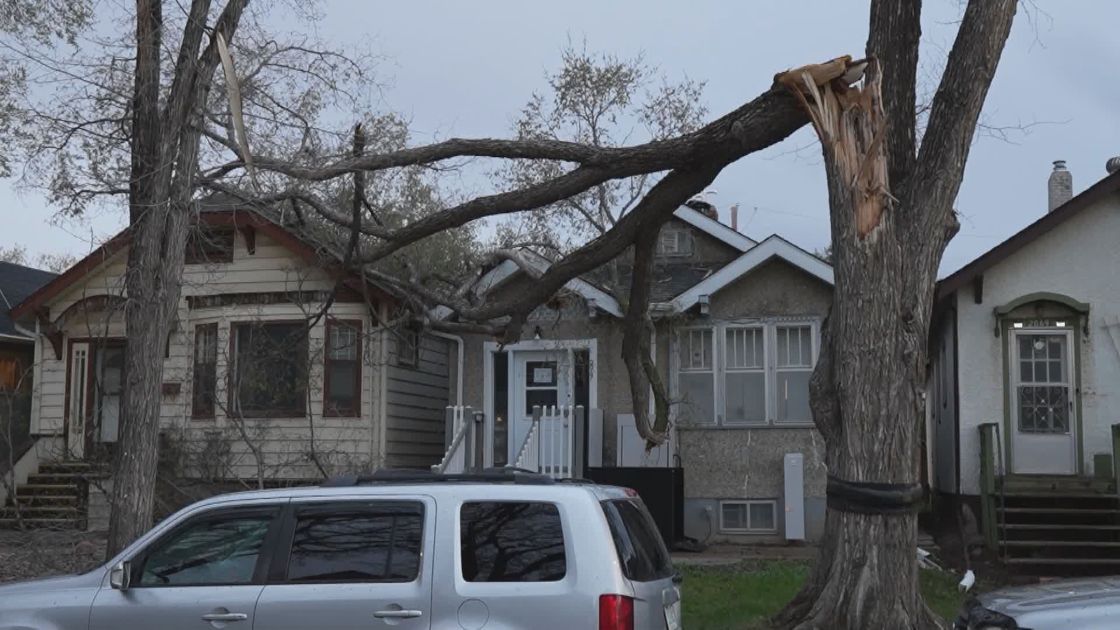
Mainstream media outlets love a good natural disaster narrative. It is easy. It is dramatic. When a spring storm packing 100 km/h winds sweeps through southern Saskatchewan, leaving 110,000 SaskPower customers sitting in the dark, the headlines write themselves. They focus on uprooted trees, overturned semi-trucks on Highway 39, and brave utility crews waiting out the gusts.
This framing is a cop-out. It treats a predictable atmospheric event as an act of God that human engineering could not possibly foresee.
The lazy consensus peddled by local news is that "extreme weather" caused the massive blackouts across Regina, Weyburn, and Eastend. That is fundamentally wrong. The weather merely pulled back the curtain on a deeper, systemic failure.
The 110,000 people who lost electricity were not victims of a historic meteorological anomaly. They were victims of an obsolete grid architecture that prioritizes centralized transmission over localized resilience.
The Myth of the Unpreventable Outage
Every utility company uses the same playbook when the lights go out. A corporate spokesperson stands in front of a camera, cites wind speeds, explains that bucket trucks cannot safely operate in high winds, and asks for patience.
I have spent years analyzing capital expenditure budgets and infrastructure durability in the industrial sector. I have watched utility executives pour billions into maintaining legacy systems while treating grid modernization like a PR line item. Let us look at the mechanics of what actually happened.
SaskPower confirmed that the widespread failures were triggered by a handful of high-voltage transmission lines going offline. When three transmission lines feeding a critical substation north of Regina failed, tens of thousands of downstream customers were plunged into darkness instantly. In the southwest corner of the province, ten transmission structures near the Frenchman River Valley collapsed entirely, leaving the town of Eastend completely cut off for over 30 hours.
Here is the technical reality: transmission lines carry bulk power over immense distances at extreme voltages before dropping it down to the distribution lines that feed your house. When a single transmission line fails, everything connected downstream dies with it.
The media treats this like an unchangeable law of physics. It is not. It is a deliberate design choice.
By relying on a fragile, centralized web of long-distance aerial lines, we have engineered a system where a single localized gust of wind in a valley can paralyze an entire economic region. The disaster is not that the wind blew; the disaster is that our energy system is built like a house of cards.
The Cost of Centralized Denial
The standard defense for keeping the grid overhead and centralized is entirely financial. Critics will immediately claim that burying lines or decentralizing the grid is too expensive.
Let us dismantle that premise with a basic thought experiment. Imagine a manufacturing facility or a commercial farm in southern Saskatchewan. When the power blinks off for 31 hours, what does it cost? Milk spoils. Assembly lines freeze. Heating systems fail. Digital infrastructure goes dark.
When you aggregate the lost productivity, property damage, and emergency response costs across 110,000 residential and commercial endpoints, the economic toll is staggering. Yet, these costs are pushed entirely onto the consumer and local businesses, while the utility provider writes off the repair costs as a cost of doing business.
We are told that burying transmission infrastructure is an engineering impossibility in rural areas. While burying high-voltage transmission lines is indeed capital-intensive and presents thermal challenges, the total refusal to deploy localized distribution loops and microgrids is indefensible.
The town of Eastend was trapped in total darkness because it is fed by exactly one transmission line. Relying on a single thread of copper strung across miles of open prairie to power an entire community is not "rural reality"—it is negligence disguised as infrastructure.
Dismantling the PAA Fallacies
If you look at public forums and "People Also Ask" search trends during a major blackout, the questions demonstrate how thoroughly the public has been conditioned to accept mediocrity.
- Why does it take so long to fix power lines in high winds?
The standard response is that workers cannot operate bucket trucks when winds exceed certain thresholds. This is true for worker safety. But the brutal truth nobody admits is that we should not be relying on human beings in bucket trucks to manually stitch a modern society back together every time the wind blows. A resilient grid utilizes automated switching topology to instantly reroute power through alternative pathways, isolating the damage without dropping entire cities offline. - Can a power grid be 100% storm-proof?
No. Absolute perfection does not exist. If a Category 5 tornado hits a substation, things will break. But blaming a standard prairie windstorm for a province-wide grid collapse is like blaming water for a leaky boat. The storm did not create the vulnerability; it merely exposed it.
The Unpopular Solution: Forced Decentralization
Fixing this does not mean spending trillions of dollars to bury every single line across millions of square kilometers of prairie terrain. It requires a complete departure from the centralized generation model.
True grid resilience means transforming passive consumers into active, self-sustaining nodes.
If regional centers like Regina and vulnerable rural hubs like Eastend were supported by localized microgrids—powered by a mix of regional generation, industrial-scale battery storage, and smart switching infrastructure—the collapse of a transmission tower in the Frenchman River Valley would be a minor maintenance note, not a civic crisis. The town would simply disconnect from the damaged bulk grid and run on localized power until the wind subsided.
The barrier to this transition is not technological. We have the engineering capabilities to build self-healing, decentralized power networks today. The barrier is institutional inertia.
Monopolistic utility structures are financially incentivized to build massive, centralized capital projects because they guarantee a rate of return on asset deployment. Upgrading a legacy transmission line looks great on a balance sheet; enabling a community to generate and manage its own power threatens the centralized revenue model.
We need to stop treating power outages as an inevitable consequence of living in a harsh climate. The wind will always blow in Saskatchewan. The real failure belongs to an outdated infrastructure philosophy that chooses to rebuild the exact same fragile systems over and over again, expecting a different result.