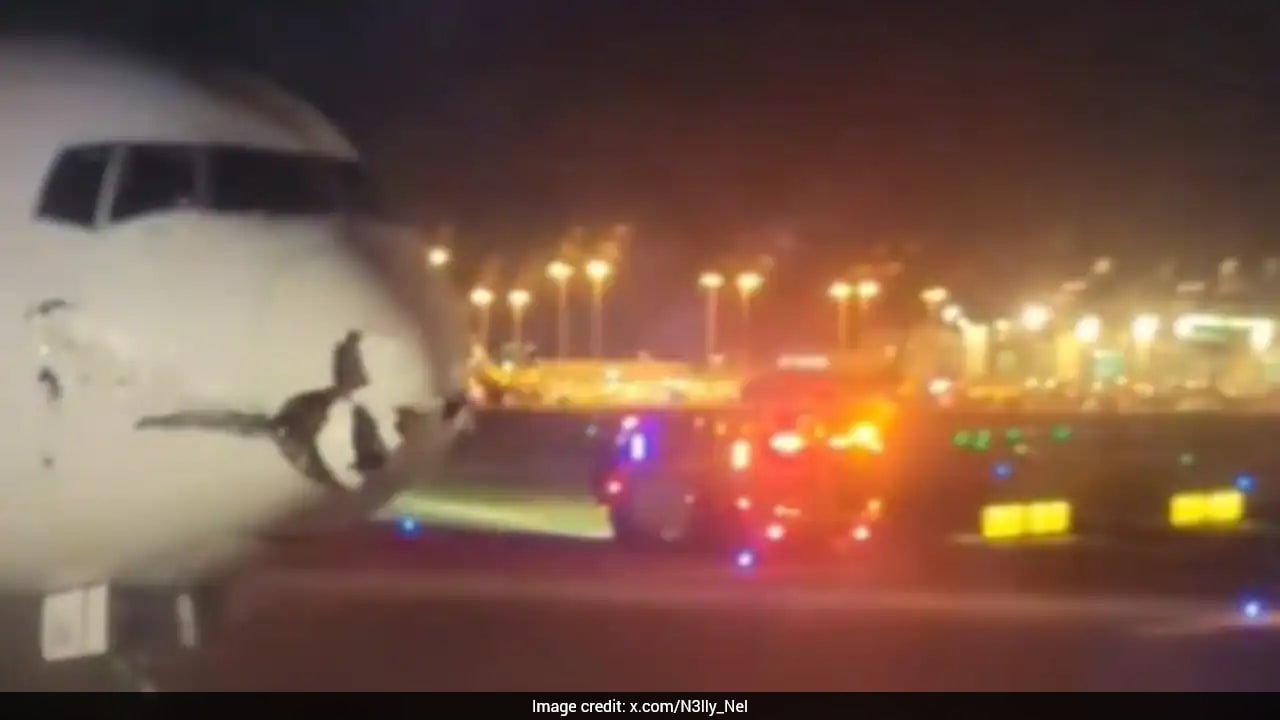
Two jets bumped into each other on the ground in Miami, two people suffered minor injuries, and right on schedule, the mainstream aviation press slapped "Boeing" into the headline like a reflex.
It is lazy journalism. Worse, it is actively misleading the flying public about where the actual danger in commercial aviation lives right now.
When a passenger jet and a cargo plane make contact on a taxiway at Miami International Airport, the name painted on the fuselage or stamped on the data plate has almost nothing to do with why the metal bent. Yet the competitor's coverage—and a hundred carbon-copy wire reports just like it—frames the incident around the manufacturer. They lean on the Pavlovian conditioning of readers who see the word "Boeing" and immediately picture blown-out door plugs, stalled angle-of-attack sensors, and corporate negligence in Everett or Charleston.
They are selling you an easy villain because explaining ground control logistics, ramp congestion, and airport infrastructure decay takes actual reporting.
The Lazy Consensus of Manufacturer Blame
Let us dissect what actually happens during a ground collision—or, in the precise vernacular of the Federal Aviation Administration, a surface incident or wingtip strike.
An airplane on the ground is not an autonomous drone. It is a multi-ton aluminum tube being steered at walking speed by human pilots following instructions from air traffic controllers, ramp controllers, and painted yellow lines on asphalt. Unless the brakes completely vanished due to a hydraulic failure—which is exceedingly rare and immediately flagged in preliminary National Transportation Safety Board (NTSB) notices—the manufacturer is a bystander.
I have spent two decades walking airport ramps, sitting in safety management briefings, and watching airlines bleed millions of dollars repairing composite wingtips sheared off by careless ground handling. In ninety-nine percent of tarmac scrapes, the root cause is one of three things:
- Spatial misjudgment on congested taxiways.
- Miscommunication between ramp control and the flight deck.
- Outdated airport geometry trying to handle modern fleet sizes.
Blaming the airframe manufacturer for a taxiway collision is like blaming Ford when two F-150s sideswipe each other in a poorly lit Walmart parking lot. It completely misses the mechanics of the crash while giving the real culprits—underfunded airport authorities, overworked controllers, and cost-cutting ground contractors—a free pass.
Why Miami International Is a Tarmac Pressure Cooker
If you want to understand why metal meets metal on the ground in South Florida, stop looking at Seattle and start looking at the concrete in Miami-Dade County.
Miami International Airport (MIA) is one of the busiest freight and international passenger hubs in the Western Hemisphere. It moves massive volumes of perishable cargo, heavy widebodies, and narrowbody domestic feeders through a footprint hemmed in by highways, residential neighborhoods, and decades-old terminal layouts.
Look at the sheer physical mismatch happening at major legacy hubs today:
- Wider Wingspans: Modern jets have wider wingspans than the aircraft those taxiways were engineered to accommodate in the 1970s and 1980s. Even standard narrowbodies now sport massive winglets or split scimitars that extend several feet further outward than their predecessors.
- Mixed-Fleet Chaos: At an airport like Miami, you have nimble regional jets sharing tight real estate with lumbering cargo freighters—often older converted widebodies with massive wingspans and sluggish ground-handling characteristics.
- Dual-Control Blind Spots: Most travelers do not realize that the FAA air traffic control tower does not control the entire airport. Once an aircraft enters the ramp or apron area, control often hands off to airline-run or airport-run ramp towers. That handoff zone is a notorious friction point where frequencies change, situational awareness drops, and clearance margins shrink to mere feet.
When a passenger aircraft and a freighter clip each other in that environment, the story is not about aerospace engineering. The story is about infrastructure choking on volume.
The Real Crisis Hidden Behind the Headline
The mainstream media loves a splashy headline about two injured passengers because blood and sirens drive clicks. By framing this as a "Boeing" incident, they tap into an existing outrage cycle. It requires zero cognitive load from the reader.
Here is what they refuse to tell you: Commercial aviation in the sky has never been safer, while commercial aviation on the ground is quietly deteriorating.
Over the last few years, the NTSB and the FAA have repeatedly sounded the alarm over surface incidents and runway incursions. Close calls on the tarmac have spiked across major U.S. hubs—from Austin and Burbank to New York JFK and Miami. Why? Because the system is running at maximum capacity with chronic staffing shortages in air traffic control facilities and high turnover among ground marshals.
Imagine a scenario where a flight crew finishes a four-hour leg in rough weather, lands on time, and is immediately handed a complex taxi clearance across active runways and tight alleyways by a controller working mandatory overtime. Meanwhile, a cargo crew is pushing back from an adjacent freight ramp on a different radio frequency, guided by a ground crew member who has been on the job for six weeks.
In that environment, a wingtip strike is not a freak accident. It is a statistical certainty.
Answering the Questions Travelers Actually Ask
When news of a ground collision breaks, panicked flyers flood search engines with the same predictable questions. Most mainstream outlets answer them with corporate PR boilerplate. Let us dismantle the premises instead.
"Are Boeing planes safe to fly right now?"
You are asking the wrong question. If you are worried about a taxiway collision, the badge on the nose of the airplane is irrelevant. An Airbus A321neo and a Boeing 737 MAX have nearly identical wingspans (roughly 117 feet) and operate under the exact same visual clearance rules on the ground. Your safety during taxi operations depends entirely on airport lighting, ground radar coverage, controller staffing, and pilot discipline—not who riveted the fuselage together.
"How do two massive planes hit each other when they have windows and radar?"
Because cockpit visibility is terrible for seeing your own wingtips. Pilots sit at the very front of a long tube, elevated fifteen to twenty feet off the ground. From the left seat of a commercial airliner, you literally cannot see the tip of your own wing without craning your neck awkwardly against the side window—and even then, depth perception at night or in heavy rain is notoriously deceptive. Furthermore, airborne weather radar is turned off on the ground because it emits dangerous radiation to ground crews, and commercial jets do not have parking sensors or backup cameras like your SUV. Pilots rely entirely on painted lines, ground marshals, and air traffic control clearances.
"Why were passengers injured if the planes were moving slowly?"
Physics does not care that the speedometer only read 15 knots. A loaded commercial airliner weighs anywhere from 150,000 to over 700,000 pounds. When hundreds of tons of momentum come to a sudden, violent halt—or whip sideways because a wingtip snagged a stationary structure or another tail—anyone standing up in the aisle to grab their roller bag from the overhead bin becomes a projectile. Almost every "minor injury" in a low-speed tarmac collision happens because passengers unbuckled their seatbelts the second the main landing gear touched the runway.
The Heavy Hitters Know Where the Blame Lies
If you look at the actual safety literature produced by the Flight Safety Foundation or the International Air Transport Association (IATA), you will not find a single serious investigator blaming aircraft manufacturers for wingtip collisions.
Instead, industry veterans point directly to Airport Surface Detection Equipment (ASDE-X)—the ground radar systems designed to track aircraft and vehicles on the tarmac and warn controllers of impending collisions. Many major airports still lack modern surface surveillance, and where it does exist, it rarely covers the chaotic non-movement ramp areas where freighters and passenger jets constantly cross paths.
Airlines hate talking about ground damage because it is an operational embarrassment that costs the global aviation industry billions of dollars every year in out-of-service aircraft, canceled flights, and composite repairs. Airports hate talking about it because fixing taxiway geometry requires tearing up concrete, shutting down gates, and spending taxpayer money on unglamorous civil engineering instead of shiny new terminal retail spaces.
So everyone lets the media run with the lazy headline. Boeing takes another PR bruise, the public gets outraged at the wrong target, and nobody asks the Miami-Dade Aviation Department or the FAA why two aircraft were cleared into conflicting airspace on the ground.
What You Should Actually Do as a Flyer
You cannot fix FAA controller staffing or widen the taxiways at Miami International before your next flight. You can, however, stop falling for clickbait safety narratives and adjust how you actually behave on an airplane.
- Keep your belt buckled until the engines shut down. That ding you hear when the plane turns off the active runway is not an invitation to stand up. The taxi phase is statistically the highest-risk period for sudden stops and unexpected impacts. Stay in your seat with your seatbelt tight until the aircraft is chocked at the gate and the captain turns off the seatbelt sign.
- Judge airlines by their hub discipline, not their fleet mix. Do not waste time filtering flight searches to avoid specific aircraft types for ground safety reasons. Instead, recognize that tight connections at notoriously congested, infrastructure-starved hubs—like Miami, JFK, Newark, and Chicago O'Hare—carry a dramatically higher risk of ground delays and surface incidents.
- Watch the ramp, not the headlines. If you want to know how safely an airline operates, look out the window when you pull up to the gate. Are ground crews using wing walkers with illuminated wands? Are baggage carts parked cleanly inside painted safety boxes, or scattered haphazardly near active taxi lanes? Ramp discipline tells you everything about an airline's safety culture.
The Downside of Calling Out the Media Narrative
I will be the first to admit that pushing back against the "blame Boeing" reflex carries a real risk: it can sound like corporate apologia.
Boeing has earned every ounce of scrutiny it has received over the past decade regarding its quality control, engineering culture, and regulatory capture. Letting a massive defense and aerospace contractor off the hook when it actually builds a flawed product is dangerous. When a door plug blows out at 16,000 feet, hammer the manufacturer relentlessly.
Nuance matters. When you cry wolf and slap the manufacturer's name on every mundane ground collision, runway excursion, or bird strike, you desensitize the public. You create noise that drowns out legitimate structural and mechanical defects when they actually occur.
Two planes scraped each other on the ground in Miami. Two people got banged up. It was an avoidable failure of ground coordination, congested airport infrastructure, and human vigilance—and until journalists stop chasing cheap brand-name clicks and start interrogating how we manage the asphalt, it is going to keep happening.