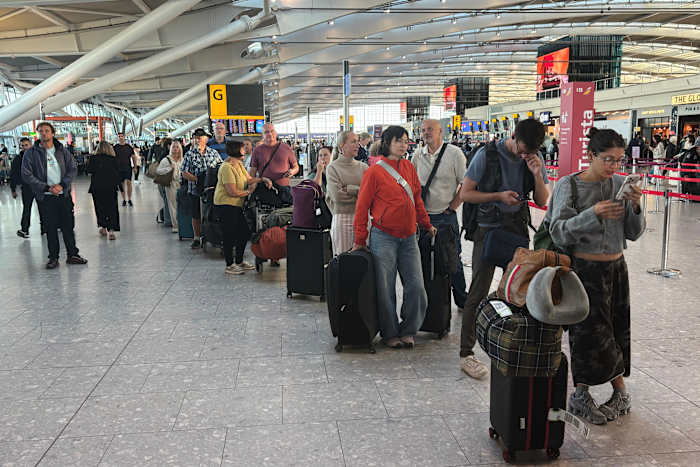
Every time a glitch ripples across British airspace, the playbook is entirely predictable. A screen flickers in Swanwick, a handful of flight plans stall, and the commentariat immediately treats the situation like an apocalyptic structural failure. Passengers moan about the state of modern aviation. Pundits demand independent reviews. Executives roll out tired apologies about unprecedented technical anomalies.
It is all a distraction.
The lazy consensus is that air traffic control is a fragile, brittle utility hanging by a thread, and that a single software hiccup proves the whole system is broken. That narrative is wrong. The recent UK airspace meltdown did not expose a systemic crisis in air traffic management. It exposed the absolute fragility of airline scheduling models built on zero margin for error.
Let us be precise. When a regional radar coordination system blips for a few hours, planes do not fall out of the sky. The safety architecture works exactly as intended: it pauses the flow. It hits the brakes. The software didn't crash; it did its job by telling everyone to hold position. The real catastrophe happened downstream, where airlines panicked because they run their fleets like Uber surges during a Friday night downpour.
The Myth of the Bulletproof Schedule
I have spent two decades watching commercial carriers build timetables that defy basic mathematics. A standard narrowbody aircraft in a major European airline rotation is scheduled to fly six or seven legs a day, with ground turnarounds compressed down to twenty-five minutes. That is not efficiency. That is high-stakes financial Jenga.
When air traffic control pauses departures for four hours, the industry acts like a structural wall has collapsed. Why? Because airlines have completely eliminated operational buffer time. They do not own spare aircraft parked at Heathrow or Gatwick just in case a computer glitches. Every single hull must be airborne to service the quarterly yield targets.
Imagine a scenario where a logistics company runs its delivery trucks with empty fuel tanks, refuelling only at highway speed while moving. If a toll booth closes for five minutes, the entire supply chain backs up into the next state. You would call that management malpractice. Yet when airlines do the exact same thing with multi-million-dollar airliners, we blame the toll booth operator.
National Air Traffic Services handles millions of movements safely every single year. Their software is ancient, yes, but it is rigorously redundant. The real issue isn't a lack of engineering talent; it is the commercial reality of a hyper-optimized aviation market where passengers demand seventy-pound tickets to Barcelona and expect Swiss-watch precision without paying for the infrastructure required to back it up.
Why More Funding Won't Fix the Real Problem
The knee-jerk demand from consumer advocates is always the same: pour hundreds of millions into upgrading air traffic control tech. Give them new servers. Build a better dashboard.
That is treating a symptom while ignoring the disease.
If you double the speed and capacity of air traffic processing computers tomorrow, airlines will simply compress their schedules even further to capture the extra margin. They will pack more departures into every single hour until the system hits the new bottleneck. You cannot engineer your way out of a scheduling philosophy designed around zero redundancy.
Let us look at how the legacy carriers handle disruption. When a delay occurs, their automated rebooking algorithms cascade through the network, bumping passengers, stranding crews, and throwing legal duty-of-care obligations into chaos. The bottleneck is rarely the guy holding the radar scope in Hampshire. The bottleneck is the crew rostering software that cannot legally let a pilot fly past their duty hours because the plane sat on a taxiway for an extra hundred minutes.
The Uncomfortable Truth About Your Ticket Price
Nobody wants to admit the trade-off. We want cheap, hyper-frequent global mobility, and we want absolute zero risk of delay. Those two desires are mutually exclusive.
If airlines were forced to carry the necessary operational buffer—keeping five percent of their fleet grounded and staffed as hot-swap reserves—ticket prices would climb by twenty or thirty percent overnight. You would get your bulletproof reliability, but you would pay for it every time you booked a family holiday.
Instead, carriers externalize the cost of disruption onto the passengers and the public infrastructure. They run lean, bank the profits during smooth weather, and when a technical pause forces a reset, they point a collective finger at the air traffic controllers and hide behind EC261 compensation payouts that they lobby to weaken every chance they get.
Stop asking for better traffic management systems. Start demanding that airlines account for reality. Until carriers are penalized for scheduling fantasies rather than operational bottlenecks, every minor software glitch will be weaponized to hide their own structural bankruptcy.
Next time the boardrooms start weeping about airspace failures, look at the fleet utilization charts instead. The planes were never meant to fly this tight, and the system is just breaking under the weight of its own greed.