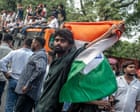
Satirical stigma inversion allows decentralized youth movements in India to convert acute economic and institutional grievances into sustained political pressure without triggering an immediate leadership decapitation. Standard media coverage of the "Cockroach Janta Party" (CJP) and the crackdowns against demonstrators under Prime Minister Narendra Modi's administration often treats the episode as a binary clash between youthful defiance and state authoritarianism. That framing misses the underlying structural mechanics. A rigorous analysis requires separating symbolic mobilization from institutional leverage, examining how state containment operates across physical, digital, and legal layers, and evaluating why street pressure over examination integrity and electoral roll revisions produces administrative concessions without automatically overthrowing an entrenched electoral coalition.
Deconstructing the Standard Narrative and Its Analytical Blind Spots
Conventional reporting on India's cockroach protests typically relies on three assumptions that obscure how political power actually shifts in large democracies. The first assumption is that visible street defiance equates to existential regime threat. When thousands gather at Jantar Mantar in New Delhi or march toward Parliament, observers frequently interpret state pushback as proof of imminent political collapse. In practice, governments routinely absorb high-visibility protests by isolating the grievance to a specific ministry, administrative agency, or procedural rule while preserving core executive authority.
The second blind spot is treating satire as a substitute for organizational capacity. Adopting an insulting label—such as "cockroaches," originating from Chief Justice Surya Kant's controversial May 2026 remarks—gives a movement instant cultural salience and memetic stickiness. Yet viral identity lowers the cost of initial participation far more easily than it builds durable cadre discipline, fundraising infrastructure, or ballot-box machinery.
The third oversight is conflating distinct waves of mobilization into a single monolithic arc. The agitation that erupted around the NEET-UG medical entrance exam paper leak and Central Board of Secondary Education revaluation irregularities in mid-2026 targeted meritocratic gatekeeping and credentialing reliability. Subsequent mobilizations in October 2026 shifted toward the Election Commission of India's Special Intensive Revision of electoral rolls, which critics contend removed more than 130 million names nationwide, including 4.76 million in Delhi. Treating credentialing anger and electoral roll disputes as identical misses how each issue alters political incentives.
The Grievance-to-Leverage Funnel
To understand why these protests gained traction despite heavy state policing, examine the four-stage conversion funnel that turns private frustration into public pressure.
- Structural Baseline Stress: India's demographic profile concentrates immense pressure on entry-level labor markets and competitive credentialing pipelines. Roughly a third of the working-age population falls between ages 15 and 29, and youth graduate unemployment remains severe, turning public examinations into high-stakes economic bottlenecks rather than routine academic hurdles.
- Triggering Institutional Failure: A systemic grievance becomes actionable when a visible administrative failure violates fairness norms. Paper leaks and scoring irregularities erode trust in meritocratic allocation, signaling that effort and household expenditure on coaching cannot guarantee fair sorting.
- Stigma Inversion and Identity Compression: Naming a movement after a derogatory label flips social shame into collective solidarity. Humor lowers psychological risk for first-time participants and compresses complex economic anxiety into a single recognizable emblem.
- Escalation to Executive Accountability: Once crowds assemble in high-symbol spaces like central Delhi and draw sympathetic attention from opposition figures, cultural figures, or hunger strikers such as Sonam Wangchuk, the cost of inaction rises for incumbent officials.
This funnel explains a crucial cause-and-effect dynamic that surface commentary often overlooks. When a movement focuses on a concrete administrative failure like an examination leak, the incumbent government possesses a clean pressure-release valve: it can sacrifice a cabinet minister—such as Education Minister Dharmendra Pradhan stepping down in July 2026—announce investigative panels or fast-track courts, and thereby deflate street momentum without conceding broader ideological or constitutional ground. Electoral roll disputes offer no such easy scapegoat because they touch the mechanics of political representation itself, where the Election Commission and government maintain that revisions clean duplicate, deceased, and ineligible entries while opposition leaders allege partisan skew.
Multi-Layer State Containment and Movement Counter-Measures
State responses to disruptive protests in India rarely rely on a single instrument. Instead, authorities deploy a layered containment architecture designed to raise the marginal cost of participation while starving organizers of coordination bandwidth.
Physically, security forces use perimeter closures, bans on assemblies of five or more people around sensitive zones, restrictions on protest venues such as Jantar Mantar, and preventive detentions—including intercepting movement figures like Abhijeet Dipke, Saurav Das, and Ashutosh Ranka upon arrival in Delhi or arresting demonstrators who cross cordons. Digitals and informational levers reinforce physical barriers: localized mobile internet shutdowns around protest corridors slow real-time crowd routing and live-streamed escalation. Legally and procedurally, authorities rely on peace bonds, criminal charges, police affidavits opposing protest permissions, and protracted court proceedings that drain activist time and legal resources.
When state enforcement combines rapid detention with legal attrition, a movement's survival depends less on crowd size on day one than on its ability to function across distributed nodes.
Protesters counter this containment stack through three operational adaptations. First, leaderless and polycentric coordination prevents single-point decapitation; detaining prominent voices slows messaging but does not automatically halt spontaneous gatherings by students or local chapters. Second, nonviolent discipline reduces the state's pretext for escalated kinetic force and preserves moral credibility with neutral observers and courts. Third, around-the-clock legal support networks lower the perceived personal penalty of arrest, keeping risk-averse participants engaged even after warnings of detention or peace-bond violations.
A limitation of this counter-strategy must be stated plainly. Decentralization protects continuity under pressure, yet it also creates coordination friction when a movement tries to negotiate binding policy settlements, verify voter-roll objections before tight administrative deadlines, or translate street energy into cohesive legislative demands.
Why Street Mobilization Rarely Equals Electoral Replacement
A common analytical error is assuming that widespread anger over governance deficits automatically translates into electoral defeat for an incumbent party. In political economy terms, street protests measure intensity of grievance among active participants, whereas elections aggregate broad coalition preferences, turnout asymmetries, and opposition coordination across hundreds of constituencies.
Several structural friction points separate protest momentum from electoral displacement in India:
- Issue Specificity vs. Regime Choice: Voters who back a protest over exam leaks or voter-list omissions may still weigh national security, welfare delivery, infrastructure, or candidate alignment differently when casting a ballot.
- Fragmentation and Ephemeral Spin-Offs: Rapidly formed protest banners—including satirical or issue-specific offshoots—often lack statewide organizational depth, poll-booth monitoring, and candidate slates.
- Administrative Containment of Grievances: Even when a government appears bruised or forced into a slower legislative timetable on contentious reforms, targeted administrative fixes or procedural deadlines can absorb energy before a general election cycle.
What protests do reliably alter is the government's risk calculus. High-visibility unrest raises reputational costs abroad—where official rhetoric touts democratic credentials—and creates internal friction if ruling-party ministers see loyalty as no longer guaranteeing immunity from political fallout. It can also prompt cautious pacing on sensitive policy items so the administration does not fight multiple fronts simultaneously.
Operational Playbook for Analysts, Organizers, and Policymakers
Evaluating or navigating movements like the cockroach protests requires shifting from emotional slogans to measurable mechanisms. For political analysts and institutional risk teams, three diagnostic checks cut through noise:
- Track Grievance Durability After Administrative Concessions: Watch whether mobilization persists once a specific official resigns or an inquiry is announced. If participation drops sharply after a narrow concession, the movement is primarily issue-bounded; if it pivots to systemic accountability or electoral mechanics, underlying political friction is deeper.
- Audit Legal and Procedural Bottlenecks Over Crowd Headcounts: Crowd photos rarely capture staying power as accurately as bail availability, legal aid capacity, court dates, and administrative filing windows such as voter-list objection deadlines.
- Separate Viral Reach from Organizational Bandwidth: Measure whether online amplification converts into sustained multi-city participation and documented legal or civic verification rather than one-off rallies.
For movement organizers seeking lasting institutional change rather than fleeting headlines, the operational imperative is converting satirical solidarity into verifiable civic execution. Humor opens the door, but disciplined nonviolence, rapid legal defense, and methodical administrative follow-through—such as helping affected citizens document and file voter-roll corrections before statutory cutoffs—determine whether outrage leaves a permanent institutional mark.
For policymakers and state institutions, the strategic lesson is equally stark: heavy-handed crackdowns, internet blackouts, and blanket venue closures may clear a square for a day, yet they often validate accusations of authoritarian overreach and harden grievances among educated youth. Durable stability requires fixing the underlying institutional bottlenecks—transparent examination administration and auditable, dispute-resistant electoral roll revisions—before administrative distrust compounds into a broader legitimacy crisis.


