The mud in eastern Ukraine does not just stick to your boots. It swallows things. It swallows trucks, artillery pieces, and, too often, the men trying to dig them out. When the autumn rains arrive or the spring thaw turns the black earth into a thick, soup-like mortar, moving a hundred pounds of ammunition across a single mile of open territory becomes an ordeal that can cost lives.
For the past several years, that mile has been the deadliest stretch of terrain on earth. For another look, consider: this related article.
To understand why a massive, low-slung, treaded machine tearing through a field without a human inside matters, you have to understand the ordinary horror of the supply run. Imagine a hypothetical soldier—let us call him Oleksandr. Oleksandr does not command a tank. He does not fire a sniper rifle. His job is to drive an unarmored van packed to the roof with artillery fuses, fresh water, and medical supplies down a single, deeply rutted dirt track toward the frontline trenches.
He drives at night. He drives without headlights. The sky above him is alive with the constant, high-pitched buzz of first-person-view drones carrying explosives, looking for the telltale heat signature of a combustion engine. If Oleksandr hits a crater, he dies. If a drone spots his windshield, he dies. If his engine stalls in the deep mud, he becomes a stationary target for artillery that has already dialed in every square yard of the road. Related coverage regarding this has been published by TechCrunch.
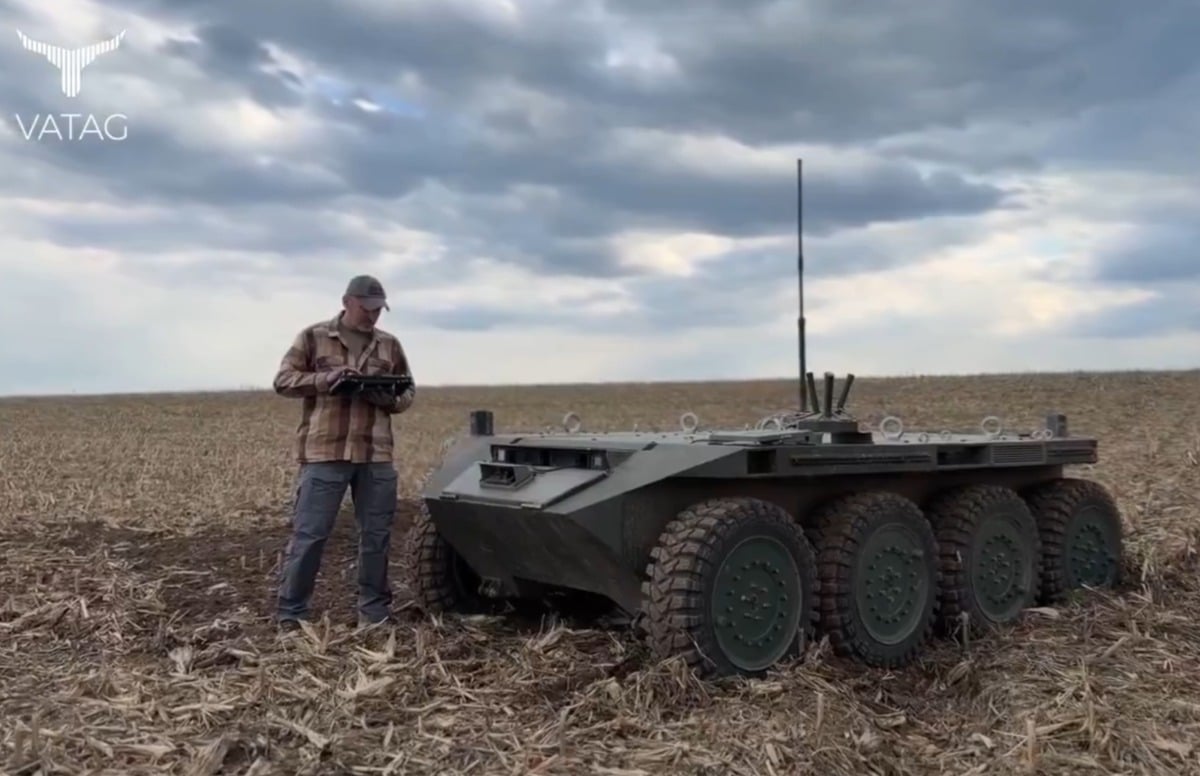
This is the context in which a Ukrainian defense firm recently pulled the tarp off its latest creation: a heavy Unmanned Ground Vehicle, or UGV. To the casual observer tracking defense tech from an armchair in western Europe or North America, the demonstration video looks like another piece of interesting military hardware. It is a large, tracked platform, looking somewhat like a tank that had its turret shaved off, grinding over concrete blocks, pushing through dense brush, and hauling immense weights.
But to the people who actually have to stand in the mud, that metal chassis represents something entirely different. It is a surrogate. It is a machine designed to take a bullet, an artillery splinter, or an anti-tank mine so that a human being does not have to.
The Mechanics of the Mechanical Beast
The reality of autonomous or remotely piloted warfare on the ground is far messier than the slick promotional videos suggest. Aerial drones have an advantage: air offers no friction, no boulders, and no hidden ditches. A ground vehicle face-to-face with the earth must contend with every jagged piece of shrapnel, every fallen tree trunk, and the unpredictable physics of wet clay.
This new heavy UGV class developed within Ukraine is a direct response to these brutal physics. Weighing several tons, these vehicles are not the small, agile scout robots used to peek around corners in urban combat. They are pack mules built of hardened steel.
The core design philosophy is simple: survivability through simplicity. The platform uses a low profile to remain invisible to thermal optics hidden behind treelines. Its tracks are wide, spreading its massive weight across a larger surface area to prevent it from sinking into the notorious Ukrainian mud. Driven by an electric or hybrid powertrain, it moves with an eerie, quiet hiss rather than the loud, rhythmic roar of a diesel truck. At a distance of fifty yards, the sound of its approach is easily masked by the ambient noise of the wind or distant shellfire.
Consider the engineering problem of remote operation in a heavy electronic warfare environment. The sky is thick with signals meant to jam, scramble, and drop drones out of the air. If a controller loses the signal to a flying drone, the drone crashes. If a controller loses the signal to a three-ton steel vehicle carrying a dozen anti-tank mines, that vehicle becomes a multi-million-dollar roadblock or, worse, a prize for the enemy.
To counter this, Ukrainian engineers have had to build deep redundancies into the control loops. These are not delicate laboratory instruments. They are operated via hardened radio links, sometimes utilizing directional antennas or tethered relay drones that hover directly above the vehicle to maintain a line-of-sight signal even when the UGV drops into a deep ravine. The software onboard is increasingly capable of basic autonomous navigation—give it a point on a digital map, and it will use its onboard sensors to figure out how to navigate around a fresh shell crater without human intervention.
The Mathematics of Survival
Every military operation is governed by an unyielding, often cruel mathematical equation. How many resources must be expended to achieve an objective? How many lives can be risked to save another?
When a soldier is severely wounded in a forward trench, the clock begins to tick. Medical doctrine speaks of the golden hour—the sixty-minute window during which rapid medical intervention can mean the difference between life and death. But when the ground between the casualty and the nearest stabilization point is swept by machine guns and watched by drones, an evacuation squad face an impossible choice.
Typically, it takes four able-bodied soldiers to carry a single wounded comrade on a litter. That means four fewer rifles in the trench. It means five people moving slowly across open ground, presenting a massive, slow-moving target for an enemy drone operator.
But a heavy UGV changes the variables of that equation completely.
In recent operational trials, these heavy platforms have been fitted with specialized medical litters and armored shields. A single operator, sitting in a reinforced bunker miles away, can guide the UGV directly to the lip of a trench. The wounded soldier is strapped onto the platform. The UGV turns around and trundles back through the gauntlet of fire.
If the vehicle is struck by shrapnel, the armor protects the casualty. If a wheel or track is blown off, the machine stops, but no new names are added to the casualty list. The metal takes the damage. The steel bleeds oil, not blood.
The same logic applies to the dirty, exhausting work of minelaying and logistics. A single heavy UGV can carry hundreds of pounds of ammunition, anti-tank mines, or building materials directly to the front line. It can do this repeatedly, all day and all night, without needing sleep, without experiencing fear, and without leaving a grieving family behind if things go wrong.
The Invisible Factory Floor
There is a temptation to look at these developments as products of a massive, state-funded industrial complex similar to the defense giants of the West. That view misses the true spirit of what is happening on the ground in Ukraine.
Much of this development happens in unassuming places. It happens in converted auto repair shops, in underground garages, and in small fabrication facilities tucked away in quiet neighborhoods. The engineers designing these systems are often the same people who, a few years ago, were developing civilian delivery apps, agricultural software, or custom racing cars.
They are working with an urgency that cannot be replicated in a peaceful laboratory. A flaw in a software update or a weak weld on a suspension arm is not caught during a scheduled quarterly review; it is caught when a vehicle fails in a field under live artillery fire. The feedback loop is instantaneous, brutal, and unforgiving.
This has led to an evolutionary speed that has stunned traditional defense procurement experts. While Western defense companies often spend a decade and hundreds of millions of dollars to develop a new armored vehicle, Ukrainian teams are moving from a sketch on a napkin to a working prototype in a matter of months. They use commercial, off-the-shelf components wherever possible, modifying electric motors from civilian vehicles and combining them with military-grade ballistic plating.
The result is a strange, hybrid technology: rugged, cost-effective, and remarkably effective. It is built not for the clean floor of a trade show, but for the unforgiving reality of the trench.
The Psychological Shift
The introduction of heavy autonomous vehicles does more than alter logistics; it alters the psychology of the soldier.
War is an exhausting psychological drain. The knowledge that you are isolated, that supplies might not reach you, or that a wound could mean a slow death because nobody can get to you creates a profound sense of vulnerability. When soldiers see a heavy, mechanical ally rolling up to their position through a zone too dangerous for human movement, that vulnerability shifts.
It creates a sense of backup. It provides a physical manifestation of technological support.
But this technological shift also brings new anxieties. Operators talk about the strange, detached stress of piloting these machines. When you are sitting in a cellar, watching a grainy video feed from a camera mounted on a UGV three miles away, you are physically safe. Your heart rate, however, does not know that. You watch an enemy drone dive toward your vehicle. You feel the impact through the loss of a video feed. You are unhurt, but the psychological toll of fighting via a mechanical proxy is a new kind of burden that modern soldiers are only beginning to understand.
There is also the constant game of cat and mouse between the engineers and the forces arrayed against them. Every time a UGV capability is demonstrated, the enemy adapts. They develop heavier electronic jamming. They deploy specialized anti-robot mines. They train drone pilots to target the optical sensors of the ground vehicles, blinding them before they can reach their destinations.
The demonstration of this heavy UGV is not the end of a story. It is merely a single frame in an ongoing, high-stakes technological race where the prize is human survival.
The Path Through the Clay
The heavy UGV will not replace the infantryman. It will not make the grim reality of ground combat clean, precise, or bloodless. What it does do is shift the point of impact.
As the technology matures, these large platforms will likely become common sights along the stabilizing lines of conflict. They will become the primary arteries of supply, moving silently through the night, carrying the heavy burdens that have broken the backs of soldiers for centuries.
The next time you see a clip of a gray, metallic box on tracks churning through a field of black mud, look past the specifications. Look past the battery capacities, the payload weights, and the remote control ranges.
Look instead at what is missing from the picture. There is no young man sitting in the cab, white-knuckled, staring through a dirty windshield, waiting for the sky to explode. He is somewhere else, underground, breathing, and waiting to go home.