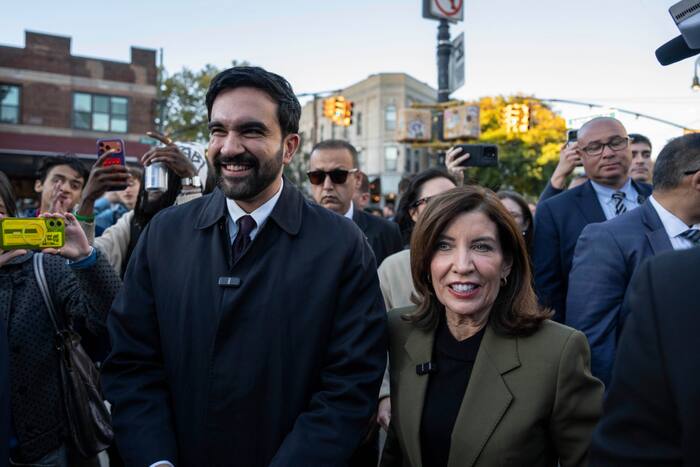
Subnational political rhetoric rarely alters federal fiscal policy without direct control over congressional appropriations or executive agency rulemaking. When New York state officials—specifically Governor Kathy Hochul and Assemblymember Zohran Mamdani—signal a new era of support for Puerto Rico following the 2026 Democratic midterm victories, the strategic reality depends entirely on whether state-level political capital can be converted into federal legislative leverage.
Understanding the actual impact of these commitments requires separating symbolic diaspora outreach from the structural mechanisms that govern Puerto Rico’s economy, debt restructuring, and federal funding parity.
The Structural Asymmetry of State-to-Territory Commitments
New York holds the largest Puerto Rican diaspora population on the United States mainland, concentrated heavily within New York City boroughs and upstate urban centers. This demographic reality creates a permanent electoral incentive for state-level executives and legislators to align with the island’s economic recovery. Yet the constitutional architecture of the United States places strict limits on what a state government can execute on behalf of an unincorporated territory.
The Jurisdiction Gap
A governor and a state assemblymember possess zero direct authority over federal statutory frameworks. Puerto Rico’s fiscal trajectory is dictated by three federal pillars:
- The Puerto Rico Oversight, Management, and Economic Stability Act (PROMESA): Enacted in 2016, this federal statute established the Financial Oversight and Management Board (FOMB), which holds veto power over the island's budgets, fiscal plans, and debt restructuring agreements.
- Federal Statutory Caps on Social Programs: Unlike U.S. states, Puerto Rico faces statutory ceilings on Medicaid block grants and is excluded from the Supplemental Nutrition Assistance Program (SNAP), receiving instead the capped Nutrition Assistance Program (NAP).
- The Merchant Marine Act of 1920 (The Jones Act): Federal maritime law mandates that goods shipped between U.S. ports travel on U.S.-built, U.S.-flagged, and U.S.-crewed vessels, inflating supply chain and energy import costs on the island.
Promises made by Albany politicians do not modify PROMESA, lift Medicaid caps, or grant Jones Act waivers. State officials operate outside the federal legislative chain of command.
The Transmission Mechanism of Political Capital
If New York officials cannot legislate for Puerto Rico, their utility rests on a secondary mechanism: delegation coordination and lobbying. New York’s congressional delegation—which includes senior leadership in both the House of Representatives and the Senate—serves as the actual conduit for federal policy shifts.
When Hochul and Mamdani campaign on or celebrate midterm gains with a focus on Puerto Rico, they are executing a coalition-maintenance strategy. By mobilizing the New York Puerto Rican electorate to secure Democratic majorities in Congress, state officials create a political debt that federal lawmakers are pressured to repay through committee assignments, appropriations riders, and oversight hearings.
Deconstructing the Intra-Party Coalition
The pairing of Kathy Hochul and Zohran Mamdani represents a deliberate alignment between the institutional, moderate wing of the New York Democratic Party and its democratic socialist flank. Analyzing their joint posture reveals how different ideological factions approach territorial policy.
The Institutionalist Framework
Governor Hochul’s approach to Puerto Rico typically centers on executive-to-executive cooperation, disaster response logistics, and state-funded technical assistance. During grid failures or hurricane recovery phases, New York has historically deployed utility workers, public health personnel, and emergency management specialists through the Emergency Management Assistance Compact (EMAC).
This model relies on:
- Bilateral Memoranda of Understanding (MOUs): Non-binding agreements facilitating trade missions, academic exchanges, and workforce development between New York agencies and the government in San Juan.
- State-Level Diaspora Funding: Allocating discretionary state budget grants to New York-based non-profits that maintain operational footprints on the island.
- Federal Advocacy: Utilizing the National Governors Association and direct White House access to lobby for expedited Federal Emergency Management Agency (FEMA) disbursements.
The limitation of the institutionalist model is its reactive nature. It treats acute infrastructure symptoms—such as the fragility of the LUMA Energy-operated electrical grid—without altering the underlying capital constraints imposed by the debt restructuring process.
The Structuralist Critique
Assemblymember Mamdani operates from an ideological framework that views Puerto Rico’s economic stagnation through the lens of structural extraction and austerity. Within this framework, the primary obstacles to recovery are the austerity budgets enforced by the Financial Oversight and Management Board, the privatization of public assets, and tax incentives like Act 60, which attract mainland capital without guaranteeing broad-based local wage growth.
For the progressive wing, a "new day" requires dismantling federal oversight mechanisms rather than merely accelerating federal grant disbursements. This creates an internal friction within the Democratic coalition:
- Moderate Priority: Maximize federal infrastructure spending, stabilize the municipal bond market, and ensure uninterrupted FEMA and Medicaid funding streams.
- Progressive Priority: Abolish the FOMB, audit and cancel remaining public debt, reverse utility privatization, and resolve the territorial status question via self-determination legislation.
While both factions celebrate midterm electoral victories as a mandate for action, their definitions of success diverge sharply once legislative drafting begins in Washington.
Evaluating the Post-Midterm Legislative Reality
A Democratic sweep in the 2026 midterm elections alters the procedural landscape in Congress, specifically regarding committee chairmanships and floor scheduling. However, translating electoral momentum into statutory change for Puerto Rico encounters severe institutional bottlenecks.
The Appropriations Bottleneck
Controlling the House of Representatives gives Democrats control over the House Committee on Natural Resources, which holds primary jurisdiction over U.S. territories, and the House Committee on Appropriations. This shift enables two immediate actions:
- Oversight Pressure: Chairpersons can subpoena FOMB members and federal agency heads to account for delays in the obligation and expenditure of already-approved disaster recovery funds from the Department of Housing and Urban Development (HUD) and FEMA.
- Parity Riders: Lawmakers can attach provisions to omnibus spending bills that temporarily increase the Federal Medical Assistance Percentage (FMAP) for Puerto Rico, preventing fiscal cliffs in the island's healthcare system.
Permanent structural reform—such as transitioning Puerto Rico fully into SNAP or granting full Supplemental Security Income (SSI) parity—requires clearing the Senate filibuster or utilizing budget reconciliation. Both pathways demand near-unanimous party discipline and carry significant Congressional Budget Office (CBO) scoring costs, often exceeding tens of billions of dollars over a ten-year window.
The FEMA Disbursement Lag
A persistent point of confusion in political rhetoric is the distinction between appropriated funds, obligated funds, and disbursed funds. Billions of dollars allocated by Congress following Hurricanes Irma, Maria, and Fiona remain unspent not because of a lack of legislative authorization, but due to administrative friction.
Federal procurement rules require strict cost-benefit analyses, environmental reviews, and local matching funds before FEMA releases capital for permanent reconstruction projects. A change in congressional control does not automatically rewrite the Robert T. Stafford Disaster Relief and Emergency Assistance Act. Unless Congress passes targeted statutory waivers that streamline procurement rules specifically for Puerto Rico’s electrical grid and water infrastructure, disbursement velocity will remain constrained by bureaucratic compliance.
The Economics of Diaspora Political Leverage
The durability of New York’s commitment to Puerto Rico is governed by political economics rather than altruism. The political influence of the Puerto Rican diaspora in New York is undergoing a demographic and geographic shift that dictates how state politicians allocate their attention.
Shifting Electoral Geography
Historically, Puerto Rican political power in New York was concentrated in legacy districts in the Bronx, East Harlem, and parts of Brooklyn. While these areas remain vital, population migration has expanded the diaspora’s footprint into swing congressional districts across the Hudson Valley, Long Island, and upstate cities like Rochester and Buffalo.
In tight midterm elections, margins in suburban and upstate districts determine control of the House of Representatives. Consequently, state leaders like Hochul and urban legislators like Mamdani recognize that messaging on Puerto Rico serves a dual purpose:
- Base Turnout: Driving voter participation in high-density urban cores where low turnout routinely threatens statewide Democratic margins.
- Swing District Persuasion: Appealing to diaspora voters in battleground districts who maintain familial and financial ties to the island.
The Risk of Symbolic Substitution
The primary failure mode in diaspora politics is symbolic substitution—the tendency of elected officials to substitute high-visibility cultural events, legislative resolutions, and fact-finding delegations for measurable policy outcomes.
When state politicians promise a "new day" for a jurisdiction they do not govern, they create an expectation gap. If federal lawmakers fail to pass the Puerto Rico Status Act, fail to reform PROMESA, or fail to secure permanent Medicaid parity during the subsequent congressional session, the political blowback frequently lands on state-level incumbents during their own reelection cycles.
Metrics for Evaluating Post-Midterm Follow-Through
To separate substantive policy execution from post-election rhetoric, observers must track specific, quantifiable indicators rather than press releases or bilateral summit announcements. True progress on Puerto Rico’s economic and political stabilization will register across four concrete metrics over the next 24 months:
- The Obligation-to-Disbursement Ratio: Track the quarterly percentage of obligated FEMA and HUD Community Development Block Grant-Disaster Recovery (CDBG-DR) funds that actually convert into completed construction outlays on the island. Rhetoric is meaningless if this ratio remains stagnant.
- Statutory FMAP Floors: Monitor whether the incoming Congress passes a multi-year or permanent extension of the 76% Federal Medical Assistance Percentage for Puerto Rico’s Medicaid program before existing temporary extensions expire, eliminating the recurring threat of healthcare funding cliffs.
- FOMB Budget Vetoes: Observe the frequency with which the Financial Oversight and Management Board exercises its statutory authority to reject budgets passed by the Puerto Rican legislature, alongside any congressional attempts to amend PROMESA to accelerate the board’s termination criteria (specifically, the requirement for four consecutive balanced budgets and restored access to capital markets).
- Grid Reliability Indices: Measure the System Average Interruption Duration Index (SAIDI) and System Average Interruption Frequency Index (SAIFI) on the island. Federal energy aid only succeeds if it measurably reduces the frequency and duration of power outages for residential and commercial consumers.
The Strategic Imperative for New York Leadership
If Kathy Hochul, Zohran Mamdani, and the broader New York Democratic apparatus intend to convert their post-midterm rhetoric into durable structural change, they must abandon broad declaratory promises and adopt a targeted lobbying architecture. State officials should formalize a permanent, metrics-driven working group that directly links New York’s congressional appropriators with technical experts from the University of Puerto Rico, municipal mayors on the island, and mainland energy regulators. Instead of issuing non-binding resolutions, Albany’s leadership must condition its political capital on three specific federal legislative deliverables in the upcoming congressional session: permanent Medicaid statutory parity, targeted Stafford Act procurement waivers to accelerate grid reconstruction, and a definitive congressional vote on territorial status resolution. Without binding state-level political mobilization directly to these federal legislative choke points, the promise of a new day will remain an exercise in domestic electoral maintenance.