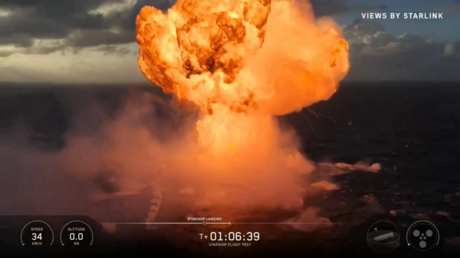
The tech press is swooning over the latest Starship V3 launch like a crowd of tech-bros watching an iPhone reveal. They cheer for the sheer height, the millions of pounds of thrust, and the promise of a commoditized cosmos. The mainstream narrative says that making rockets bigger and cheaper solves space colonization.
It does not. It creates a massive logistical choke point that the industry is wholly unprepared to handle. Building on this topic, you can also read: Inside the 2026 Solar Eclipse Crisis Nobody is Talking About.
We are watching a classic Silicon Valley misdirection. By focusing entirely on launch capacity, the aerospace narrative has mistaken the highway for the destination. Building a bigger truck does not matter if there are no warehouses at the end of the route and if the fuel stops require breaking the laws of financial gravity. Starship V3 is a magnificent piece of engineering, but the business model beneath it is built on a series of structural delusions.
The Refueling Lie That Everyone Ignores
The media loves to talk about Starship’s payload capacity to low Earth orbit (LEO). They parrot the 100 to 150 metric ton figures as if that is the number that gets us to Mars. It isn't. To send that same ship to the Moon or Mars, you have to launch it, let it sit in orbit, and then launch an armada of tanker rockets to fill its tanks before it can leave Earth's gravitational pull. Analysts at The Verge have also weighed in on this trend.
Let’s look at the actual physics. Starship uses liquid methane and liquid oxygen. Cryogenic propellants boil off in the vacuum of space. To send one fully loaded Starship V3 to deep space, you need somewhere between 8 and 12 tanker flights launched in rapid succession.
- The Logistical Nightmare: You are not looking at one launch. You are looking at a logistical train of a dozen heavy-lift launches within a tight window to avoid losing your fuel to boil-off.
- The Launch Pad Strain: No pad on Earth has ever sustained that kind of launch cadence. The thermal stress, acoustic damage, and refurbishment realities of a mega-rocket pad mean the turnaround time cannot simply be "wished" down to zero.
- The Financial Reality: When you multiply the advertised low cost of a single launch by twelve, the economics disintegrate.
I have spent years analyzing capital expenditure in high-risk engineering sectors. Companies routinely fail because they optimize the most visible part of the machine while ignoring the support infrastructure. SpaceX is building a brilliant engine, but the orbital gas station it requires remains a theoretical concept. If orbital refueling fails to scale seamlessly, Starship V3 becomes an oversized, economically unviable white elephant limited to dumping internet satellites into LEO.
The False Economy of Mass Production
The competitor articles claim that mass-producing stainless steel rockets like airplanes will drop the cost of access to space to double-digit dollars per kilogram. This argument ignores how supply chains and global markets operate.
Airplanes are cheap to operate because they fly thousands of hours per year for decades. They carry passengers who pay instantly. Rockets, even fully reusable ones, face harsh environmental realities. The thermal cycling of atmospheric reentry degrades exotic alloys and heat shield tiles. The Raptor engines operate at chamber pressures that push the absolute limits of metallurgy.
Even if SpaceX manages to turn around a Starship hull in 24 hours, who fills it?
The global demand for space payload does not match this sudden spike in supply. Aside from SpaceX's own Starlink network, the rest of the world’s commercial satellite builders, scientific institutions, and defense agencies combined do not produce enough hardware to justify a daily mega-rocket launch schedule. When supply massively outstrips demand, prices do not just fall; the entire manufacturing ecosystem collapses under the weight of its own unamortized fixed costs. You cannot run a factory optimized for mass production if your assembly line has to sit idle for nine months out of the year waiting for customers to build something heavy enough to warrant the flight.
Dismantling the People Also Ask Consensus
Look at what the public is asking, and look at how the answers miss the mark entirely.
Does Starship V3 make traditional aerospace companies obsolete?
The common answer is yes, because legacy operators like United Launch Alliance (ULA) or Arianespace are stuck using expensive, expendable rockets. But this ignores the risk-mitigation profiles of national security and high-value scientific payloads.
A defense agency tracking missile signatures or a university that spent fifteen years building a $10 billion space telescope does not care if a launch costs $10 million or $100 million. Launch cost is a fraction of their total budget. What they care about is schedule certainty and a track record of zero failures. A highly complex, multi-tanker refueling architecture introduces dozens of single points of failure. Until Starship proves it can execute orbital rendezvous and fuel transfer with boring, repetitive reliability, traditional operators with simple, single-shot profiles will retain a ironclad grip on the highest-margin sectors of the market.
Can Starship cut travel time on Earth with point-to-point travel?
This is the most absurd claim circulating in the industry. The idea is that you can board a rocket in New York and land in Tokyo 40 minutes later.
Consider the operational reality. A Starship launch generates an acoustic footprint that requires launch pads to be miles away from civilian population centers. To catch a 40-minute flight, you would need to take a two-hour boat ride or helicopter flight out to an offshore floating platform. Then you undergo rigorous safety briefings, load into a windowless capsule, endure multiple Gs of acceleration, experience a brief window of weightlessness, and pull more Gs on descent, followed by another two-hour boat ride to the actual city.
It is an uncomfortable, logistically nightmarish solution to a problem that business-class aviation solved decades ago. Point-to-point rocket travel is a marketing gimmick designed to keep investors hooked on the idea of a massive consumer market that will never materialize.
The Real Bottleneck is Not the Rocket
If you want to understand where the space economy is actually going, stop looking at the vehicles. Look at the destinations.
We have spent billions of dollars perfecting the art of throwing metal into the sky, yet we possess almost zero infrastructure for when that metal arrives. If Starship drops 100 tons of equipment on the lunar surface tomorrow, that equipment will sit in the dust. We do not have autonomous mining rigs capable of operating through the two-week lunar night. We do not have scalable orbital habitats that can mitigate radiation over long periods without constant resupply from Earth.
The real money, and the real disruption, will not come from building rocket number 4, 5, or 50. It will come from the unglamorous, deeply complex sub-systems that make space habitable:
- Closed-Loop Life Support: Systems that can recycle 99% of water and air without mechanical breakdown for five years straight.
- Nuclear Surface Power: Solar arrays are useless in deep craters or during prolonged planetary nights; space requires compact, high-output fission reactors.
- In-Situ Resource Utilization (ISRU): Automated chemical plants that can extract oxygen from regolith without human mechanics on site to clean the filters every Tuesday.
Investing in launch vehicles right now is like investing in a fleet of cruise ships when the destination island is an active, barren volcano. It is a fundamental misallocation of capital driven by the visual spectacle of a rocket launch.
The Trillion-Dollar Pivot
The hard truth is that the space industry is creating an asset bubble. The valuation of space companies is tied to the assumption that cheaper launch costs automatically unlock a trillion-dollar economy. But cheap launch is merely a prerequisite, not a guarantee.
If you are an engineer, an investor, or an entrepreneur looking at the aerospace landscape, ignore the smoke and fire in South Texas. The companies that will own the next century are not the ones bending steel to build bigger tanks. They are the ones solving the quiet, brutal physics of survival, power, and manufacturing in environments explicitly hostile to human life.
Stop celebrating the truck. Start building what goes inside the warehouse.