The official record shows that 101 people died in Spain due to heat-related causes during a single month of May. It is a statistic that local authorities have never had to record so early in the year. While early-season heatwaves are routinely dismissed as freak meteorological anomalies, the data reveals a far more systemic failure. Spain is not just experiencing warmer spring weather. It is facing a structural shift where public health infrastructure, labor laws, and urban architecture are failing to adapt to a permanently altered climate reality.
The primary driver of this mortality spike is not just the absolute temperature, but the timing.
When extreme heat strikes in July or August, the human body has already undergone a weeks-long process of acclimatization. Cardiovascular systems have adjusted, blood volume has slightly expanded, and behavioral habits have shifted. In May, the biological shock is immediate. The sudden onset of mid-summer heat in late spring catches vulnerable populations entirely off guard, turning manageable temperatures into lethal events.
The Early Season Vulnerability Trap
Public health officials have historically tied heat mitigation plans to the traditional summer calendar. Emergency cooling centers, localized warning systems, and targeted social work interventions rarely activate before June 15. This bureaucratic rigidity creates a deadly operational vacuum when July-level temperatures arrive four weeks early.
The mortality figures from May demonstrate that the vulnerable population is broader than most policy papers assume. It is not exclusively the elderly or those with pre-existing cardiovascular conditions dying in insulated apartments, though they comprise a significant portion of the baseline risk. The early-season spike heavily impacts outdoor laborers, delivery drivers, and agricultural workers who operate under contracts drawn up for a different climate era.
When a heatwave hits in May, economic pressures prevent workers from demanding altered hours. Construction schedules are locked in. Harvesting cycles cannot be delayed. Because the official "high risk" season has not commenced, statutory labor protections governing extreme heat often remain dormant.
The physiology of early-season heat stress is straightforward but brutal. Sweat production takes roughly one to two weeks of continuous exposure to reach maximum efficiency. When a rapid thermal spike occurs in May, the body's primary cooling mechanism fails to operate at peak capacity. Core temperatures rise faster, putting immense, immediate strain on the heart. It is a silent mechanism. Many of the recorded 101 fatalities did not occur on the pavement from heatstroke; they occurred in hospitals hours or days later as acute heart failure triggered by thermal distress.
Urban Geometry as a Thermal Amplifier
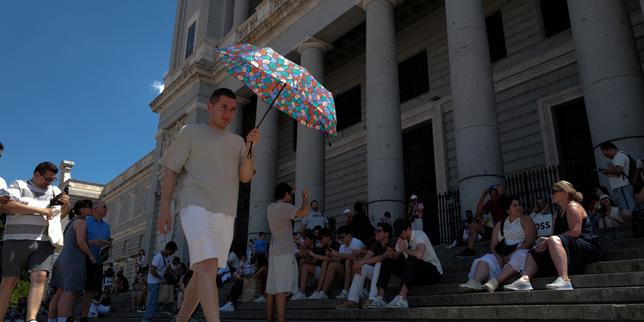
The geography of these deaths points directly to the architectural choices of Spain's major metropolitan areas. Cities like Madrid, Seville, and Zaragoza have spent decades replacing green spaces with granite plazas and asphalt infrastructure. This is not an aesthetic critique. It is a structural indictment.
During a May heatwave, these materials act as thermal sponges. They absorb solar radiation throughout the day and release it slowly during the night, a phenomenon known as the urban heat island effect.
[Daytime Solar Radiation] -> Absorbed by Granite/Asphalt
                                   |
                                   v
[Nighttime Radiation Release] -> Prevents Structural Cooling -> High Nocturnal Mortality
When nighttime temperatures fail to drop below 22 degrees Celsius (71.6 degrees Fahrenheit), the human body is denied its critical recovery period. The cardiovascular system must continue to work at an elevated rate to pump blood to the skin for cooling, even during sleep. For an elderly resident living in a top-floor apartment without air conditioning, three consecutive tropical nights in May represent an unsustainable physiological tax.
The socioeconomic divide dictates who survives these early anomalies. Air conditioning is frequently framed as a comfort feature, but in modern southern Europe, it has become essential medical infrastructure. Lower-income neighborhoods feature older, poorly insulated housing stock with fewer trees and less access to shaded public spaces. Residents in these districts face a double penalty. They experience higher ambient temperatures due to urban geometry, and they lack the financial means to run cooling units amid volatile energy prices.
The Failure of Predictive Modeling
National meteorological services have grown exceptionally accurate at forecasting temperature spikes, yet the translation of weather data into public health action remains fractured. The current threshold systems used to trigger alerts are largely static, based on historical summer averages rather than a rolling baseline that accounts for seasonal readiness.
A temperature of 38 degrees Celsius (100.4 degrees Fahrenheit) in August triggers a standard orange alert, a warning that the public expects and understands. That exact same temperature in mid-May represents a profound ecological and medical emergency.
By treating all heatwaves through a uniform lens, warning systems fail to communicate the heightened risk of early-season exposure. People do not alter their behavior because the calendar tells them it is still spring. They continue strenuous outdoor exercise, neglect hydration, and leave windows closed during the hottest parts of the day.
This behavioral inertia is compounded by institutional inertia. Southern European economies rely heavily on tourism and outdoor services. Admitting that the active season now extends into May—with all the associated liabilities, labor restrictions, and operational slowdowns—presents an uncomfortable economic reality that regional governments are hesitant to confront.
Rethinking the Calendar of Adaptation
Addressing this shifting mortality profile requires dismantling the traditional concept of "summer." Mitigation strategies cannot be tied to arbitrary months on a calendar; they must be dynamically linked to real-time thermal thresholds.
- Dynamic Labor Triggers: Statutory limits on outdoor work must automatically activate based on wet-bulb temperatures, regardless of whether the month is May or September.
- Retroactive Architectural Mandates: Urban planning must pivot away from mineral-heavy designs toward aggressive reforestation, green roofs, and permeable surfaces to break the nighttime heat retention cycle.
- Proactive Clinical Outreach: Medical registries must be utilized to contact high-risk cardiovascular patients the moment an unseasonal spike is forecasted, rather than waiting for emergency rooms to fill.
The 101 deaths recorded in Spain are not an isolated tragedy to be filed away under historical anomalies. They serve as a clear, data-driven warning that the timeline of climate risk has outpaced the timeline of bureaucratic response. The infrastructure designed to keep populations safe is built for a world that no longer exists, leaving the most vulnerable to pay the price for every week the state hesitates to adapt.