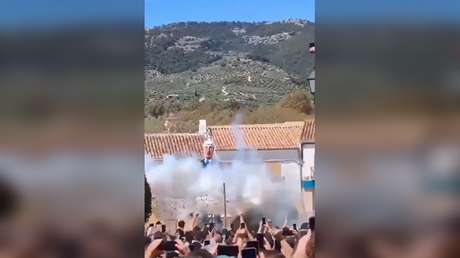
The diplomatic floor between Madrid and Jerusalem has finally caved in. What began as a local Easter tradition in a dusty Spanish village has spiraled into a high-stakes international crisis, leaving the Spanish chargé d'affaires standing in a Tel Aviv office to receive a formal lashing from Israeli officials. The catalyst was a 23-foot effigy of Prime Minister Benjamin Netanyahu, stuffed with 14 kilograms of gunpowder, which was detonated before a cheering crowd in El Burgo on April 5, 2026. This was not a random act of vandalism; it was a state-sanctioned cultural event that Israel now claims is the direct fruit of Spanish government incitement.
Israel’s Foreign Ministry wasted no time in linking the pyrotechnics to the rhetoric of Spanish Prime Minister Pedro Sánchez. In a scathing statement, Jerusalem argued that the "appalling antisemitic hatred" witnessed in the Malaga province is a byproduct of Madrid’s consistent hostility toward Israeli military operations in Gaza and Lebanon. This explosion is merely the latest, loudest signal that the relationship between these two Mediterranean nations has reached its most toxic point in decades.
The Burning of Judas and the Modern Target
To understand the fury, one must look at the ritual itself. The "Burning of Judas" is a centuries-old ceremony held across various parts of the Catholic world on Easter Sunday. Historically, an effigy representing Judas Iscariot—the disciple who betrayed Jesus—is burned or blown up to symbolize the triumph of good over evil. In the village of El Burgo, the tradition has evolved into a form of political satire. In previous years, the town has turned its gunpowder toward figures like Donald Trump and Vladimir Putin.
However, the choice of Netanyahu carries a weight that Trump or Putin does not. For Israel and several international Jewish organizations, the spectacle evokes the "blood libel" and the medieval roots of European antisemitism, where Jews were collectively blamed for the death of Christ. The International Christian Embassy Jerusalem (ICEJ) was among the first to sound the alarm, noting that these ceremonies have historically been used to portray Jews as inherently evil or greedy. When you take a religious ritual aimed at a "traitor" and replace him with the world's only Jewish head of state, the line between political protest and ethnic targeting becomes dangerously thin.
A Government Under Fire
Madrid’s response has been one of cold denial. A Spanish Foreign Ministry source dismissed the Israeli accusations as "insidious," insisting the government remains committed to fighting all forms of discrimination. But for the Netanyahu administration, the silence from Pedro Sánchez is louder than the 14 kilograms of gunpowder that leveled the effigy.
Sánchez has positioned himself as the most aggressive critic of Israel within the European Union. Over the last two years, he has spearheaded the recognition of a Palestinian state, called for an EU-wide arms embargo on Israel, and most recently, shuttered Spanish airspace to any aircraft involved in the regional conflict. Israel views these not as principled policy stances, but as a "systemic incitement" that provides the social permission for a village in Malaga to treat a Jewish leader like a sacrificial demon.
The friction is fueled by concrete policy clashes:
- The Airspace Ban: Spain’s refusal to allow weapons shipments through its ports or sky has directly hindered Israeli logistics.
- The Lebanon Conflict: Spanish Foreign Minister José Manuel Albares has accused Israel of violating international law following airstrikes that occurred during a shaky ceasefire period.
- The Genocide Allegation: Sánchez’s frequent use of the term "genocide" in relation to Gaza remains a non-negotiable red line for Jerusalem.
The Geopolitical Fallout
This isn't just a spat over a bonfire. We are witnessing the fragmentation of Western consensus on the Middle East. While Germany and the United States have largely maintained a protective—if occasionally critical—stance toward Israel, Spain is leading a bloc of Mediterranean and Atlantic nations that are moving toward active containment.
The tension has moved beyond the halls of the UN and into the town squares. When a mayor like Maria Dolores Narvaez defends the event as a "tradition," she ignores the reality that in 2026, tradition is a secondary concern to global optics. In a world where a viral video of a burning leader can trigger a diplomatic reprimand within hours, no local festival is truly local.
The summons of the Spanish diplomat in Tel Aviv is a final warning. Israel is signaling that it will no longer separate "cultural expression" from the political climate created by its neighbors. If Madrid continues to treat Israel as a pariah on the world stage, it cannot be surprised when its citizens follow suit in the streets. The fire in El Burgo may have been extinguished, but the heat between these two capitals is only beginning to rise. Madrid now faces a choice: rein in the rhetoric that fuels such displays or prepare for a total severance of ties with the most powerful military force in the Middle East.
Jerusalem is not asking for an apology for a village festival; it is demanding a reversal of Spain's entire foreign policy trajectory. Until that happens, the smoke from El Burgo will continue to cloud the Mediterranean horizon.