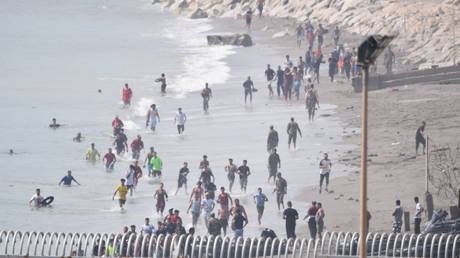
The press corps loves a good piece of nautical theater. When Madrid announces a shiny new engineering project at its North African doorstep, the headlines write themselves: modern fortifications, high-tech deterrence, border security upgraded.
Except it is all a distraction.
Spain installing a floating barrier in Ceuta is not a security breakthrough. It is an expensive pacifier designed to look aggressive on evening television while quietly failing to address the physics of migration. I have watched governments burn billions on marine fences, floating booms, and concrete band-aids across the Mediterranean for over a decade. Every single time, the outcome is identical. The barrier gets press, the politicians get a soundbite, and the human traffic simply shifts ten feet to the left or twenty feet into the air.
If you think a floating plastic tube in the Alboran Sea is going to stop desperation fueled by economic collapse, you do not understand supply and demand. You understand PR.
The Engineering Illusion of Marine Fences
Let us look at what a floating barrier actually is. It is a series of anchored buoys, heavy chains, and weighted skirts designed to deter swimmers and small watercraft from skirting around terrestrial border fences into Spanish territory.
On paper, it sounds logical. In reality, the ocean is an unmanageable partner.
Marine environments are hostile. Tides rise and fall, saltwater corrodes anchors, and Atlantic swells turn rigid floating structures into expensive toys. Maintenance costs alone will bleed municipal budgets dry within thirty-six months. More importantly, water has no friction for commerce or movement. If a barrier is stationary, the human element is fluid.
When you block a coast with a physical line, you do not decrease the pressure of migration. You compress it. You force individuals into longer, deadlier open-water routes further out to sea, or you incentivize higher-risk land assaults on the existing double-row fences.
The media calls these barriers "deterrents." Anyone who has spent a week tracking maritime logistics calls them speed bumps.
The Lazy Consensus of Border Fortification
The mainstream narrative surrounding Ceuta and Melilla relies on a comforting fiction. The fiction states that borders are purely physical problems requiring physical solutions. Build it higher, float it longer, electrify it smarter, and the problem vanishes.
This is lazy policy-making. It assumes that migration is an external infection that can be quarantined with enough steel and plastic.
Think of it like digital cybersecurity. If a corporation relies solely on a thick firewall while ignoring internal network architecture, compromised credentials, and employee behavior, hackers waltz right through. Physical borders function identically. A floating barrier protects a tiny fraction of a maritime perimeter while the broader macroeconomic drivers—unemployment, geopolitical instability, and visa inequality—remain untouched.
Spain is spending millions to secure a hundred-meter stretch of coastline while ignoring the hundreds of miles of open horizon surrounding it. It is theater for Brussels and domestic voters who demand to see "action."
Action and effectiveness are rarely synonyms in government procurement.
The Economics of Desperation
Let us talk numbers because nobody else in the mainstream coverage wants to ruin the mood with math.
When you increase the friction of a specific route, you do not eliminate the traffic. You increase the profit margins for the operators facilitating it. Smuggling networks thrive on high-barrier environments. The harder it is to cross legally or semi-legally, the more desperate clients are willing to pay astronomical fees to illicit actors who find workarounds.
A floating barrier in Ceuta does not starve the smuggling trade. It subsidizes it. It forces migrants to rely on riskier methods, driving up the value of specialized local knowledge and corrupt channels.
Imagine a retail store trying to stop shoplifting by locking the front door while leaving the roof open and the loading dock unattended. That is what a localized marine barrier achieves. It addresses the symptom that is easiest to film while leaving the root mechanics untouched.
The Real Cost of Looking Tough
Politicians love Ceuta because it is a physical manifestation of European sovereignty. Spain sits on the only European land border with Africa, sharing it with Morocco. That makes it a geopolitical stage.
Every time migration numbers tick upward during summer weather, panic sets in. Madrid feels compelled to react visibly. A floating barrier looks tough. It looks high-tech. It photographs well from a drone.
The trade-off is grim. While capital is tied up in anchoring plastic buoys to the ocean floor, funding is diverted away from intelligence-led policing, diplomatic agreements with origin countries, and streamlined processing frameworks that could actually manage human flows efficiently.
You cannot engineer your way out of a demographic and economic mismatch with marine hardware.
The Counter-Intuitively Boring Truth
Real border management is deeply unglamorous. It does not involve bright yellow buoys bobbing in the surf. It involves data integration, fast-track consular negotiations, labor market integration frameworks, and targeted international aid that actually reaches local economies instead of corrupt state coffers.
Those solutions do not fit into a fifteen-second TikTok clip or a triumphant press release from the Ministry of the Interior.
Spain knows this. The technocrats designing these policies know this. But the public wants theater, and the state is more than happy to deliver a Hollywood-style prop floating in the Mediterranean.
Stop buying the marketing. It is not a security upgrade. It is an expensive buoy designed to keep a political narrative afloat until the next news cycle washes it away.