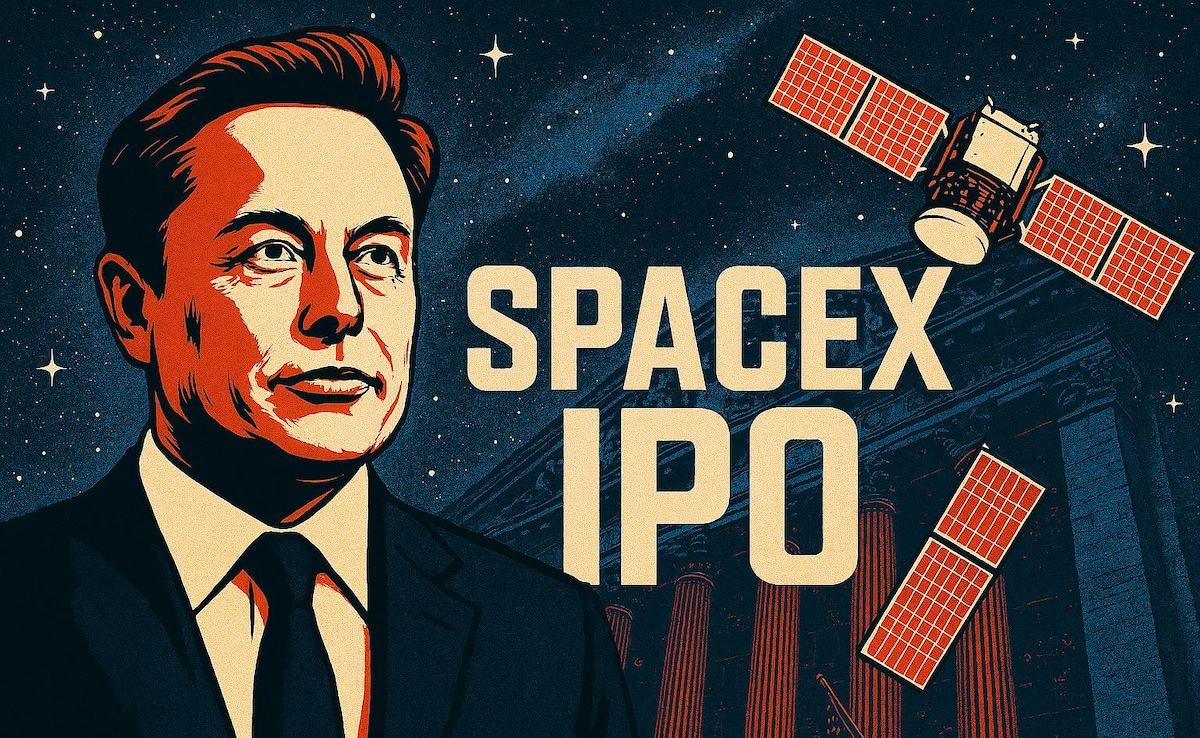
The financial press is having a collective panic attack over a hypothetical SpaceX initial public offering.
Commentators are dusting off old case studies of high-profile market debuts that fell flat, warning retail investors that massive listings are historically a trap. They point to the wreckage of past tech unicorns and capital-intensive giants that stumbled under the weight of public market scrutiny. They look at the massive capital expenditures required to fuel Starship and Starlink and see a ticking time bomb for public shareholders.
They are completely misreading the situation.
Comparing Elon Musk’s aerospace empire to historical mega-listings like Saudi Aramco, Alibaba, or the dot-com disasters of yesteryear is a fundamental error in analysis. It applies legacy financial metrics to a company that operates on entirely different economic principles. The conventional wisdom states that big listings burn early investors.
The conventional wisdom is dead wrong.
The Flawed Premise of the CapEx Scare
Traditional market analysts look at SpaceX and see a company trapped in a capital expenditure nightmare. They calculate the burn rate of testing massive rocket prototypes in south Texas, add the cost of mass-producing thousands of low-Earth orbit satellites, and conclude that public markets would crush the company's valuation under the weight of quarterly earnings reports.
This view misses the core mechanic of modern aerospace economics: vertical integration and rapid iterative manufacturing.
When a traditional defense contractor builds a rocket, every component passes through a bloated supply chain of sub-contractors, each tacking on a profit margin. A single valve can cost tens of thousands of dollars and take months to deliver. If the design fails, the financial damage is catastrophic because the feedback loop takes years.
SpaceX flipped this model entirely. By manufacturing over 85% of its hardware in-house, the cost of failure drops precipitously. When a Starship prototype explodes during a test flight, the legacy finance crowd sees tens of millions of dollars vaporized. A deep-tech insider sees cheap data.
Legacy Aerospace: High Unit Cost + Low Iteration Rate = Fragile Economics
SpaceX Model: Low Unit Cost + High Iteration Rate = Exponential Deflation
The data gathered from a single controlled failure allows engineers to implement design fixes in weeks, not years. The capital isn't wasted; it is converted into proprietary operational data that competitors cannot buy at any price. Wall Street metrics treat hardware development like a traditional infrastructure project, ignoring that SpaceX operates much closer to a software development cycle.
Dismantling the People Also Ask Myth: Is SpaceX Too Volatile for Regular Investors?
Search engines are flooded with retail investors asking whether a public SpaceX would be a wealth destroyer due to its high-risk profile. The standard answer from risk-averse financial advisors is a resounding yes. They advise sticking to predictable cash-flow businesses.
That advice is built on a misunderstanding of what actually drives long-term value in capital markets.
The real risk isn't volatility; the real risk is obsolescence. Traditional telecom giants and legacy aerospace firms look stable on paper because they have predictable dividends and steady balance sheets. But beneath the surface, their core infrastructure is being systematically rendered obsolete by high-throughput satellite constellations.
Consider the international launch market. A decade ago, European and Russian launch providers held a dominant share of commercial satellite deployments. Today, the Falcon 9 handles a massive percentage of global payload mass to orbit. The legacy players did not fail because of bad financial management; they failed because their technology became a historical footnote overnight.
Investing in a public SpaceX wouldn't be a bet on a stable utility. It would be an allocation toward a monopoly on the infrastructure of the orbital economy. The downside to this contrarian view is obvious: the company is highly dependent on a single, polarizing figurehead, and regulatory roadblocks can freeze operations for months. If a major launch failure occurs with humans on board, the stock would face a brutal correction. But judging the company by the standard metrics of the automotive or legacy telecom sectors is an analytical dead end.
The Starlink Cash Machine Everyone Is Ignoring
The loudest skeptics argue that space exploration is a money pit with no path to profitability. They treat the Mars mission as the core business model, assuming public shareholders will be forced to fund a philanthropic science project.
This completely ignores the cash-engine that is Starlink.
Starlink is not a space project; it is a global telecommunications disruptor disguised as a satellite constellation. Traditional fiber optic networks require billions of dollars in physical ground infrastructure to connect remote areas. They require rights-of-way, manual labor, and decades of maintenance.
Starlink bypasses the geography problem entirely. The marginal cost of adding a new subscriber to an existing orbital constellation is close to zero. Once the baseline network is operational, every new enterprise contract, maritime shipping fleet, and rural household added to the system represents pure, high-margin revenue.
Global Connectivity Infrastructure Comparison
| Metric | Traditional Fiber Optic | Starlink Constellation |
|---|---|---|
| Deployment Speed | Years to Decades | Weeks to Months |
| Geographic Limitations | High (Mountains, Oceans, Remote Areas) | None (Global Coverage) |
| Marginal Cost per User | High (Physical Line Extension) | Near Zero (Software Activation) |
| Maintenance Profile | Heavy Ground Labor / Infrastructure | Automated Orbital Management |
I have watched venture funds pour hundreds of millions into SaaS companies that claim to have a "moat" because of their software architecture, only to see that moat evaporate when a competitor copies the code. SpaceX has a physical, capital-intensive moat backed by regulatory spectrum allocations and a vertically integrated launch system that slashes the cost per kilogram to orbit. You cannot clone a constellation of thousands of operational satellites with a team of silicon valley developers.
Stop Looking for a Traditional IPO
The biggest mistake the market is making is waiting for a standard S-1 filing and a traditional roadshow. If SpaceX opens up to public capital, it will likely not look like the listings of the past.
The company does not need the public markets to survive. It routinely raises billions in secondary markets at steadily climbing valuations from institutional players who are begging for allocations. A public listing would not be a desperate scramble for liquidity to pay off creditors; it would be a strategic move to unlock liquidity for early employees and establish a currency for massive global acquisitions.
If you are waiting for a traditional IPO to buy into the orbital economy at a discount, you have already lost the game. The institutional capital is already there, locking up the value long before retail investors can even smell the prospectus.
The historical warnings about mega-listings failing are based on companies that went public at the absolute peak of their market dominance, using the capital inflow to paper over structural decline. SpaceX is entering the public consciousness at the absolute beginning of its industrial scale. The launch infrastructure is built, the constellation is generating billions in high-margin revenue, and the competition is years away from a viable alternative.
Apply your nineteenth-century financial models to nineteenth-century industries. Deep tech operates on a different timeline, driven by physics and structural deflation. Stop looking at the market cap and start looking at the cost per kilogram to orbit. That is the only metric that matters, and right now, nobody else is even on the scoreboard.