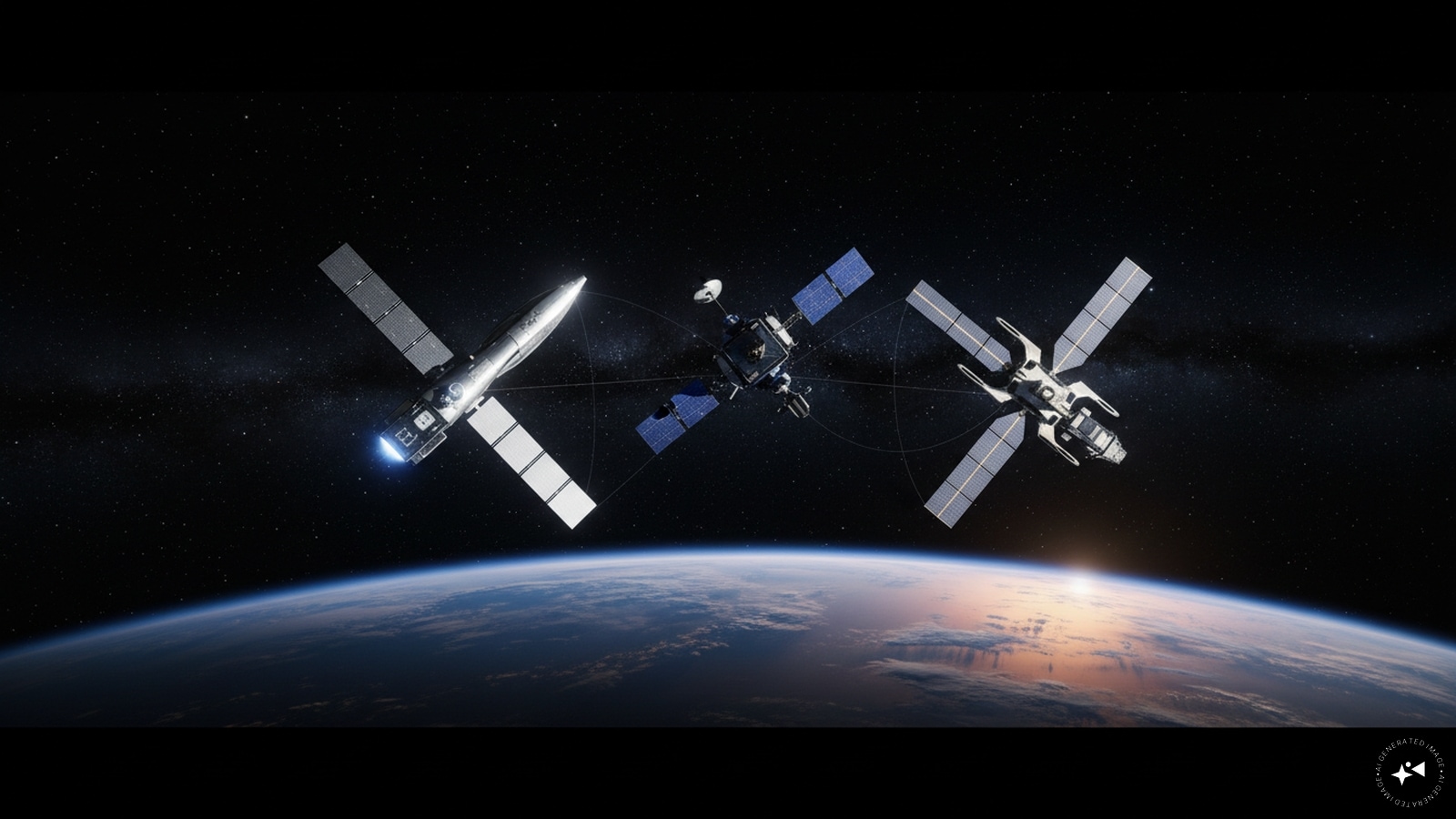
For decades, official Washington maintained a carefully manicured fiction that Earth's orbit remained a sanctuary dedicated exclusively to science, weather tracking, and commercial telecommunications. That polite illusion ended abruptly when senior military officials confirmed that the United States has deployed operational space control weapons into orbit.
This admission shatters the last remaining diplomatic guardrails protecting the final frontier. While the Pentagon refuses to detail the exact specifications or placement of these orbital systems, the public confirmation signals a dangerous transition from covert posturing to overt orbital militarization. The mask is off, and the architects of modern military strategy are preparing for an entirely new tier of geopolitical friction.
To understand why this development matters, one must look past the bureaucratic language of space control. Space control encompasses kinetic and non-kinetic mechanisms designed to contest, degrade, or destroy adversary assets in low Earth orbit and geosynchronous arcs. For years, intelligence agencies tracked suspicious orbital maneuvers by foreign powers, quietly building a case that celestial security was an obsolete concept. When a nation acknowledges its own offensive and defensive hardware circling above, it is because deterrence has failed or transformed into something far more aggressive.
The strategic reality is that modern terrestrial armies are entirely dependent on orbital infrastructure. Communications, GPS navigation, missile launch detection, and battlefield intelligence all rely on a fragile constellation of satellites moving in predictable paths overhead. Blind or disable those eyes and ears in the sky, and an advanced military force instantly reverts to mid-twentieth-century operating capacities. Recognizing this vulnerability, the great powers spent the last fifteen years turning the void into a high-stakes chessboard.
Beijing and Moscow did not wait for Washington to take the first public step. China's rapid military modernization program includes ground-based lasers, robotic servicing arms capable of grappling foreign hardware, and direct-ascent anti-satellite missiles. Russia, meanwhile, has pursued electronic jamming systems and orbital prototypes designed to disrupt critical networks, alongside persistent concerns regarding nuclear-capable anti-satellite concepts. The United States spent years characterizing these foreign programs as unacceptable threats while quietly developing its own countermeasures. Now, the quiet part is being spoken out loud.
Reactions from rival capitals followed a predictable script. Foreign ministries in Beijing and Moscow condemned the move, accusing Washington of accelerating an arms race and turning outer space into a literal battlefield. Yet these protests ring hollow to defense analysts who note that all three nations are equally guilty of breaking the strategic trust that kept orbit relatively weapon-free for half a century. When every major military power treats space as a warfighting domain, mutual vulnerability replaces mutual restraint.
The danger of this new era lies in the mechanics of orbital engagement. Space is not an open ocean where opposing navies can maneuver or retreat. Objects in low Earth orbit travel at roughly seventeen thousand miles per hour, locked into fixed ballistic trajectories governed strictly by orbital mechanics. At these velocities, kinetic impacts generate millions of hyper-velocity shrapnel pieces. A single engagement or defensive destruction of a satellite can trigger a cascading chain reaction known as the Kessler syndrome.
Debris fields expanding unchecked through orbit would eventually shred commercial weather satellites, scientific probes, and civilian communication grids indiscriminately. By introducing weapons designed to disable or destroy targets in this environment, major powers are accepting a terrifying risk. A defensive strike against an adversary's reconnaissance platform could inadvertently wipe out global financial networks or meteorological tracking systems within hours.
Furthermore, the ambiguity inherent in space operations creates a hair-trigger security dilemma. If a satellite belonging to a rival nation alters its course or approaches a critical defense asset, how is the operator on the ground supposed to interpret the maneuver? Is it conducting routine maintenance, inspection, or preparing to blind an early-warning sensor? In an environment where communication lags are measured in critical seconds and margins for error do not exist, a defensive reaction can easily be misread as an unprovoked first strike.
The public acknowledgment of deployed space weapons marks the crossing of a Rubicon. The arms race in orbit is no longer a theoretical projection debated by defense intellectuals in academic journals. It is an active, funded, and acknowledged reality governing the foreign policies of the world's most powerful nations. As diplomacy takes a back seat to orbital dominance, the sky above has transformed from a shared horizon into the next theater of war.