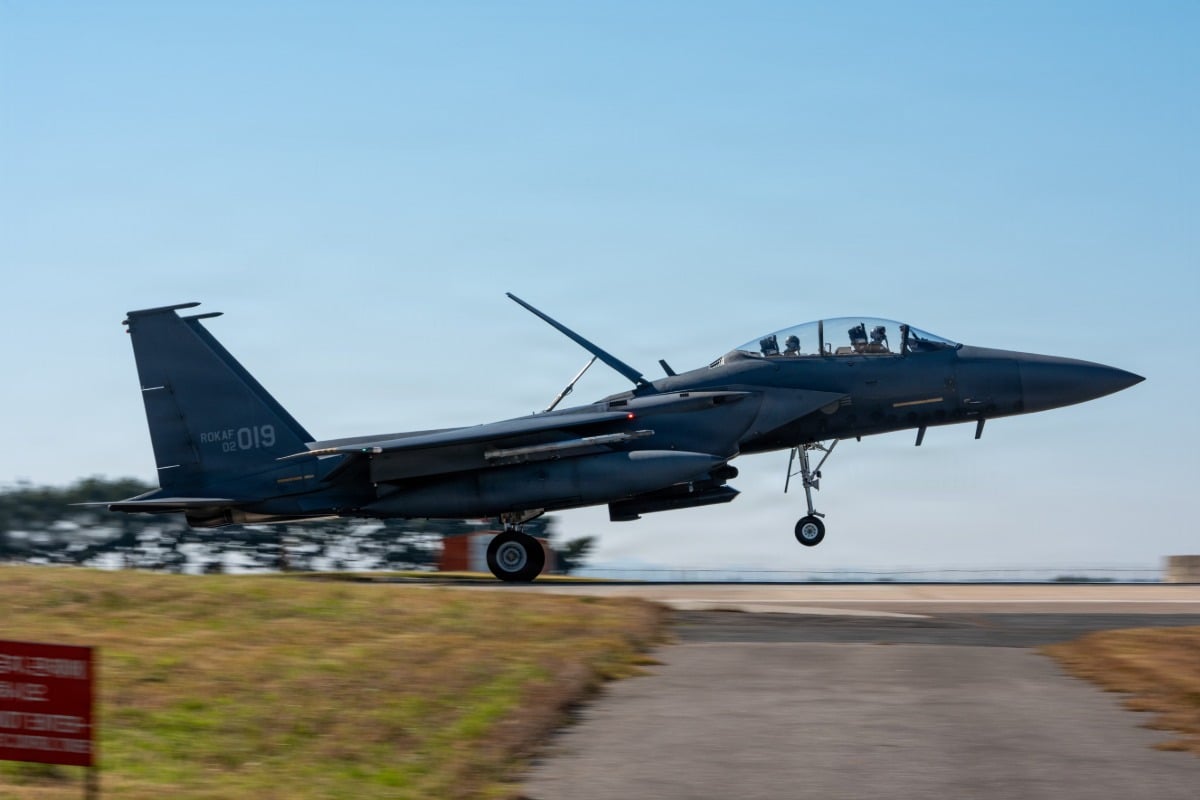
The defense industry loves a massive hardware announcement.
When BAE Systems secured the contract to upgrade the electronic warfare systems of South Korea’s aging F-15K Slam Eagle fleet, the defense press did exactly what it always does. It parroted the press release. They celebrated the modernization of the Republic of Korea Air Force (ROKAF), threw around terms like survivability, and praised the multi-million-dollar commitment to keeping fourth-generation fighter jets relevant.
It is the standard defense tech narrative: old iron plus new microchips equals a modern deterrent.
It is also an expensive illusion.
The consensus surrounding the F-15K upgrade program misses the fundamental shift in East Asian airspace. Beijing and Pyongyang are not building arsenals designed to fight fair against upgraded fourth-generation platforms. They are building dense, layered, anti-access/area-denial (A2/AD) networks specifically engineered to turn heavy, non-stealth fighters into multi-million-dollar liabilities, no matter how fast their new digital radar warning receivers blink.
Sinking massive capital into the structural longevity and electronic warfare suites of the F-15K is not strategic foresight. It is a sunk-cost fallacy wrapped in a defense contract.
The Anatomy of a Sunk-Cost Upgrade
To understand why this contract is a misallocation of defensive capital, look at what the F-15K actually is. The Slam Eagle is a magnificent machine for the year 2005. It carries a staggering payload, possesses immense range, and has served as the heavy-hitting backbone of South Korea's strike capability for two decades.
But it has a radar cross-section that resembles a flying barn door.
The upgrade puts BAE Systems' Advanced Display Core Processor II and a new electronic warfare suite into the cockpit. The logic seems sound on paper: improve the jet's ability to detect, identify, and jam enemy radar threats so it can survive long enough to drop its ordinance.
During my time analyzing legacy fleet life-extensions, I watched defense ministries burn through entire procurement budgets trying to build electronic shields around un-stealthy airframes. The result is always the same. You spend hundreds of millions to buy a few extra minutes of survivability in medium-threat environments, while the high-threat environments become completely inaccessible.
The upgrade treats electronic warfare as an absolute shield. In reality, jamming is a game of physics and geometry. When an aircraft lacks low-observable design characteristics, the amount of jamming power required to blind modern, ground-based Active Electronically Scanned Array (AESA) radars increases exponentially with distance. You cannot out-jam the physics of a massive, ground-powered radar array with a pod strapped to a twenty-year-old fighter fuselage.
The Flawed Premise of the "High-Low" Fleet Mix
Defense planners justify keeping the F-15K active by pointing to the "high-low" fleet mix concept. The argument goes like this: South Korea uses its stealthy F-35A fleet to kick down the door, neutralize enemy air defenses, and clear the skies. Once the threat is minimized, the non-stealthy F-15Ks fly in with their massive missile payloads to clean up the mess.
This framework is dangerously outdated.
Modern conflict areas do not have a clear "before and after" phase. Air defense networks are no longer static missile batteries that stay dead once hit. They are mobile, highly distributed, and tightly integrated networks. A system like China’s S-400 or their newer domestic variants can switch frequencies, go dark, move positions, and pop back online the moment the stealth vanguard passes through.
If an F-15K is operating behind the F-35 line, it remains visible to long-range track-while-scan systems. It becomes a magnet for long-range air-to-air missiles like the PL-15, which are designed to out-range standard Western options. By forcing the F-15K into these environments, South Korea is risking a high-value asset and highly trained crew on the assumption that an adversary's airspace can be completely sanitized. It cannot.
The True Cost of Digital Modernization
Every dollar spent bolstering an old airframe is a dollar stolen from autonomous, attritable technology.
Let us look at the brutal math of defense procurement. Modifying an existing fighter jet is never as simple as swapping a modular component. It requires thousands of hours of structural engineering, rewiring, software integration, testing, and flight certification.
- Down-time: While these jets sit in hangars getting stripped down for BAE's new hardware, they are removed from active deterrence rotations.
- Maintenance Spikes: New electronics do not fix old hydraulic lines, metal fatigue, or aging engines. The cost per flight hour of an old jet continues to climb, eating away at operational readiness budgets.
- Opportunity Cost: The hundreds of millions allocated here could have funded the domestic mass production of low-cost, long-range loitering munitions, loyal wingman drones, or decentralized mobile missile launchers.
Imagine a scenario where a conflict breaks out in the Taiwan Strait or across the DMZ. What deters an adversary more? Sixty upgraded fourth-generation fighters that require pristine runways, massive maintenance footprints, and predictable flight paths? Or three thousand low-cost, autonomous strike drones spread across hidden, mobile launch sites throughout the Korean peninsula?
The answer is obvious to everyone except the traditional defense primes whose business models depend on massive, multi-year sustainment contracts.
The Real Alternative South Korea Ignored
The counter-argument from traditionalists is predictable: "We cannot just throw away sixty heavy fighters; we need the payload capacity."
This is the wrong way to look at the problem. You do not need the F-15K to deliver payloads when the payload itself can become the platform. Instead of spending capital to make a vulnerable jet slightly less vulnerable, the strategic pivot should be toward long-range, ground-launched cruise missiles and hypersonic glide vehicles.
South Korea already possesses incredible domestic missile capabilities with the Hyunmoo series. Investing the F-15K upgrade budget directly into expanding the volume and survivability of ground-based missile forces removes the human pilot from the risk equation entirely. A ground-based launcher hidden in a reinforced bunker does not care about enemy electronic warfare suites or air superiority. It fires, hits its target, and cannot be shot down by a patrolling enemy fighter.
For the air domain, the capital should have been aggressively funneled into accelerating the development of the KF-21 Boramae’s subsequent blocks—specifically transforming it into a true internal-bay stealth platform—and pairing it with autonomous combat drones.
The Playbook for Modern Air Sovereignty
If defense planners want to actually survive the next decade of peer conflict, they must stop falling in love with the platforms of their youth. The playbook needs an immediate rewrite.
- Cap the Legacy Spending: Freeze all future electronic upgrades for non-stealth assets beyond bare-minimum safety standards. Accept that these platforms are now second-line defensive tools for low-threat airspace or maritime patrol outside enemy SAM envelopes.
- Accelerate Attritability: Shift procurement metrics from "mission capability rates" of expensive crewed jets to "mass output numbers" of autonomous systems. Volume has a quality all its own when facing dense air defenses.
- Prioritize Kinetic Disruption over Airborne Jamming: Stop trying to jam ground-based radars from vulnerable aircraft. Destroy them with cheap, saturated radiation-seeking drones or long-range artillery rockets before the air assets even take off.
The BAE Systems deal is a win for corporate balance sheets and a comfort blanket for traditional military commanders who prefer the familiar rumble of a twin-engine fighter. But in the cold reality of modern electronic warfare and integrated defense networks, it is a monument to past concepts of operations.
You cannot buy your way out of obsolescence with a better radar warning receiver. The sky has changed, the threat has changed, and no amount of digital paint can hide a twenty-year-old target.

:max_bytes(150000):strip_icc():focal(842x0:844x2)/twin-peaks-billy-zane-040425-70a37fe9a7cb4ffb9e7821106c80f296.jpg)

