The coffee maker in Olena’s kitchen has a specific, metallic rattle when the spin cycle on her washing machine hits its peak. It is a mundane, comforting sort of noise. It belongs to a life measured in grocery lists, overdue library books, and the quiet negotiation of who takes out the trash.
Then the air sirens start.
The sound does not rise gradually. It tears through the early morning fog like blunt shears through silk. Within seconds, the metallic rattle of the coffee maker is swallowed by a low, vibrating hum that lives less in the ears and more in the center of the chest.
This is the reality of a major ballistic missile strike. On paper, wire services report it with cold, clinical efficiency: “Russia launches massive aerial bombardment across multiple Ukrainian urban centers.” They list the telemetry. They count the strategic bombers deployed from faraway bases in Murmansk. They note the payload capacities.
But telemetry cannot capture the specific texture of a Tuesday morning when the sky turns against you.
The Geometry of Terror
To understand a modern ballistic missile attack, one must understand the cruel mathematics of time and distance. Unlike loitering drones that buzz across the landscape like angry mopeds, giving hours of agonizing warning, a ballistic missile is an exercise in suddenness.
Consider the Kinzhal. It travels at hypersonic speeds. When fired, it climbs into the upper atmosphere, tracing a high, parabolic arc before plunging toward its target with the momentum of a falling mountain. From the moment the launch flash is detected by satellite sensors to the moment of impact in a city like Kyiv or Kharkiv, the window for human reaction is microscopic.
Ten minutes. Sometimes less.
Imagine trying to wake two sleeping children, find a stray shoe, grab a folder of birth certificates, and descend six flights of concrete stairs in the time it takes to toast a bagel. The mind rebels against that kind of speed. It forces a surreal sort of prioritization. Do you grab the winter coats because the basement is damp, or do you run in your pajamas because every second spent at the closet is a roll of the dice?
The statistics provided by military analysts tell us that air defense systems intercepted a high percentage of the incoming ordnance during this latest raid. They talk about success rates and kill ratios. These numbers are accurate, and they represent a staggering feat of engineering by the crews operating Western-supplied defense batteries.
Yet, the math of air defense contains a tragic paradox.
When an interceptor missile meets a ballistic threat miles above a residential neighborhood, the threat does not simply vanish into thin air. Newton’s laws remain stubborn. Tons of burning rocket fuel, shredded titanium casing, and unexploded warhead fragments must go somewhere. They obey gravity.
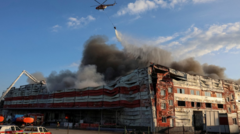
So, a successful interception looks like a localized apocalypse on the ground. It is a rain of white-hot metal that punches through the roofs of parked Kias, ignites apartment balconies, and shears the limbs off ancient oak trees in public parks. To the family shivering in a subway station, the distinction between a direct hit and a successful interception feels entirely academic when the shockwave blows the dust of a century out of the tunnel ventilation shafts.
The Geography of the Shattered Glass
If you walk through any Ukrainian city the morning after a major raid, the dominant sound is not weeping. It is sweeping.
The broom on asphalt has become the rhythmic background track of urban survival. Shhhk. Shhhk. Shhhk. Green glass from broken Heineken bottles at a sidewalk cafe blends with the heavy, laminated shards of storefront windows and the delicate, transparent splinters from someone’s living room.
The targets of these strikes are ostensibly strategic. Official communiqués from the attacking side speak of military infrastructure, energy grids, and decision-making centers. But a five-ton missile possesses a terrible indifference.
When a detonation occurs in a dense urban grid, the blast wave behaves like water forced through a narrow pipe. It surges down alleys. It bounces off brick facades. It searches for weakness, and it invariably finds it in the glass that allows humans to look out at their world.
In the historic center of the city, an elderly man named Mykhailo—a hypothetical composite of three different men currently sweeping the sidewalk on any given morning—stands outside his bookstore. His hands are bare despite the chill. He is sorting through wet cardboard. A missile struck an electrical substation three blocks away, but the atmospheric pressure wave chose his storefront to vent its anger.
His inventory is ruined, soaked by the water from ruptured overhead pipes. He holds up a translation of Hemingway, its pages swollen like a dead sponge. He does not look angry. He looks profoundly, unspeakably tired.
This is the hidden cost of the conflict that rarely makes the graphics on the evening news. It is the slow, grinding erosion of predictability. It is the knowledge that everything you build, everything you arrange nicely on a shelf, is held on a lease that can be canceled by a crew launching a weapon from a Caspian Sea bomber thousands of miles away.
The Underground Normal
Human beings are terrifyingly adaptable. It is our greatest strength and our most unsettling flaw.
Beneath the streets, the metro stations have transformed from transportation hubs into subterranean villages. The transition happens with a practiced, eerie smoothness. When the sirens wail, people do not stampede. They walk with a heavy, purposeful cadence down the long escalators.
They bring yoga mats. They bring thermoses of sweet tea. They bring dogs that have learned, through some strange canine intuition, not to bark at the thunder above.
In the deep belly of the station, life mimics the surface. College students sit on the granite steps, the glow of their laptops illuminating faces concentrated on macroeconomics assignments. Nearby, a woman applies mascara using her phone camera as a mirror. She is going to be late for work, but she still intends to look professional when she arrives.
This is not defiance in the cinematic sense. There are no flags being waved, no grand speeches being delivered from atop benches. It is something much more stubborn: the refusal to let terror disrupt the mundane.
But beneath that performative normalcy lies a deep, systemic exhaustion. The human nervous system was not designed to simmer in adrenaline for years on end. Doctors in the region talk about a quiet epidemic of cardiovascular issues, of hair turning gray in a matter of months among people in their twenties, of children who no longer flinch at explosions but have stopped speaking entirely.
The true damage of a ballistic missile attack cannot be measured solely by the craters it leaves in the asphalt or the megawatts deducted from the power grid. It must be measured in the collective psychological tax levied against millions of people who are forced to contemplate their own sudden deletion while choosing fresh produce at the market.
The sirens eventually fall silent. The all-clear signal is a steady, monotone whistle that sounds like a sigh of relief from the city itself.
People emerge from the concrete belly of the earth, blinking into the midday light. The air smells of ozone, damp plaster, and the sweet, resinous smoke of burning poplar trees. They look up, checking the sky out of habit, before adjusting their bags and stepping over the piles of swept glass to find out if their offices still have electricity.
Back in the apartment, the washing machine has finished its cycle. The coffee maker is cold. On the kitchen table, a half-eaten piece of toast sits next to a puddle of spilled milk, left behind in the ten-minute scramble between peace and the parabolic arc of a missile.