The Empty Playground
The evening air in Thimphu tastes of pine needles and woodsmoke. If you stand near the edge of the Changlimithang Stadium when the sun dips below the ridges, you can hear the wind whipping through the prayer flags. It is a beautiful, crisp sound.
But it is also entirely too quiet. For an alternative look, check out: this related article.
A decade ago, this same hour was punctuated by the chaotic symphony of children shouting, chasing soccer balls, and scraping their knees on the dirt. Today, the streets of the capital feel spacious. Clean. And hauntingly empty.
Bhutan, a kingdom famous for measuring Gross National Happiness instead of Gross Domestic Product, is facing a crisis that cannot be solved by spiritual mindfulness alone. The country is running out of people. Further reporting on the subject has been shared by Al Jazeera.
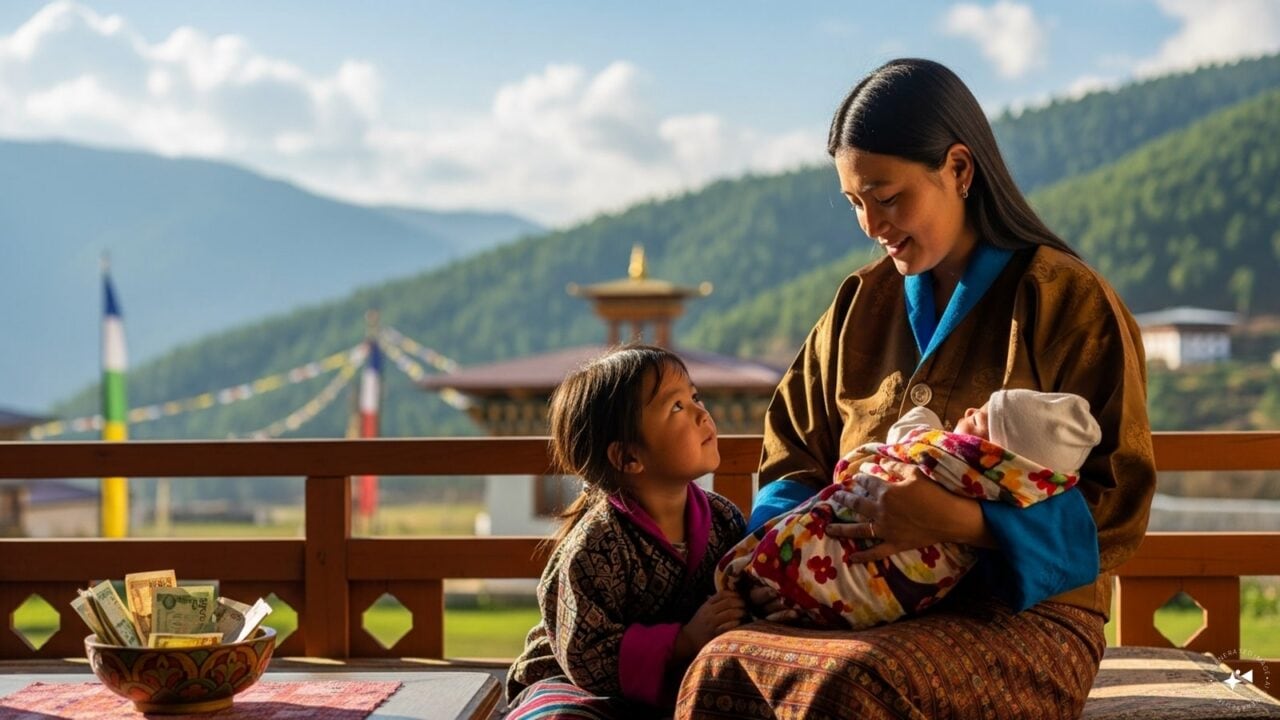
To understand the weight of this, consider a hypothetical family in the valley of Paro. Let us call the mother Pema and the father Dorji. They are educated, working in the growing tourism and service sectors, and they have exactly one child. Pema’s grandmother had eight siblings. Her mother had four. Pema looks at her lone son and worries about who will help him tend the family land, who will carry on the local rituals, and who will support her when her joints grow stiff from the mountain winters.
Pema and Dorji are not anomalies. They are the new normal. The kingdom's fertility rate has plummeted well below the replacement level of 2.1 births per woman. Bhutan is graying faster than almost anyone anticipated, and the government has realized that a nation without youth is a nation without a future.
The response? A direct, unprecedented financial intervention. The government is preparing to pay families cold, hard cash to have more babies.
The Economics of a Cradle
It sounds cynical at first. Can you truly put a price tag on a child’s smile, or the continuation of a lineage?
The policy builders in Thimphu argue that they are not buying babies; they are leveling the playing field. The cost of raising a child in modern Bhutan has skyrocketed. Decades ago, a child was an asset to a farming family, an extra pair of hands to harvest red rice and herd cattle. Today, as Bhutan transitions into a modernized, urban society, a child represents tuition fees, expensive apartment rentals in crowded cities, and skyrocketing grocery bills.
The proposed cash incentive program is a direct acknowledgment of this economic friction. While the exact tier systems and monthly disbursements are being finalized, the strategy focuses on providing substantial financial support to mothers for their second and subsequent children. The goal is simple: remove the immediate financial terror of expanding a family.
But cash injections face a steep uphill battle against deeply ingrained social shifts.
When you look at countries like South Korea or Japan, billions of dollars have been poured into baby bonuses and subsidized childcare. The result? Barely a nudge in the birth graphs. Once a society decides that smaller families equal a higher quality of life, turning that ship around is like trying to stop a Himalayan landslide with an umbrella.
Bhutan is betting that its deep sense of community and cultural preservation will make its citizens respond differently. The kingdom has always walked a tightrope between the ancient and the modern. This policy is just the latest, most urgent attempt to keep its balance.
The Invisible Exodus
The dwindling birth rate is only one half of the vise gripping the nation. The other half is an unprecedented wave of migration.
Step into any trendy cafe in Thimphu and ask the young barista about their five-year plan. The answer is rarely about staying in the mountains. It is almost always about Australia.
Perth has become an accidental second capital for young Bhutanese. Driven by a lack of high-paying jobs, limited economic diversification, and the glittering promise of foreign wages, thousands of the country’s brightest minds, nurses, teachers, and entrepreneurs are packing their bags and boarding flights out of Paro international airport.
This creates a brutal compound effect. The young people who are at the prime age to start families are leaving the country entirely. The ones who stay are often too stressed about their own economic survival to consider having two, three, or four children.
Imagine a traditional Bhutanese farmhouse. It is built to last centuries, with thick rammed-earth walls and intricately painted wooden windows. Now, imagine that house with only two elderly grandparents sitting by the bukhari wood stove. The fields outside are fallow because there is no one left to plow them. The local monastery has fewer young monks to learn the sacred dances. This is the existential threat that keeps Bhutan’s leaders awake at night. The cash incentive is not just an economic policy; it is an act of cultural self-defense.
The Vulnerability of a Tiny Giant
It is easy to look at Bhutan through a romantic lens. Western travelers often view it as a real-world Shangri-La, a place untouched by the harsh realities of the globalized world.
The reality is much more fragile.
Bhutan is wedged between two geopolitical titans, India and China. Its sovereignty and distinct identity depend entirely on the strength, resilience, and sheer presence of its population. A emptying landscape creates a vacuum. A dwindling workforce means a reliance on foreign labor to build roads, hydro-plants, and infrastructure, which changes the social fabric of the country.
There is an inherent vulnerability in admitting that your population is shrinking. It requires a government to look in the mirror and acknowledge that despite high happiness indices, the practical day-to-day survival of its citizens is becoming too difficult to sustain large families.
The cash incentives are a gamble. Critics point out that money alone cannot fix the underlying structural issues. If there are no diverse, high-paying jobs for these children once they grow up, the government is simply subsidizing the next generation of emigrants to Australia. The baby bonus must be paired with massive economic reforms, a revitalization of the private sector, and a reimagining of what a modern Bhutanese career looks like.
The First Cry
The success of this monetary experiment will not be measured in quarterly economic reports or GDP growth charts. It will be measured in the maternity wards of the national referral hospital in Thimphu.
It will be measured by women like Pema sitting down with their partners, looking at their bank accounts, and feeling a sense of relief rather than dread. It will be validated when the anxieties of modern inflation are softened by the knowledge that their country is actively backing their choice to bring new life into the world.
Change in the mountains happens slowly, until it happens all at once. The coming years will reveal whether a government check can rekindle the warmth of a crowded family hearth.
For now, the country waits. The prayer flags continue to spin in the wind, sending silent blessings over valleys that desperately need to hear the chaotic, messy, beautiful sound of children crying out in the dark.



:max_bytes(150000):strip_icc()/how-many-types-of-dwarfism-are-there-2860725-v1-8dae2c531b4b47d9ae36ae404d3308a0.png)