The air in the West Bank hills rarely settles. It vibrates with an ancient tension, carrying the scent of dry earth, wild thyme, and, too often, the metallic tang of smoke. For generations, families have olive-pressed their way through the seasons here, watching the same sun rise over terraced slopes that have absorbed the footprints of empires, prophets, and endless generations of farmers.
Yet, when Mike Huckabee—a figure more commonly associated with the evangelical pulpit and American political pulpits than the convoluted geopolitics of the Jordan Valley—stepped up to a microphone at a town hall meeting to address what he termed terrorist attacks by settlers against Palestinians, the room did not just listen. It held its breath.
Language matters, especially in a landscape where words are frequently weaponized. When an American conservative voice, historically aligned with the most unyielding factions of the Israeli political right, uses the word "terrorist" to describe acts committed against Palestinian villagers by radical elements within the settler movement, it acts as a cultural earthquake. It fractures the neat, comfortable boxes that cable news networks and partisan commentators build for their audiences.
Consider the anatomy of a Tuesday afternoon in a small West Bank agricultural hamlet. The sun beats down on corrugated tin roofs. An old man named Ibrahim sits beneath a gnarled olive tree, his hands calloused from decades of nursing stubborn soil into yielding fruit. To him, the news is not a abstract debate broadcast on satellite television. It is the sound of shattering glass at midnight. It is the sight of scorched groves where trees planted by his grandfather now stand as black, skeletal remains.
For years, the narrative presented to the outside world has been binary. You are either entirely for one side or entirely for the other. Nuance is treated as betrayal. Sympathy for a displaced farmer is interpreted as hostility toward an entire nation. But human suffering defies political geometry. It bleeds across ideological lines.
When Huckabee stood before that gathering, the weight of his own political history hung in the air. He had spent decades defending the expansion of settlements, walking the ancient paths of Judea and Samaria with a Bible in one hand and a map in the other, viewing the land through a lens of profound theological and historical restoration. To hear someone with that precise pedigree look out and explicitly condemn extremist violence against Palestinian neighbors is jarring. It forces a reckoning. It suggests that the ground beneath our feet is shifting, even if the politicians are the last to admit it.
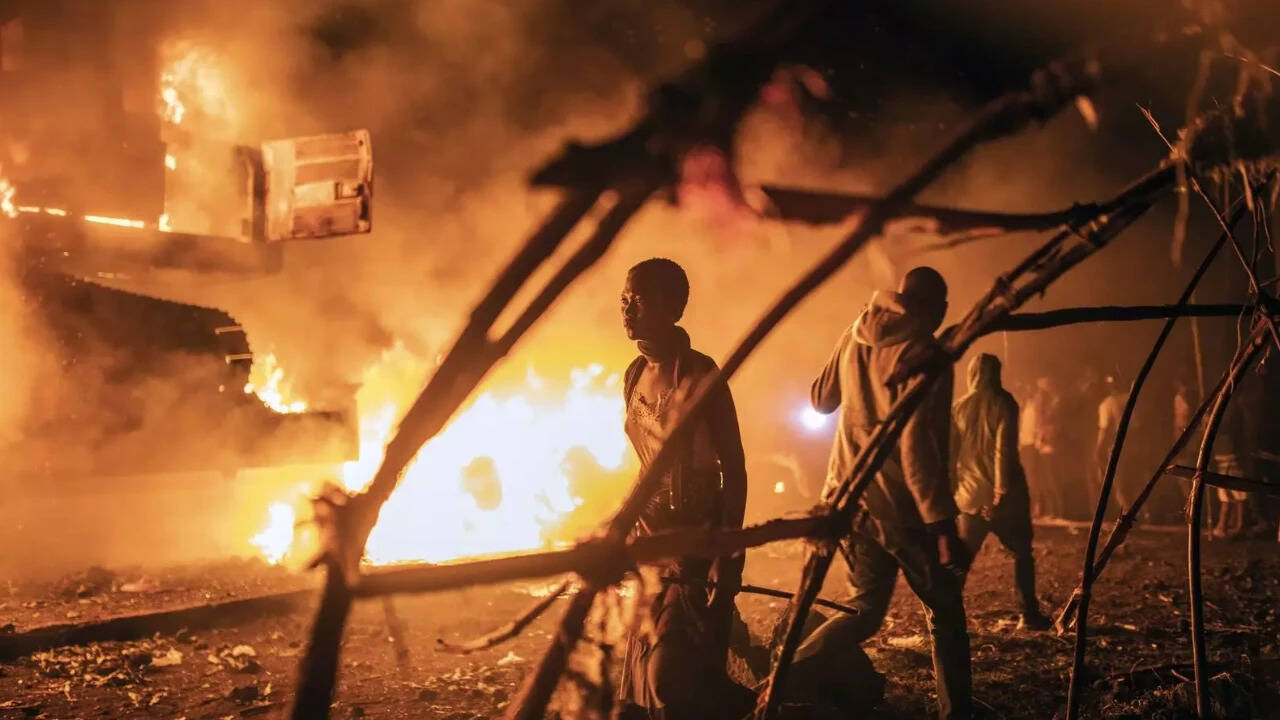
Violence in the West Bank has a distinct architecture. It rarely arrives in the form of sweeping, cinematic battles. Instead, it creeps in through intimidation, through midnight arson attacks on agricultural vehicles, through stones thrown at school buses, and through the quiet, systematic pressure designed to make daily life unbearable for families who have farmed these hills for centuries. It is designed to induce exhaustion. It wears down the spirit until survival feels like an exhausting daily negotiation.
When acts of terror—and there is no other honest word for violence committed against civilians to instill fear and coerce communities—are carried out by extremists operating under the ideological cover of a nationalist movement, a profound moral crisis emerges for that movement. This was the unspoken core of Huckabee’s intervention. One cannot champion the security and historical roots of a people while simultaneously ignoring or excusing the radical fringe that behaves with impunity in the shadows.
History teaches us a harsh lesson about silence. When communities look away from the extremists within their own ranks, they do not neutralize them; they empower them. The cancer spreads from the margins to the center until the entire body politic is consumed by suspicion and vengeance.
Ibrahim does not care about American political polling numbers. He does not care about the shifting alliances in Washington or the diplomatic gymnastics of the United Nations. He cares about whether his grandchildren can walk down the dirt path to school without being pelted with stones. He cares about whether the olives he harvested this autumn will make it to the press, or whether the orchard will be reduced to ash while local authorities look the other way.
The town hall meeting where these words were spoken will likely fade from the daily news cycle, buried beneath the relentless avalanche of modern media. But the echo remains. It proves that the human heart, even when encased in rigid ideology, occasionally breaks open when confronted with undeniable cruelty.
We live in an era that demands absolute tribal loyalty. We are told to pick our team, defend every action of our allies, and demonize every breath of our opponents. But the reality on the ground in the West Bank defies such lazy categorization. It is messy, bloody, and heartbreakingly human.
Until we find the courage to name injustice, regardless of who is holding the match or throwing the stone, the hills will continue to echo with sorrow. And the trees, older than any flag or border, will continue to bear witness to a tragedy we have the power to stop, if only we dared to look honestly at what is happening in our name.