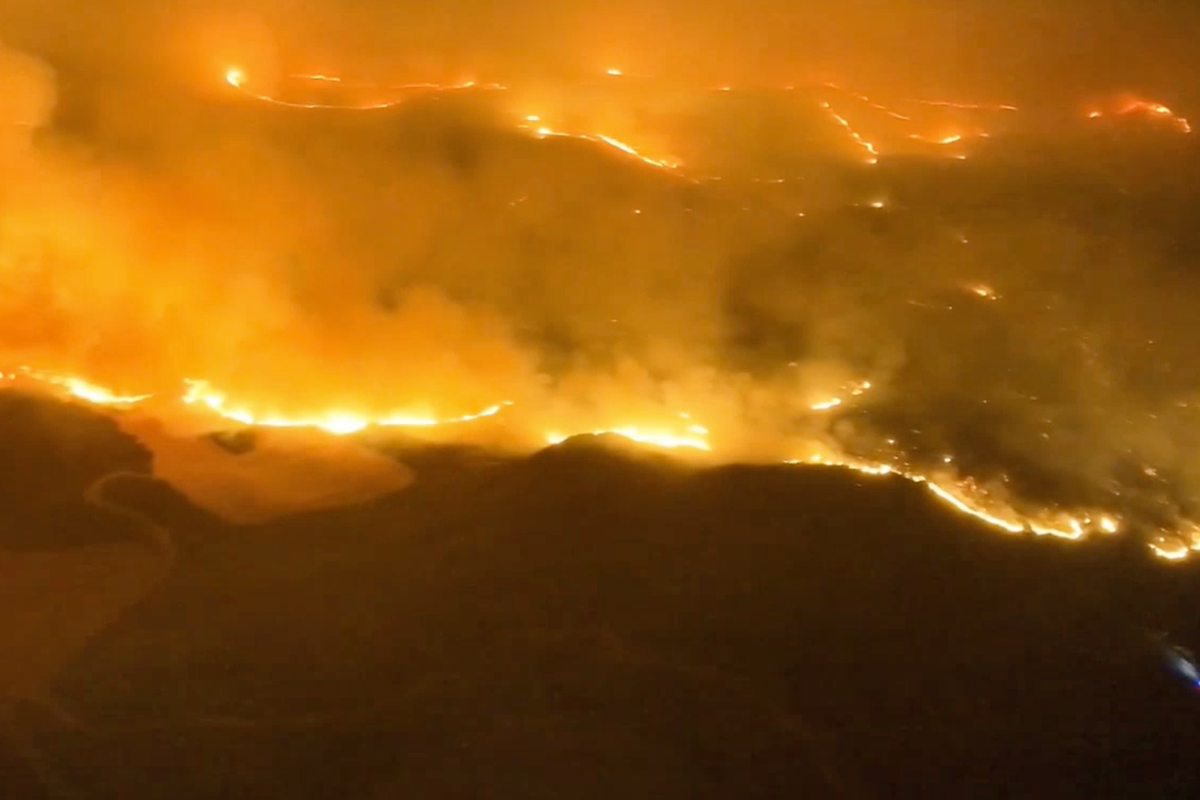
The mainstream media loves a good crisis narrative. When 15,800 hectares of scrub and forest go up in smoke in northern Spain, the coverage follows a predictable, lazy script. You get dramatic footage of water bombers, grim-faced local politicians promising recovery funds, and a collective weeping over "ecological catastrophe."
The underlying premise of every single report is the same: fire is the enemy, absolute suppression is the goal, and a black landscape is a failed landscape.
It is a comforting, emotionally satisfying narrative. It is also completely wrong.
By treating every wildfire as a tragedy to be eliminated, we are actively engineering the mega-fires of tomorrow. The 15,800-hectare blaze in northern Spain isn't proof that nature is broken. It is proof that our approach to land management is broken. We have spent decades suffocating the landscape's natural release valves, and now we are surprised when the boiler explodes.
The Toxic Myth of Total Suppression
For over half a century, southern Europe has operated under a zero-tolerance policy for smoke. The moment a flame appears on a hillside, an army of trucks and aircraft rushes to snuff it out.
On paper, this looks like a victory for conservation. In reality, it is ecological debt.
Mediterranean ecosystems are born to burn. Species like the Pyrenean oak and various native shrubs evolved alongside fire. When you aggressively suppress every minor ignition, you do not eliminate fire; you merely delay it. Meanwhile, the undergrowth thickens. Dead biomass accumulates. The fuel load builds year after year, transforming the countryside into a massive, contiguous tinderbox.
When a fire finally escapes initial containment during a hot, dry summer, it doesn't just crawl along the ground clearing out brush. It explodes into a high-intensity canopy fire that sterilizes the soil, kills mature trees that would normally survive low-level burns, and threatens entire villages.
I have watched forestry departments pour millions of euros into advanced firefighting technology—smarter drones, bigger planes, predictive AI modeling. It is a classic case of throwing high-tech band-aids at a structural hemorrhage. You cannot out-tech a landscape that has been artificially choked with fuel for forty years.
The Depopulation Paradox
To truly understand why northern Spain is burning, you have to look at economics, not just meteorology. The media points to rising temperatures as the sole culprit because it absolves local policy of blame. Climate change is a massive exacerbating factor, but it is acting on a canvas we prepared.
The real driver is the phenomenon known as España Vaciada—the emptied Spain.
For centuries, rural landscapes were mosaic patterns. You had a patch of pine forest, followed by a cleared pasture, followed by an olive grove, followed by a small village grazing its goats. This patchwork created natural firebreaks. If a fire started in the scrub, it hit a grazed, cleared field and ran out of steam.
Over the past six decades, rural flight has abandoned millions of hectares of agricultural land. Without livestock to graze the grass and without villagers to harvest firewood, nature reclaimed the land in the worst way possible. Continuous, dense brushwood now stretches unbroken for hundreds of kilometers.
When people ask, "How do we stop these massive fires?" they are asking the wrong question. You do not stop them at the flame stage. You stop them decades earlier at the landscape stage.
Stop Replanting the Wrong Trees
The standard political response to a fire is to promise immediate reforestation. It looks great for photo opportunities. Politicians plant saplings in the ashes, signaling rebirth and resilience.
This is often the worst thing you can do.
Frequently, these areas are replanted with highly flammable monocultures, such as fast-growing pine or eucalyptus, chosen for economic return or quick green coverage rather than ecological resilience. Even when native species are used, they are often planted too densely, recreating the exact same fuel continuity that caused the disaster in the first place.
Instead of fighting to keep the landscape frozen in a pristine, artificial state, we need to embrace Pyrodiversity. This means accepting that a healthy ecosystem requires a mix of recently burned patches, recovering scrub, and mature forest.
The Unpopular Solution: Start More Fires
If we want to stop 15,800-hectare disasters, we have to start setting fires on purpose.
Prescribed burning—introducing low-intensity, controlled fire during the damp winter months—is the only proven way to reduce the fuel load at scale. Mechanical thinning with chainsaws and tractors is too slow, too expensive, and logistically impossible across rugged Spanish mountain ranges.
The obstacles to this are entirely political and cultural, not ecological.
- Public perception: The public has been conditioned to see smoke as a sign of failure. A politician who authorizes a controlled burn that blankets a valley in haze faces immediate backlash.
- Liability: If a prescribed burn escapes containment—which happens in a tiny fraction of cases—the career of the official who signed off on it is over. If a massive wildfire breaks out naturally, nobody blames the forestry director; they blame the weather.
This warped incentive structure ensures that we choose the certainty of future catastrophic mega-fires over the minor inconvenience of current controlled burns.
We need to incentivize rural land management that brings herbivores back to the hills. We need to fund goat and sheep herders to maintain strategic firebreaks around infrastructure. We need to legalize and streamline the process for rural landowners to conduct small-scale debris burning.
The downside to this contrarian approach is obvious: it requires accepting smoke as a permanent feature of the rural landscape. It means acknowledging that some summers will be hazy, and some vistas will look charred for a few seasons. It requires moving away from the fantasy of an untouched, emerald-green wilderness that never existed in the Mediterranean to begin with.
The next time you see a headline mourning thousands of hectares lost to fire in Spain, stop viewing it as an isolated act of God or a sudden climate anomaly. View it for what it actually is: the inevitable collection notice for decades of ecological mismanagement.
We can either manage fire on our own terms during the winter, or let it manage us during the summer. There is no third option.