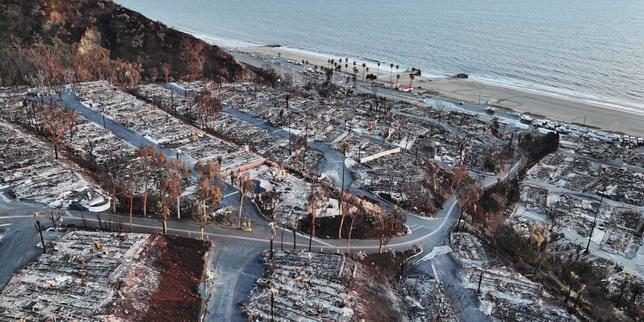
Ash does not fall like snow.
If you have never stood on a suburban driveway in Southern California while a Santa Ana wind screams down from the canyons, you might imagine wildfire ash as soft, pale, and silent, drifting downward with the gentle grace of a winter squall. It isn't. It stings. It arrives in jagged, black flakes the size of quarters, hot enough to blister bare skin, smelling not of a cozy campfire but of melted vinyl, burning tires, vaporized insulation, and forty years of someone else’s family photographs turning into carbon. Learn more on a related issue: this related article.
In Los Angeles, everyone knows the smell of October and January. We keep go-bags in the trunks of our cars, packed with birth certificates, spare dog leashes, and hard drives. We check wind gusts the way sailors check barometers. We accept, as the silent tax paid for living between the desert and the sea, that the brush will eventually burn. Lightning strikes. Power lines sag and spark against dry chaparral. Nature has its own brutal, cyclical appetite.
What breaks the human spirit—what turns a natural disaster into an existential wound—is learning that the match was struck on purpose. Additional reporting by NBC News explores related views on this issue.
Recently, inside a quiet, fluorescent-lit courtroom in Los Angeles, a jury finally delivered a guilty verdict against a suspect accused of igniting devastating blazes across the region. It took two trials to get there. Two exhausting, agonizingly slow turns of the legal wheel before twelve citizens looked at the evidence, looked at the accused, and agreed on criminal accountability.
On paper, that is a neat ending. A headline. A closed docket. Suspect convicted after retrial. You read it over morning coffee, nod once, and scroll to the weather forecast.
Wait. Stop scrolling. Look closer at what happened between the first spark and that final gavel, because the real story of the Los Angeles arson trials is not about a courtroom victory—it is about the agonizing fragility of justice when the evidence itself burns to nothing.
The Architecture of a Mistrial
To understand why it took two trials to convict an arsonist in a city haunted by fire, you have to understand what fire does to the truth.
In almost every other violent crime, the scene preserves the story. A bullet leaves striations; a knife leaves a wound pattern; a shattered window leaves glass on the floor indicating which way the force traveled. Investigators walk into a room frozen in time and work backward.
Arson is the only crime that actively eats its own evidence.
Picture a hypothetical forensic investigator—let us call her Elena—kneeling in the gray silt of a hillside ravine three days after the flames have been knocked down. The heat at the point of origin reached upwards of fifteen hundred degrees Fahrenheit. Whatever accelerant might have been poured onto the dry mustard grass evaporated in milliseconds. Any plastic container melted into an unrecognizable puddle of slag. Footprint impressions were baked into dust and then blown away by the very winds that carried the embers into the neighborhoods below.
Elena is looking for a V-pattern on a charred hillside, trying to read the direction of heat travel from the angle at which a scrub oak burned. She is sifting through tons of black powder for a single brass hinge from a lighter or a drop of residual hydrocarbons trapped beneath a heavy stone.
Now, take that fragile, microscopic trail of breadcrumbs and carry it into a criminal courtroom where the standard of proof is beyond a reasonable doubt.
In the first trial, the prosecution had to build a bridge out of smoke. Defense attorneys, doing their constitutional duty, attacked every plank. They pointed out that Southern California brush is a tinderbox waiting for a stray cigarette butt, a catalytic converter parked over tall weeds, or a faulty transformer. When a jury hears "reasonable doubt" in an arson case, they aren't being stubborn or naive. They are confronting a terrifying epistemic gap: how do you prove a human hand set a fire when the fire itself erased the handprint?
The first jury deadlocked. A mistrial was declared.
For the prosecutors, a mistrial means starting over from zero—re-subpoenaing witnesses, re-testing soil samples, re-arguing motions. For the families who lost their homes, however, a mistrial feels like watching your house burn down a second time in slow motion.
The Invisible Ledger of Loss
We measure wildfires in tidy, staggering metrics. Acres scorched. Structures destroyed. Millions of dollars in suppression costs.
Those numbers are useless for measuring grief.
Consider a hypothetical resident—call him Marcus—who lived three canyons away from the initial ignition point. On the night the fire broke out, Marcus had eleven minutes between the shriek of the emergency alert on his phone and the wall of orange light cresting the ridge behind his backyard. Eleven minutes to decide what forty-two years of living looks like when compressed into the backseat of a sedan.
He grabbed his daughter’s asthma inhaler, his late father’s wristwatch, and the family cat. He left behind his wedding album, his grandmother’s cast-iron skillet, his tax records, and the pencil marks on the pantry doorframe tracking how tall his daughter grew each September.
When the flames passed, Marcus didn't just lose property. He lost friction.
Think about the thousand tiny, invisible anchors that keep a human being tethered to sanity: knowing which drawer holds the scissors, knowing the creak of the third stair from the bottom, knowing the exact shade of afternoon light that hits the kitchen wall at four o'clock. Overnight, every mundane action requires exhausting cognitive effort. You stand in the aisle of a pharmacy staring at toothbrushes, paralyzed by the realization that you do not own a cup to put one in.
And then there is the insurance labyrinth. Months of itemizing every fork, every sock, every paperback novel from memory while sleeping on a relative's pull-out couch. Watching contractors quote prices that exceed your policy limits by six figures. Fighting adjusters over the definition of "smoke remediation" while your lungs still rattle every time the wind picks up.
Throughout all of it, Marcus followed the news of the arrest. He watched the first trial end without a verdict. He sat with the bitter, suffocating helplessness of knowing that a human being had deliberately set in motion the chain of events that erased his life—and that the legal system might simply shrug and say, We cannot be sure.
Anatomy of a Second Chance
Why did the second trial succeed where the first one faltered?
In the American legal system, a retrial is never a simple rerun. It is an autopsy of failure. Prosecutors examine every raised eyebrow from the first jury box, every moment where a technical explanation of fire dynamics lost the room, every gap in the timeline that allowed a defense narrative to take root.
Between the first and second trials in Los Angeles, the work shifted from discovery to translation.
Arson prosecution lives or dies on circumstantial convergence. A single thread can be snapped easily; a dozen threads woven together become a rope strong enough to hold a conviction. Prosecutors in retrials rarely rely on a single dramatic smoking gun. Instead, they construct a relentless, suffocating chronology:
- Digital ghosts: Cell tower pings and license plate readers placing a vehicle near the canyon turnout minutes before the first 911 call hit the dispatch board.
- Behavioral anomalies: Surveillance footage from a gas station miles away, capturing a routine purchase—a bottle of water, a lighter, a glance toward the smoke plume rising on the horizon—that looks entirely innocent until laid beside a map of the wind patterns.
- Forensic elimination: Methodically ruling out every natural and accidental cause—checking utility grid logs for power surges, analyzing weather data for dry lightning, inspecting the terrain for discarded glass or mechanical debris—until only human intent remains standing in the ash.
I have sat in courtrooms during complex forensic trials, and the turning point is almost never a cinematic outburst. It is a quiet shift in posture among the jurors. It happens when the technical jargon of meteorology, cell-site location information, and pyrolysis stops sounding like a lecture and starts looking like a photograph. You watch twelve strangers lean forward at the exact same moment, realizing that coincidence has run out of room to hide.
When the foreperson finally read the word guilty in that Los Angeles courtroom, there were no fireworks. Courtrooms are built to absorb emotion, to flatten rage and sorrow into procedural decorum. The defendant sat still. The bailiffs stood by the doors. A clerk stamped a piece of paper.
What a Verdict Cannot Rebuild
We love stories where the gavel falls and order is restored. It satisfies an ancient hunger for symmetry: a crime is committed, a culprit is caught, a punishment is handed down, and the ledger balances.
I wish I could tell you that this conviction heals Los Angeles. It doesn't.
A guilty verdict does not regrow a fifty-year-old coastal live oak. It does not bring back the family photographs turned to gray dust in the bottom of a melted safe, nor does it quiet the sudden spike of adrenaline every resident in the foothills feels when they catch a whiff of woodsmoke on a dry, windy afternoon. The Santa Ana winds will blow again this autumn. The chaparral will dry out under the relentless California sun. Another spark—whether born of malice, negligence, or pure bad luck—will eventually find dry grass.
What the second trial accomplished is quieter, harder, and infinitely more fragile than vengeance. It proved that even when an act of destruction is engineered to erase its own origins, patience and rigor can still pull the truth out of the cinders.
Outside the courthouse in downtown Los Angeles, the afternoon sun hits the concrete steps with a blinding, dry glare. Down the street, someone is sweeping dust off a sidewalk with a stiff-bristled broom, pushing gray powder into the gutter, stroke after slow stroke, clearing the ground so the city can keep walking.

