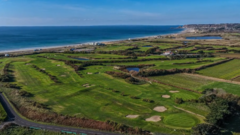
The morning mist off the River Wey doesn't care about property lines. It drifts across the manicured edges of the old fairways, blurring the boundary between what is owned and what is simply lived in. For decades, the local golf course was a backdrop to hundreds of lives in Farnham—a place where people chased small white balls, yes, but more importantly, a place where the town could breathe. It was a vast pocket of green in a county increasingly choked by concrete and commuters.
Then the gates closed. The private owners walked away, and the silence that followed wasn't the peaceful kind. It was the heavy, anxious quiet that precedes a bulldozer. Meanwhile, you can find other stories here: Operationalizing MAHASAGAR: The Strategic Mechanics of India-Indonesia Maritime Integration.
When a piece of land like this goes dark, a predictable script usually unfolds. Speculators arrive. Blueprints are drawn up in distant boardrooms. High-density housing developments are given glossy marketing names like "Oak View" or "Meadow Croft"—names that almost always mourn the very things they destroyed to build them. The residents watch as their childhood playgrounds are carved into profitable squares. They feel powerless.
But something different is happening in Farnham. To see the complete picture, check out the excellent article by USA Today.
The town council stepped forward with a proposition that sounds almost radical in modern Britain. Instead of letting the land fall to the highest bidder, they want the public to buy it. They want to turn a private playground into a permanent, public asset. It is a decision that forces us to confront a fundamental question about how we live today: What is the true value of a town’s open space?
The Invisible Stakes of the Commons
To understand why this matters, you have to look past the financial spreadsheets. Consider a hypothetical resident—let’s call her Margaret. Margaret has lived down the road from the course for thirty years. She never played a round of golf in her life. She doesn't know a birdie from a bogey. But her kitchen window looks out toward that tree line. For three decades, the seasonal shift of those oaks has been the metronome of her life.
If those trees come down to make way for three hundred homes, Margaret doesn't just lose a view. She loses her connection to the place she calls home. The traffic on her narrow lane doubles. The local doctors' surgery, already buckled under the weight of an expanding population, becomes harder to book. The local school's classrooms grow tighter.
This is the hidden cost of development that developers never seem to calculate. They pay for the brick and the mortar, but the community pays the emotional and infrastructure tax.
The push for public ownership in Farnham isn’t about nostalgia. It is about self-defense. When the town council backed the idea of bringing the site into public hands, they weren't just buying dirt and grass. They were buying control over their own future.
The mechanics of this kind of acquisition are notoriously difficult. Local government budgets are stretched to a breaking point across the country. Every pound spent on purchasing land is a pound that critics argue could be spent on immediate social services. It is a valid concern. It is scary to watch a local authority gamble millions on a long-term vision when short-term needs are screaming for attention.
But look at what happens when towns fail to take these risks.
Walk through almost any suburban hub within an hour of London. You will see the same story repeated with depressing uniformity. Every scrap of scrubland, every redundant allotment, every faded sports field gets swallowed. Once that land is paved over, it is gone forever. No developer has ever voluntarily knocked down a block of flats to build a park. The decision made today is irreversible. A thousand years of green can vanish in a single summer of construction.
The Financial Illusion of Development
There is a common argument that building more homes is always a net positive for a local economy. New people mean more money spent in local shops, more council tax collected, more economic energy.
But this economic theory often breaks down when applied to historic market towns. Farnham's charm—the very reason people want to move there—lies in its historic scale, its relationship with the surrounding Surrey hills, and its balance of urban and rural life. If you crush the balance, you destroy the value.
Think of a town like an ancient ship. It can carry a heavy load, but if you keep piling cargo onto the deck without reinforcing the hull, eventually it sinks. The infrastructure of many historic towns was never designed for the density of twentieth-century, let alone twenty-first-century, development. The roads are narrow. The drainage systems are old.
By backing public ownership, the council is essentially arguing that the most financially responsible thing to do with the golf course is to do nothing to it at all. Or rather, to let nature do what it does best.
Imagine the alternative. If the site is left to the private market, the town enters a multi-year war of attrition. Developers will submit plans. The council will reject them. The developers will appeal. Lawyers will make fortunes arguing over planning technicalities in expensive rooms. The community will spend its collective energy fighting a defensive rearguard action, exhausted by the constant threat of losing.
Buying the land stops the war. It provides certainty.
Reclaiming the Meaning of Public Space
We have grown so used to the idea that every square inch of the earth must have a commercial purpose that the concept of public ownership can feel foreign. We are conditioned to ask: What will we do with it? Will it be a nature reserve? A community farm? A new park with a cafe?
Perhaps it will be all of those things. But the true luxury of public ownership is that the town doesn't have to decide right away. The land can just exist. It can be a place where a kid learns to ride a bike without worrying about cars. A place where an old dog can wander off-leash. A place where the only sound is the wind through the rough.
The value of open space is often intangible, which makes it incredibly difficult to defend in a political debate. You can't easily put a price tag on the mental health benefits of a morning walk in the fresh air. You can't quantify the worth of a community coming together to watch the sunset over a ridge.
But anyone who lived through the lockdowns of the early 2020s knows exactly how precious those spaces are. We learned, with brutal clarity, that when you confine people to small indoor spaces, their world shrinks, and their health suffers. The parks and common lands became our collective living rooms. Farnham’s move to secure this site suggests that some leaders haven't forgotten that lesson.
The road ahead for the project is long. Backing an idea in a council chamber is a far cry from raising the funds, navigating the legal minefields, and taking physical possession of the keys. There will be arguments over management, maintenance costs, and access rights.
But the first, most crucial step has been taken. The town has looked at a massive piece of vulnerable land and said: This belongs to us.
On an evening just after the council’s decision, the old golf course sat quiet under a darkening sky. The flags were long gone from the greens. The bunkers were slowly filling with weeds and wild clover. To a speculator, it looked like a blank canvas waiting for profit. To the people who live around it, it looked like home, finally being kept safe from the storm.