The rain myth that left families stranded
Rain isn't always enough to solve a water crisis.
Take Chiloé Island off the southern coast of Chile. The Ancud region gets roughly 87 inches of rain in a normal year. That is a massive amount of precipitation. Yet, for years, families in the small rural community of Catruman spent summers with empty taps.
The issue wasn't total rainfall. It was timing and ground absorption.
Heavy downpours hit during winter months, rushing over hard, degraded ground straight into the ocean. By summer, local streams dried up completely for months at a time. Municipal water tankers had to haul emergency supplies over dirt roads just so people could drink and cook.
Before local leaders stepped in, 64% of households in Catruman relied on emergency tanker trucks during dry months. Over a third of the community depended on those trucks for half the year. Municipal records show people survived on just 2.4 gallons of water a day per person. That tiny allowance had to cover drinking, cooking, livestock, and vegetable plots.
It was an impossible way to live.
People assumed the solution was more trucks or bigger concrete reservoirs. They were wrong. The long-term answer lay in repairing the dirt beneath their feet and bringing back the native vegetation that once stored water like a giant natural sponge.
Why concrete reservoirs fail where healthy ground succeeds
When water running down a hill has nowhere to soak in, it turns into destructive runoff.
In Catruman, decades of deforestation, cattle grazing, and land clearing had stripped away native ground cover. Without roots to anchor the soil and organic matter to absorb moisture, winter rain washed over the hillsides like water on concrete. Dirt eroded. Streams flooded briefly in July and choked out completely by January.
Building a massive concrete reservoir wouldn't fix that basic structural failure. High-tech pumps and artificial dams cost a fortune to run, require electric power, and break down quickly in remote rural areas.
Instead, residents teamed up with researchers from Chile's Institute of Ecology and Biodiversity to look at the entire watershed. They treated the surrounding hillsides as the actual storage vessel.
First, they mapped all 36 microcatchments across Catruman to track how rainwater moved through the topography. They located a primary stream that managed to maintain a trickle even during peak summer heat. Protecting that single water source became the cornerstone of the whole project.
How native trees and simple dirt trenches restore water flows
Restoration didn't require expensive machinery. It took manual labor, smart engineering, and native plants.
Locals worked directly with upstream landowners to set aside land around the water source. They planted over 500 native trees around damaged ground and an old spring. They chose species uniquely adapted to southern Chile:
- Ulmo (Eucryphia cordifolia)
- Coihue (Nothofagus dombeyi)
- Canelo (Drimys winteri)
- Luma (Luma apiculata)
- Arrayán (Luma Chequen)
Native evergreen trees possess deep root networks and thick canopy structures. They shade the ground, lowering surface temperatures and slowing down evaporation during hot months. Leaves drop and decompose, building a deep layer of mulch that traps moisture in the upper soil.
Alongside planting, crews dug shallow infiltration trenches along the natural contours of the slopes.
These trenches act as natural speed bumps for rainwater. Instead of torrential winter rain rushing down the hillside and eroding topsoil, water falls into the shallow channels, sits briefly, and slowly seeps deep underground. That process recharges local aquifers and feeds underground springs that keep surface streams flowing straight through the dry summer.
Designing a system that runs on gravity instead of electricity
Fixing the ground was only half the job. The community still needed a reliable way to route clean water directly into homes without draining the ecosystem dry.
They built a natural, gravity-fed distribution network.
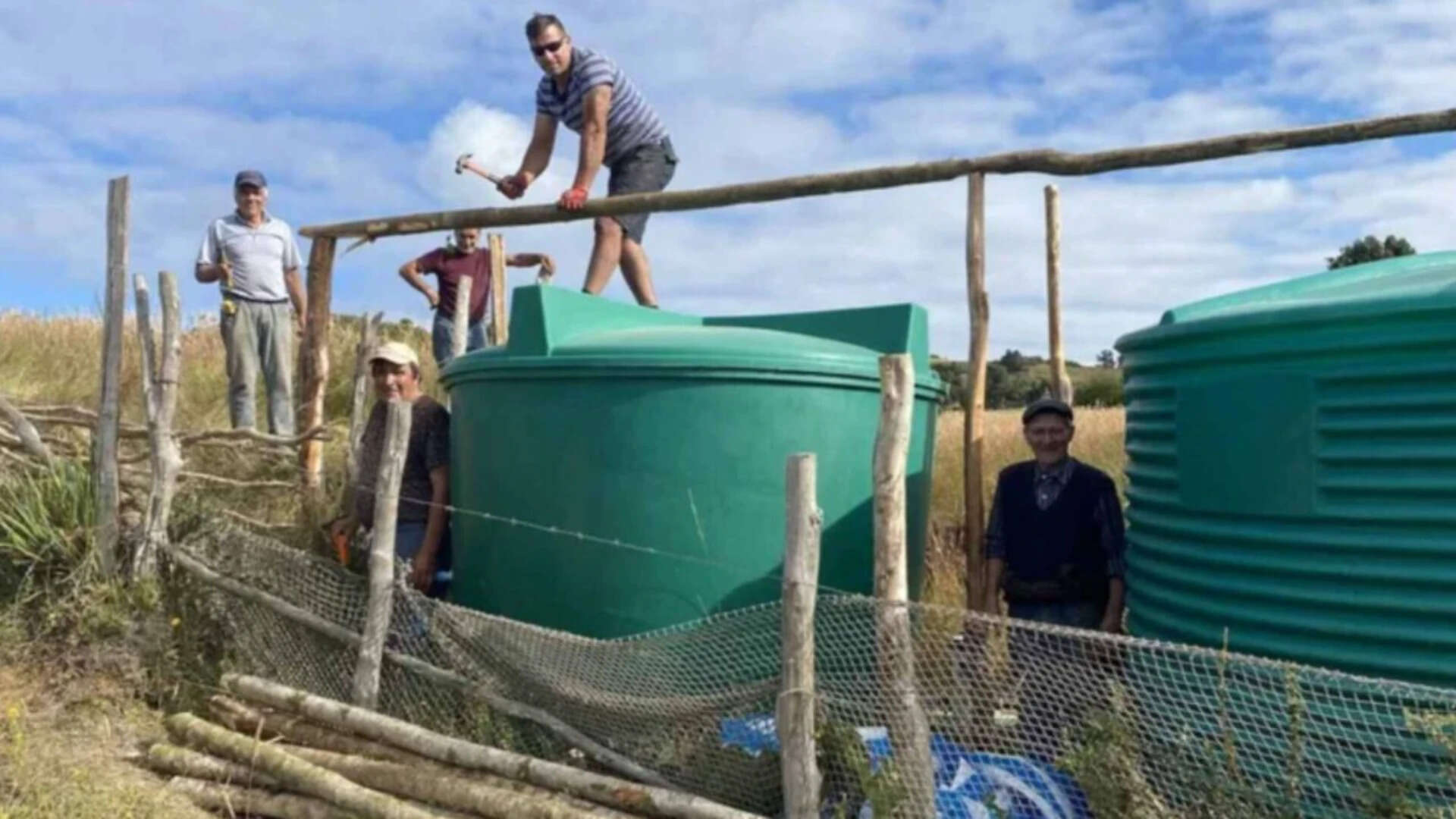
Water enters an intake along the protected stream, passes through simple mechanical filters, and fills a 6,600-gallon storage tank built on high ground. Because the tank sits elevated above the homes, gravity pushes the water through subterranean pipes down into the village.
There are no electric pumps to burn out during power outages. There are no huge fuel bills to keep generators running.
The numbers prove how well nature-based engineering works when done right:
- Daily flow: Even during the driest summer weeks, the restored stream delivers about 6.3 gallons per minute, or 9,100 gallons per day.
- Community demand: The daily requirement for 14 local families and the community center is roughly 2,640 gallons.
- Ecosystem surplus: More than 6,000 gallons remain in the stream bed every day, preserving local wildlife and keeping the surrounding forest hydrated.
Nearly seven years after the system went live, Catruman residents no longer wait for municipal tanker trucks. They manage their own supply.
Lessons for other communities facing severe water stress
The success in Catruman isn't an isolated fluke. Across Chile, from the arid fringes of the Atacama Desert down to the temperate zones of South America, rural populations are reaching the same conclusion: traditional infrastructure cannot fix ecological breakdown.
In the Coquimbo region, mountain communities use fog-harvesting nets and small stone walls called limanes to trap runoff, store water, and reforest desert slopes. In central regions like Colchagua, women-led groups build biofilters to recycle household greywater while building organic soil with compost and native tree cover.
If your community or property is dealing with severe seasonal water shortages, the key takeaways from these successful projects are straightforward:
- Stop focusing only on storage tanks and start looking at the land above your water source.
- Replace shallow-rooted invasive vegetation with deep-rooted native tree species that retain ground moisture.
- Cut simple infiltration contours or swales across sloped ground to slow down surface runoff and encourage deep soil soaking.
- Keep mechanical infrastructure as simple as possible by leveraging natural gravity elevation rather than electric pumps.
Restoring an ecosystem takes time, but waiting for expensive government intervention takes longer. Protecting watersheds at the local level is the fastest way to secure long-term water independence.