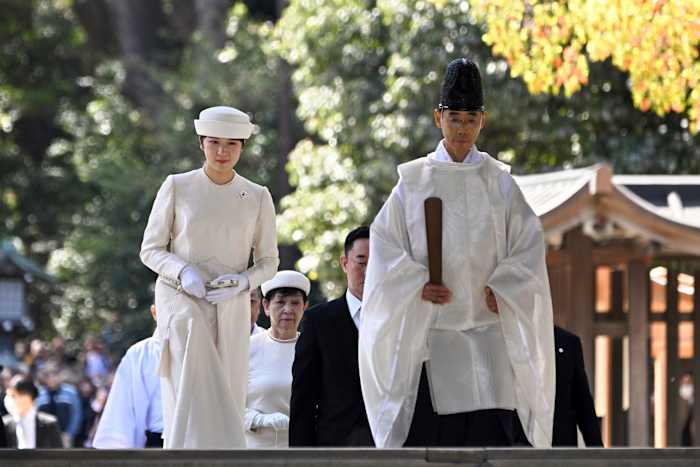
Japan is running out of royals. A stubborn parliamentary decision to preserve male-only succession has locked the world’s oldest continuous hereditary monarchy into a demographic dead end. By refusing to allow women to ascend the Chrysanthemum Throne or retain their royal status after marriage, the government has guaranteed the system's eventual collapse. There are currently only three heirs in the entire line of succession, and only one belongs to the younger generation.
This crisis is not a sudden accident. It is the result of decades of political paralysis, where a conservative ruling class has repeatedly prioritized patriarchal tradition over the mathematical reality of survival.
The Math That Will End a Dynasty
To understand why the Chrysanthemum Throne is crumbling, you have to look at the family tree.
Under the 1947 Imperial House Law, only male descendants in the male line can succeed to the throne. When female royals marry commoners, they are stripped of their royal status, given a one-time dowry, and cast out of the family. This rule has systematically hollowed out the imperial household.
Today, the family is reduced to just a handful of active members. The three remaining heirs are:
- Crown Prince Akishino (60), the Emperor’s brother.
- Prince Hisahito (19), the Emperor’s nephew and the sole male of his generation.
- Prince Hitachi (90), the Emperor’s elderly uncle.
This means the entire future of a 2,000-year-old institution rests on a single teenager, Prince Hisahito. If he does not marry and produce a male heir, the line ends. Relying on a single point of failure is a terrible strategy in engineering, and it is an even worse strategy for a nation's sovereign symbol.
The math is brutal. The pool of royal women who could perform official duties is vanishing. Princess Mako left the family in 2021 after marrying a commoner. Her sister, Princess Kako, and the Emperor’s daughter, Princess Aiko, face the exact same fate if they choose to marry.
How Political Cowardice Blocked Reform
This crisis was entirely preventable.
In the early 2000s, the imperial family had not seen a male birth since 1965. The government, led by Prime Minister Junichiro Koizumi, was on the verge of amending the Imperial House Law to allow female succession. Public support was overwhelming. Over 80% of the Japanese public favored allowing a reigning Empress, which would have put Princess Aiko next in line.
Then, Prince Hisahito was born in 2006.
Conservative politicians sighed with relief and immediately shelved the reform papers. They treated a single male birth as a permanent solution rather than a temporary reprieve. For nearly two decades, consecutive administrations kicked the can down the road, hoping the problem would solve itself.
When parliament finally tackled the issue recently, the resulting proposals avoided the core problem entirely. Instead of addressing female succession, lawmakers floated two convoluted workarounds:
- Allowing female royals to keep their status after marriage, but keeping their husbands and children out of the royal lineage.
- Adopting male descendants from defunct branches of the imperial family that were stripped of their nobility by US occupation forces in 1947.
Both options are deeply flawed. The first creates an awkward, two-tier system within the family where a princess's children are treated as commoners while she remains royal. The second attempts to draft distant cousins, who have lived their entire lives as ordinary citizens, and drop them into a highly restrictive, ritualistic lifestyle they did not choose.
The Myth of Unbroken Male Lineage
Conservatives argue that the "unbroken male line" is the defining characteristic of the Japanese monarchy. They claim that allowing a female sovereign, or an heir from a female line, would destroy the spiritual essence of the throne.
This argument ignores historical reality.
Japan has had eight reigning Empresses throughout its history. While these women often served as caretakers during succession disputes and did not pass the throne to their own children, their existence proves that female rule is not foreign to Japanese tradition.
Furthermore, the obsession with pure male lineage is a relatively modern invention, codified during the Meiji Restoration in the late 19th century as part of an effort to build a highly centralized, militaristic state. Before then, the imperial family used concubines to ensure a steady supply of male heirs. The current emperor is a direct descendant of concubines. Since concubinage is no longer socially acceptable or legal, the traditional mechanism for maintaining a male-only line has been destroyed, yet the rules have not adapted to this reality.
The Human Cost of Royal Duty
Living inside the imperial family is not a fairy tale. It is a highly scrutinized, gilded cage managed by the Imperial Household Agency (IHA), an incredibly conservative bureaucracy that controls every aspect of the royals' daily lives.
The pressure to produce a male heir has caused severe psychological damage to royal women. Empress Masako, a Harvard-educated former diplomat, suffered from a decade-long, stress-induced adjustment disorder brought on by the intense pressure to give birth to a son. Her daughter, Princess Aiko, has lived under the constant shadow of being deemed unfit to rule simply because of her gender. Princess Mako was diagnosed with complex post-traumatic stress disorder (PTSD) before leaving the family, following years of media hounding and public scrutiny over her marriage.
By refusing to reform the succession laws, the state continues to place an immense, unfair burden on Prince Hisahito and his future spouse. Any woman who marries him will immediately face the same crushing pressure to produce a male child that nearly broke Empress Masako.
The Public Disconnect
There is a widening chasm between the Japanese public and the conservative politicians who run the country. Poll after poll shows that the vast majority of Japanese citizens would gladly welcome Princess Aiko as their reigning Empress. She is popular, highly educated, and represents a modern Japan.
Yet, the ruling Liberal Democratic Party (LDP) remains beholden to its ultra-conservative base, which views the male-only line as a non-negotiable pillar of national identity. To these traditionalists, a female-led monarchy is simply unacceptable, even if the alternative is the extinction of the institution itself.
By choosing preservation over adaptation, the traditionalists are achieving the exact opposite of their goal. They are not protecting the monarchy; they are scheduling its demise. Without a radical shift in policy, the Chrysanthemum Throne will eventually become empty, not because of a revolution, but because of a simple lack of heirs.