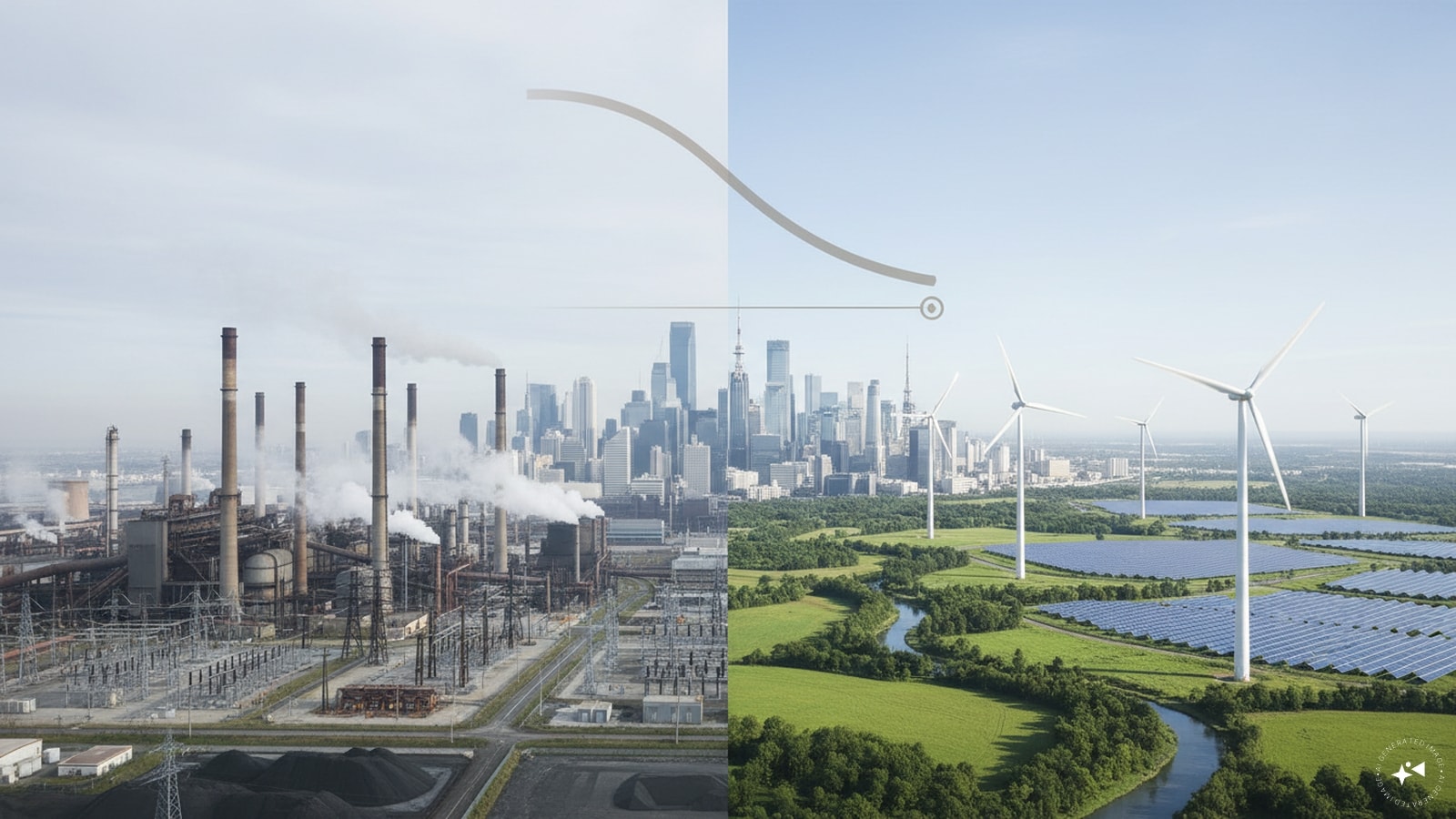
The air in Dhaka during late November tastes faintly of woodsmoke and river silt, carrying a warmth that used to vanish by October.
I sat on a concrete stoop in Savar last week, watching a neighbor repair a corrugated tin roof that had peeled back like a sardine can during a late-season squall that meteorologists insisted shouldn't have happened. Across the street, a radio murmured the afternoon news. A voice with the practiced neutrality of a bank teller announced that the world’s nations, having gathered their brightest minds and sharpest pencils, had updated their promises to save the planet. Expanding on this theme, you can find more in: Stop Falling for the Political Healing Myth in Kibbutz Nir Oz.
Six percent.
That is the number. According to the United Nations, the sum total of every updated national climate pledge on Earth will cut global greenhouse gas emissions by just six percent by the year 2035. Experts at The Guardian have shared their thoughts on this matter.
Listen to the sound of that number. Six percent. It sounds like a polite discount on a bruised apple. It sounds like a rounding error on a corporate tax return. It does not sound like the survival of human civilization, because it isn't. To keep the Earth from crossing the 1.5-degree Celsius threshold—the invisible tripwire beyond which ecosystems begin to unravel in earnest—science demands a cut closer to sixty percent within that same window.
We promised a fire brigade. We delivered a garden hose with a kink in it.
The Arithmetic of a Slow-Motion Wreck
Numbers of this scale have a way of numbing the human brain. Evolution wired us to sprint away from a charging tiger, not to panic over a parts-per-million graph stretching across a decade. When a report states that global emissions are projected to fall by a mere fraction of what is required, our eyes glaze over. We check our phones. We wonder what is for dinner.
To understand what a six percent reduction actually means, strip away the diplomatic jargon and consider a hypothetical family living ten years from now. Let us call them the Kowalskis, though they could just as easily be the Rahman family down the road or your own household.
Imagine Elena Kowalski in the summer of 2035. She is forty-two, a schoolteacher in a mid-sized city that once boasted four distinct seasons. Under a trajectory where global emissions barely budge by six percent, Elena’s reality is dictated by physics that no longer care about municipal budgets. Her electric bill has tripled because the grid strains every afternoon under the weight of air conditioners running at full blast just to keep indoor temperatures survivable. Her grocery cart costs forty percent more than it did a decade prior, not because of supply chain hiccups, but because consecutive droughts in the grain belt and floods in the produce valleys have turned reliable harvests into a gambling addiction.
When Elena turns on the television, she sees coastal cities building walls they cannot afford to maintain, and insurance companies quietly canceling policies across entire zip codes.
This is not science fiction. It is the direct mathematical consequence of the gap between what governments have pledged and what the atmosphere requires. Think of the Earth’s atmosphere like a bathtub with the faucet running at full pressure. Right now, humanity is pouring roughly fifty-seven billion tons of heat-trapping gases into that tub every single year. Scientists have told us, with terrifying unanimity, that the water is lapping at the porcelain rim. If it spills over, the floorboards rot, the ceiling collapses, and the house becomes unlivable.
Cutting emissions by six percent by 2035 does not pull the plug. It does not even turn off the tap. It merely twists the handle a fraction of a millimeter to the left, while the water keeps rising toward the edge.
Why Nations Keep Writing Bad Checks
If the math is so brutally clear, why are the world’s leaders handing us a six percent solution?
The answer lies in a quiet, suffocating trap known as short-term political survival. I have spent years reading climate policy papers, and the pattern never changes. A prime minister or a president looks at the calendar and sees an election in two years, or four. Transitioning an entire economy off coal, oil, and natural gas requires massive upfront investment, angry lobbyists, and temporary friction at the gas pump.
So, leaders do what humans do when faced with a painful dental procedure: they schedule it for next year.
Under the Paris Agreement, countries submit their own homework—documents officially called Nationally Determined Contributions, or NDCs. There are no police officers patrolling the stratosphere to arrest a nation that misses its target. The system runs entirely on peer pressure and public shame. In the early days, optimists believed that once nations saw their neighbors building wind farms and solar arrays, a virtuous race to the top would ignite.
Instead, we got a masterclass in creative accounting.
Consider what happens behind closed doors during international climate summits. Diplomats spend seventy-two sleepless hours arguing over single verbs—debating whether to "phase out" fossil fuels or merely "phase down" them. Meanwhile, back home, those very same governments approve new offshore drilling permits, subsidize coal plants, and clear ancient forests for cattle pasture. They pledge net-zero by 2050, a date conveniently far enough away that every politician signing the paper will be safely retired when the bill comes due.
I will admit, there are days when looking at this ledger fills me with a cold, hollow dread. It is easy to feel powerless when the people holding the levers of global industry treat an existential crisis like a public relations exercise. You start to wonder if human beings are simply wired to consume until the pantry is bare.
The Invisible Line We Are About to Cross
Yet history suggests we are terrible at predicting how fast things break—and how fast they can change.
For decades, climate scientists warned that warming would arrive gradually, like a dial slowly turning up the heat in a room. They were wrong. The climate system behaves less like a dial and more like a light switch, or a canoe tipping over. You can lean a canoe quite far to the left and feel completely safe. You lean it one inch further, and suddenly you are underwater.
In climate science, these thresholds are called tipping points. When global temperatures rise past 1.5 degrees Celsius—a limit we are now hurtling toward with a six percent emissions cut—we risk triggering reactions that feed on themselves.
Think about the Arctic permafrost. For thousands of years, frozen soil across Siberia, Alaska, and Canada has locked away twice as much carbon as currently exists in the entire atmosphere. As the planet warms, that ground thaws. Microbes wake up, digest the ancient organic matter, and belch methane—a gas over eighty times more potent at trapping heat in the short term than carbon dioxide. Once that process accelerates, it does not matter if every factory on Earth shuts down tomorrow; the planet itself begins stoking the furnace.
The same terrifying feedback loop threatens the Amazon rainforest, which is drying out so rapidly that parts of it have already flipped from absorbing carbon to releasing it. It threatens the great ocean currents that regulate European winters and tropical monsoons.
A six percent cut by 2035 is essentially a bet that we can lean the canoe over the edge and somehow stay dry.
The Quiet Revolution Happening Beneath the Headlines
If the story ended with the United Nations report, you would be forgiven for closing this page and pouring yourself a stiff drink. The official numbers are bleak. There is no point pretending otherwise.
But looking only at government pledges is like judging the speed of a train by watching the guy selling tickets at the station. While diplomats drag their feet, an industrial revolution is tearing through the global economy at a pace that has left even seasoned energy analysts stunned.
Walk through the ports of Rotterdam, Shanghai, or Los Angeles today, and you are witnessing the dismantling of the fossil fuel era in real time. Solar power has become the cheapest source of electricity in human history. Not slightly cheaper—dramatically cheaper. In many parts of the world, it now costs less to build a brand-new solar farm from scratch than it does to simply keep buying coal to feed an existing power plant.
Electric vehicles, dismissed a decade ago as expensive golf carts for wealthy eccentricities, now account for roughly one in five cars sold globally, and in markets like China and Norway, they have already conquered the mainstream. Massive grid-scale batteries, the missing link that allows solar and wind power to keep the lights on after sunset, are dropping in price faster than silicon computer chips did in the 1990s.
Here is the paradox that keeps me from surrendering to despair: governments consistently underestimate how fast clean technology scales, which means their official pledges are often hilariously out of date before the ink dries.
Five years ago, international energy agencies predicted that renewable energy would grow at a modest crawl. Every single year since, real-world installations have shattered those forecasts by wide margins. Economics, ruthless and unsentimental, is starting to do what moral pleas could not. Capital is fleeing dirty energy because dirty energy is becoming a bad investment.
What Happens When the Bill Arrives
Still, economics alone will not save us in time. A market transition that takes forty years is a triumph for Wall Street and a tragedy for low-lying nations like Bangladesh, where millions of families live mere feet above a rising sea.
To close the chasm between six percent and sixty percent, the pressure has to come from outside the conference rooms. History proves that politicians rarely lead parades; they wait to see which way the crowd is marching, then sprint to the front and claim they organized it.
We saw this with the ozone layer in the late 1980s. When scientists discovered that industrial chemicals were tearing a hole in the sky, chemical companies insisted that banning them would bankrupt the global economy. Consumers boycotted aerosol sprays. Voters demanded action. Within a few years, world leaders signed the Montreal Protocol, and today, the ozone layer is actively healing.
We are standing at a vastly larger crossroads now, and the stakes are measured in every harvest, every coastline, and every breath our children will take.
Look closely at the next decade. It is not merely a stretch of time on a calendar; it is the narrowest window of consequence our species has ever faced. The decisions made in boardrooms, city halls, and voting booths between now and 2035 will lock in the weather patterns of the next thousand years.
The Heat on the Tin Roof
The sun had dipped below the palm trees by the time my neighbor in Savar finished hammering the last nail into his tin roof. He climbed down the wooden ladder, wiped a streak of sweat and rust across his forearm, and looked up at the bruised purple clouds gathering on the horizon.
"Will it hold?" I asked him.
He squinted at the metal sheets, tapping one lightly with the handle of his hammer. The dull metallic ring echoed down the quiet street.
"For tonight, maybe," he said, offering a tired half-smile. "Until the next storm comes."
That is the reality of a six percent world. It is a patchwork repair on a roof facing a hurricane. We have the blueprints, the materials, and the wealth to build a shelter that can weather anything the sky throws at us—all we lack is the nerve to pick up the hammer before the rain begins to fall.


