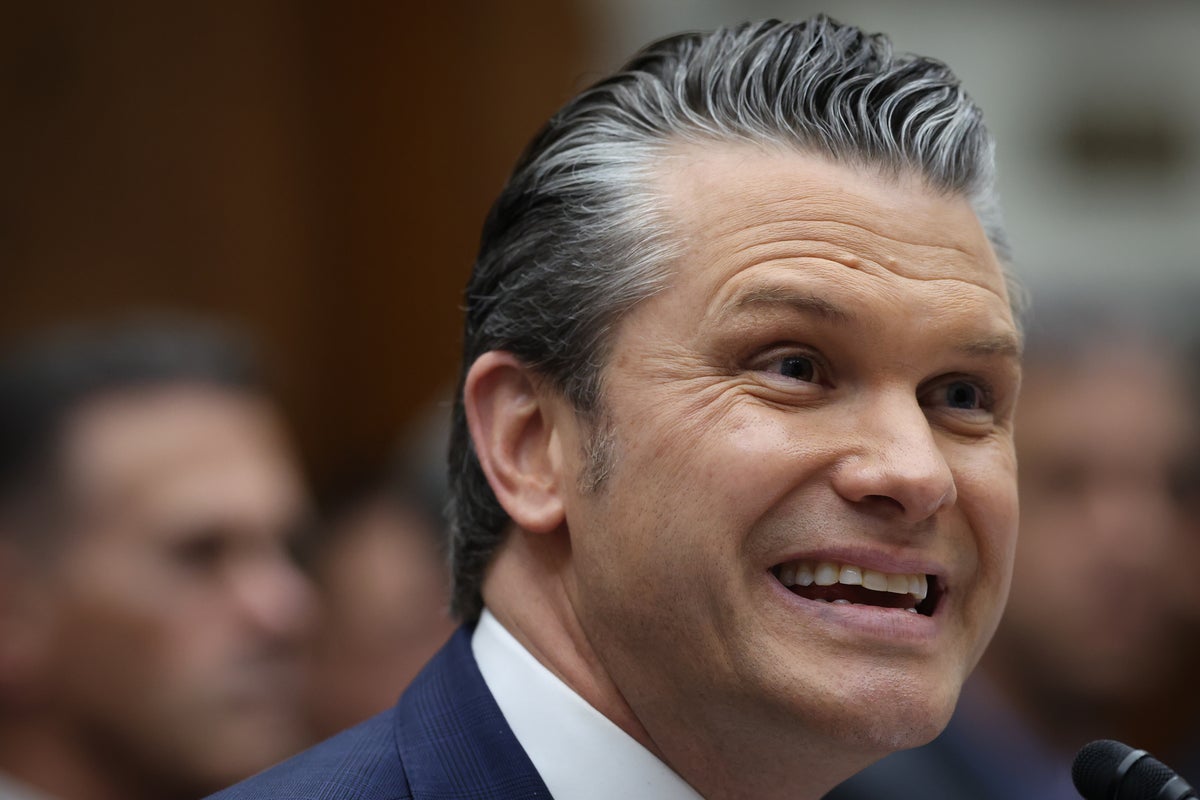
The air in the hearing room felt thick, a physical weight pressing down on everyone present as the clock ticked past the fifth hour. It wasn't just the heat of the television lights or the cramped quarters of the Rayburn Building. It was the gravity of what happens when a single man’s philosophy meets the reality of global explosives. Pete Hegseth sat at the witness table, a posture of rigid composure, facing a semi-circle of lawmakers who looked less like legislators and more like tired detectives trying to crack a high-stakes case.
At the heart of this marathon was a question that has haunted the American psyche since the Cold War. When does a deterrent become a provocation? Learn more on a similar topic: this related article.
For Hegseth, the nominee for Secretary of Defense, the answer seemed etched in a worldview of overwhelming strength. For the committee members across from him, that same answer felt like a map leading directly toward a catastrophic conflict with Iran. This wasn't a policy debate. It was an ideological collision.
The Weight of the Uniform
To understand the tension, you have to look at the shadows cast by the participants. Hegseth isn't a career bureaucrat. He is a combat veteran, a man who has seen the dirt and the blood of the Middle East firsthand. When he speaks about military readiness, he isn't citing a spreadsheet; he is recalling the weight of a ruck and the sound of incoming fire. This lived experience gives him a certain magnetism, a sense of "I’ve been there," which he used as a shield throughout the day. More journalism by The New York Times explores related perspectives on this issue.
But experience is a double-edged sword. To his critics on the panel, Hegseth’s history as a firebrand media personality and a soldier has created a "warfighter" mentality that might be too narrow for the delicate, often agonizingly slow world of international diplomacy.
Consider a hypothetical young lieutenant stationed on a destroyer in the Persian Gulf. This officer wakes up every morning knowing that a single miscalculation—a drone flying too close, a radio warning misinterpreted—could trigger a chain reaction that costs thousands of lives. For that lieutenant, the rhetoric used in a Washington D.C. hearing room isn't abstract. It is the boundary of their reality.
The lawmakers hammered away at this. They weren't just asking about budgets. They were asking if Hegseth understood that once the first missile is fired, the "narrative" ends and the carnage begins.
The Calculus of a Strike
The most grueling exchanges centered on the idea of preemptive action. Hegseth has historically been vocal about the need to neutralize threats before they reach American shores. On paper, it sounds like common sense. In the jagged reality of geopolitics, it is a gamble with the highest possible stakes.
"We cannot lead from a position of doubt," Hegseth argued, or words to that effect, his voice steady even as the questioning turned sharp. He framed the Iranian regime not as a state actor to be managed, but as an existential threat to be checked.
Lawmakers fired back with the ghosts of 2003. They brought up "faulty intelligence" and the long, grinding years of "forever wars" that Hegseth himself had once criticized. The irony was thick enough to choke on. Here was a man who rose to prominence by questioning the status quo of the military establishment, now being grilled by that very establishment on whether he would be the one to start the next Great War.
The room grew quiet when the topic turned to Iran's nuclear capabilities. This is where the math gets terrifying. If the United States moves to strike a facility, the response isn't just a return volley. It is a regional wildfire. Hezbollah in Lebanon, militias in Iraq, and sleeper cells elsewhere all become variables in an equation that no one has truly solved.
Hegseth maintained that "maximum pressure" is the only language Tehran respects. The committee looked at him and saw a man holding a match near a powder keg, convinced that the sheer size of the match would keep the keg from exploding.
The Invisible Stakes
Why does a six-hour hearing matter to someone sitting at a kitchen table in Ohio or a coffee shop in Seattle? Because the decisions made in the wake of this confirmation will dictate the next decade of American life.
War is expensive. Not just in the billions of dollars diverted from schools and infrastructure, but in the moral tax it levies on a nation. We are a country weary of conflict. We are a people who have spent twenty years watching our neighbors return home changed, or not return at all.
Hegseth’s vision for the Pentagon is a radical departure. He wants to strip away what he calls "woke" distractions and return the focus to lethality. But "lethality" is a cold word. It hides the messy, human truth of what happens when you actually use it. It hides the civilian casualties, the displaced families, and the generational resentment that fuels the next cycle of violence.
One congresswoman leaned forward, her glasses perched on the end of her nose, and asked Hegseth point-blank about the threshold for war.
Silence.
In that moment, the entire room seemed to hold its breath. The answer wasn't a number or a specific provocation. It was a philosophy. Hegseth’s response was carefully measured, a blend of constitutional deference and "peace through strength" rhetoric. It was a masterpiece of political maneuvering, yet it left the underlying anxiety of the room completely untouched.
The Fractured Consensus
As the sun began to set outside the Capitol, the hearing took on a surreal quality. The fatigue was visible. Eyes were bloodshot. The questions became more repetitive, the answers more rehearsed. Yet, the divide only grew wider.
There is no longer a consensus on what "defense" actually means.
To the supporters in the room, Hegseth represents a long-overdue return to American dominance. They see a man who won't apologize for being the strongest kid on the block. They see someone who will cut through the red tape of the Department of Defense and make the military a feared force once again.
To the detractors, he represents a dangerous regression. They see a man who views the world through the scope of a rifle, unable to grasp the complexities of a multi-polar world where soft power often achieves what a carrier strike group cannot.
The hearing wasn't just about a job opening. It was an autopsy of the American foreign policy soul. We are torn between the desire to retreat from the world's problems and the impulse to solve them with a hammer.
The Long Road to the Vote
Hegseth didn't flinch. Regardless of how one feels about his positions, his stamina was undeniable. He parried thrusts about his past comments, his personal life, and his lack of traditional administrative experience with the practiced ease of a man who spent years in front of a camera.
But a Pentagon chief isn't a broadcaster. They are the person who has to look the President in the eye and say, "Sir, if we do this, ten thousand people die tonight."
That is the emotional core that the dry news reports miss. The Secretary of Defense is the custodian of our sons and daughters. Every word Hegseth spoke was being weighed against that responsibility. When he talked about "re-establishing deterrence," the mothers of active-duty sailors heard something very different than the defense contractors in the back of the room.
The hearing eventually ended, not with a bang, but with a weary gavel strike. Hegseth stood up, straightened his suit, and shook a few hands. The lawmakers packed their files and headed for the exits, their faces unreadable.
Nothing was truly settled. The facts of the hearing—the hours, the names, the specific bills mentioned—will fade into the archives of the Congressional Record. What remains is the image of a man convinced that the only way to avoid a war is to be more ready for it than anyone else on Earth, standing before a group of people who are terrified he might be right, or worse, that he might be catastrophically wrong.
The ghost of the Iranian conflict didn't leave the room when the lights went out. It just waited in the corners, a silent passenger in the cars driving away from the Hill, hitched to the future of a man who believes that in a world of wolves, you must be the apex predator or be devoured.
The true cost of that belief is a bill that hasn't been presented yet. But as the empty hearing room grew cold, the silence left behind felt like the quiet before a storm that no one is quite sure they can survive.