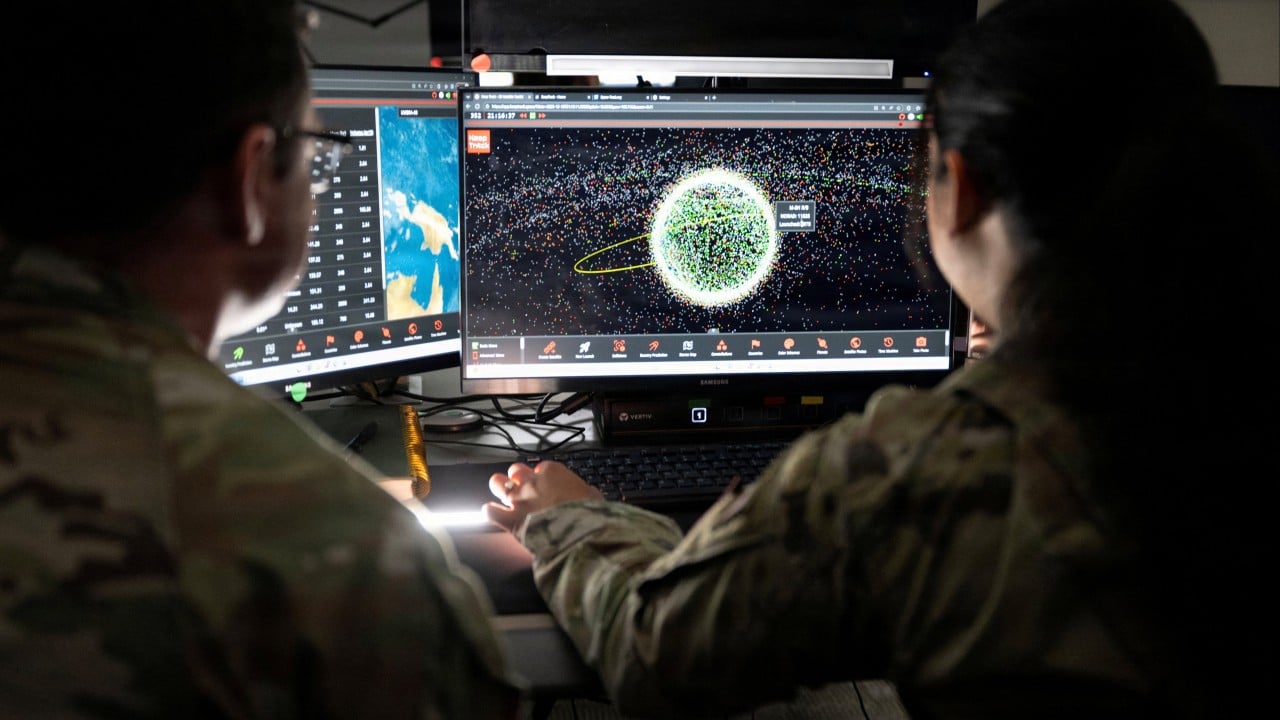
The coffee grows cold on the desk while the monitor pulses with a silent, blue-tinted rhythm. Down here, beneath twenty feet of reinforced concrete and blast-resistant steel, the air smells of recycled ozone and quiet anxiety. But four hundred miles straight up, in the freezing, silent vacuum of low Earth orbit, something heavy is moving. It does not carry a flag that anyone can see from the ground. It does not broadcast a loud warning. It simply tracks, drifts, and waits.
For decades, we treated the sky as a sanctuary. We launched our glass eyes—satellites that map the weather, guide our cars through unfamiliar streets, and link continents in milliseconds—under the comforting illusion that space was a neutral zone. A scientific commons. A place apart from the messy, violent disputes of dirt and asphalt. Don't forget to check out our earlier coverage on this related article.
That illusion is dead.
The United States Space Force has officially confirmed what aerospace engineers and defense analysts have whispered in guarded corridors for years: weapons are deployed in orbit. Not as a futuristic exercise. Not as a theoretical prototype sitting in a desert hangar. They are up there right now. Armed, functional, and designated for both offensive and defensive operations. If you want more about the context here, MIT Technology Review provides an informative breakdown.
Consider what happens next.
The Glass Ceiling Above Our Heads
To understand the weight of this reality, you have to strip away the science fiction tropes of laser battles and exploding starships. Real orbital warfare is terrifyingly mundane, and precisely because of that, infinitely more dangerous.
Imagine a satellite the size of a school bus, costing a billion dollars and representing ten years of painstaking engineering, gliding smoothly through the dark. Now imagine an object closing in on it at seventeen thousand miles per hour. No sound. No smoke trail. Just a kinetic impact or a targeted burst of directed energy designed to blind sensors, fry circuits, or shatter solar arrays into a million hyper-velocity shrapnel bullets.
When the Space Force talks about offensive and defensive capabilities in orbit, they are talking about deterrence in an arena where there is nowhere to hide. On Earth, a nation can dig a trench, deploy mobile launchers, or retreat behind a mountain range. In orbit, every single asset moves in a predictable, mathematically absolute trajectory dictated by the unbending laws of orbital mechanics. You cannot swerve. You cannot park behind a cloud. You can only endure or strike first.
I remember talking to a retired radar technician who spent thirty years watching blips crawl across analog screens in Colorado Springs. He looked at his coffee mug, traced the rim with a calloused thumb, and said something that has stuck with me ever since.
"We spent the last century building a nervous system for the entire planet," he told me. "We put it in the one place where anyone can reach it, and no one can defend it."
He was talking about our reliance on orbital infrastructure. GPS is not just a convenience for finding the nearest coffee shop. It is the invisible pulse synchronizing global financial markets, directing electrical grid switches, coordinating emergency response teams, and timing international shipping containers. When an adversary threatens a satellite, they are not just threatening a piece of hardware. They are threatening the synchronization of modern civilization.
The Logic of the Dark
Why put weapons up there? The answer is as old as humanity itself. Fear.
For a long time, American military planners operated under the assumption that space would remain a sanctuary because nobody wanted to open Pandora's box. If you destroy an opponent's satellite, they will destroy yours. Mutual assured destruction, translated from the nuclear silos of the Cold War into the weightless void of the thermosphere.
Yet deterrence only works if the stakes are clear and the lines are visible. Space blurs every line. If a satellite suddenly stops transmitting, was it hit by a rogue piece of space debris? Did a solar flare fry its motherboard? Or did a maneuvering spacecraft belonging to a rival superpower gently nudge it out of alignment or blast its optics with a high-powered laser?
Attribution is the holy grail and the impossible nightmare of modern astrodynamics. When you cannot prove who pulled the trigger, retaliation becomes paralyzed. And in that paralysis, fear breeds escalation.
This is why the Space Force has shifted its posture. Remaining silent while competitors quietly test rendezvous-and-proximity operations—craft that creep up alongside American assets to inspect, shadow, or potentially disable them—is no longer an option. The doctrine has evolved from passive observation to active readiness. If you want peace in the high frontier, you must be prepared to fight a war you cannot afford to lose.
The irony is staggering. We reached the stars out of a romantic urge to explore, to look back at our fragile blue marble and realize our shared humanity. We mapped the constellations, walked on the moon, and peered into the deep origins of the universe. And now, we are quietly turning the heavens into a fortified trench line.
Living on the Edge of the Precipice
Most of us will go through our lives without ever looking up and wondering which passing streak of light is a weather satellite and which one is an armed interceptor waiting for a kill command. We will swipe our phones, navigate through city traffic, and watch live broadcasts from the other side of the globe, blissfully unaware of the silent dance happening hundreds of miles above the stratosphere.
Perhaps that is a mercy. Ignorance keeps the panic at bay.
Yet there is a profound melancholy in watching the last untamed frontier become just another theater of geopolitical paranoia. We have taken our terrestrial anxieties, our mistrust, our weapons, and our ambitions, and we have hurled them into the dark.
The silence up there is absolute. No wind blows through the solar panels. No atmosphere carries the sound of approaching danger. There is only the endless fall around the curve of the Earth, a perpetual race against gravity where the stakes are nothing less than the operational continuity of human civilization.
Look up tonight if you get the chance. Find a patch of dark sky away from the city lights and watch for a slow-moving star drifting across the constellations.
It might be watching you back.