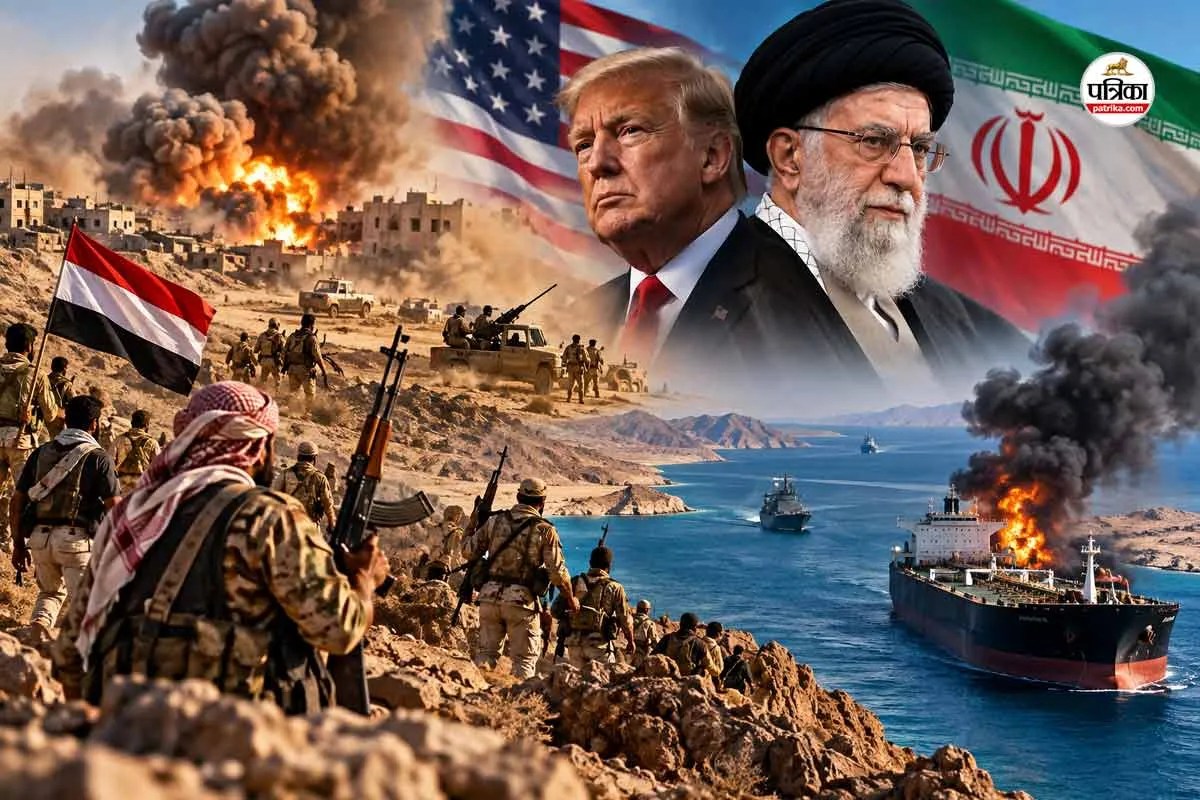
The night does not fall gently over the waters of Bab-el-Mandeb; it drops like a heavy, leaden curtain.
Out on the deck of a container vessel drifting somewhere between the Horn of Africa and the Arabian Peninsula, the air tastes of salt and sulfur. A low, rhythmic thrum vibrates through the steel hull—not the engine, but the pulse of an ancient sea route turned into a modern high-stakes chessboard. Thousands of miles away in Washington, analysts stare at glowing monitors, tracking blips on a radar screen as abstract vectors of risk. But here, on the dark swells of the Red Sea, the tension is not a PowerPoint presentation. It is the sudden, blinding flash of a projectile cutting through the midnight sky. It is the deafening roar of a drone engine overhead, hunting for shadows.
The guns in Yemen have found their voice again.
To understand why the Middle East trembles every time the Bab-el-Mandeb strait churns, you have to look past the bureaucratic language of international diplomacy. You have to look at the human cost of a choke point. Every supply chain, every rising price tag at a suburban grocery store, every whispered anxiety in a shipping container terminal halfway across the planet traces back to this narrow corridor of water. When the Houthis strike, the shockwaves do not stay
The Smoke on the Red Sea
news
The coffee in Sanaa grows cold before anyone remembers to drink it. In a dim kitchen overlooking streets carved from ancient stone and troubled by modern echoes, an old man listens to the distant, rhythmic thud that has become the punctuation of his declining years.
It is not thunder. Thunder brings rain to coax the terraced hillsides into green. This sound brings fire. Out on the dark waters of the Red Sea, a steel behemoth burns, and the smoke drifts inland, mixing with the dust of a country that has forgotten what peace feels like.
We talk about geopolitics as if it were a game of chess played by men in marble halls. We speak of Washington and Tehran, of strategic chokepoints and oil tankers rerouting around the Cape of Good Hope, adding millions of dollars and countless days to every voyage. We crunch the numbers. We measure the tonnage. We track the trajectory of missiles launched from the arid plateaus of Yemen toward the horizon.
Yet numbers have a way of stripping the blood from the story.
To understand why the Middle East is trembling once more, why the guns in Yemen are roaring with a fury that defies exhaustion, and why Tehran sends sharp, unyielding messages across the diplomatic wire, you have to step away from the map. You have to walk into the suffocating reality of a region caught between the ambition of regional players and the indifference of distant empires.
Consider what happens on the ground. For years, the Houthi movement has consolidated power through an alchemy of ideological fervor, survivalism, and the sheer vacuum left by a fractured state. They do not fight merely for territory anymore; they fight for a narrative of defiance. When they launch ballistic missiles and explosive drones toward commercial shipping lanes, they are not just disrupting global supply chains. They are performing an act of escalation designed to echo across capitals from Riyadh to Washington.
The rationale they offer is simple, resonant to their base, and inflammatory to the world: solidarity with Gaza, a stand against Western hegemony, a assertion of dominance over the waters that touch their shores. But beneath the rhetoric lies a colder calculus. Conflict is an engine. It justifies internal control. It turns an impoverished population’s gaze outward toward a foreign enemy so they might not look too closely at the empty plates on their own tables.
Thousands of miles away, in the air-conditioned quiet of the Pentagon and the State Department, analysts stare at glowing screens. They measure the cost of interception. Every time a U.S. Navy destroyer fires a multi-million-dollar Standard Missile to swat down a cheap, Iranian-designed drone buzzing toward a container ship, a grim equation is being written. It is an economic attrition war fought in real time. The superpower wins every tactical engagement, yet loses strategic bandwidth, bogged down in a perpetual loop of whack-a-mole diplomacy and defensive posture.
And behind the curtain stands Iran.
Tehran’s strategy has long been written in the ink of proxy warfare. It is a doctrine of plausible deniability and maximum leverage. By arming, funding, and guiding networks spanning from Lebanon to Yemen, Iran projects power far beyond its borders without ever having to march its own regular army across an international boundary. When the West demands accountability, Tehran issues a two-tok message: sharp, defiant, and laced with the warning that any direct strike on Iranian soil or assets will trigger a regional conflagration no one can contain.
It is a game of nuclear chicken played with conventional weapons in a brittle landscape.
The tragedy of this architecture is that the architects never pay the full price. The price is paid by the fisherman in Hodeidah whose wooden boat is pulverized because it was mistaken for a supply skiff. The price is paid by the retail consumer in Europe and North America who watches the price of imported goods creep upward because a cargo ship chose the long way around Africa. The price is paid by a generation of Yemeni children who know the sound of a jet engine better than the sound of a school bell.
We like to think that crises have clean beginnings and neat resolutions. We look for the turning point, the diplomatic breakthrough, the treaty signed with golden pens on polished mahogany. But some conflicts do not end; they simply evolve, settling into the marrow of daily life until violence becomes the weather.
Back in Sanaa, the old man finishes wiping down his table. The distant concussions continue, shaking the glass in its warped wooden frame. He does not check the news ticker on a smartphone. He already knows the script. The missiles will fly, the statements will be issued, the stock markets will jitter, and somewhere in the dark, another tanker will alter its course, cutting through the swells, fleeing a war it never asked to fight, carrying the invisible weight of a world that refuses to learn how to live with itself.


