Saltwater has a way of erasing the noise. Stand at the edge of the Atlantic where the New York coastline meets the endless horizon, and the world shrinks to two things: the rhythmic, bruising crash of the surf and the steady pull of the tide. Most days, the water looks like a sheet of hammered tin—gray, opaque, and indifferent.
We think we know what lives out there. We picture the familiar cast of characters. Striped bass flashing silver in the breakers. Bluefish chasing terrified minnows into the shallows. Gulls wheeling overhead, screaming their hunger to the wind.
We are wrong.
Look closer. Or better yet, look down from above.
The Eye in the Sky
Technology has a peculiar habit of giving us humility. For generations, our understanding of the ocean was restricted to what we could pull across the gunwale of a small boat, what we could spear with a polarized pair of sunglasses, or what washed up tangled in kelp on the morning tide.
Then came the buzzing eyes of modern drones.
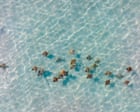
Hovering hundreds of feet above the Atlantic chop, these compact cameras strip away the glare of the surface. They peer straight down into the water column, turning the murky coastal soup into a crystalline window. And what they have captured recently off the shores of Long Island and the greater New York coastline is nothing short of breathtaking.
Imagine floating in the air, the wind rushing past the propellers, watching a dark, undulating shadow detach itself from the sandy bottom.
It breathes. It glides. It flies through the water without a single frantic stroke.
Stingrays. Hundreds of them. Moving in synchrony just yards from where families spread their towels and children chase the foam.
The Secret Life of the Shallows
Marine biologists have long known that these creatures use the coastal waters of the Northeast as a seasonal corridor. As the sun bakes the summer shallows, raising water temperatures to a comfortable threshold, migratory species arrive in droves.
Picture a hypothetical marine researcher named Elena, standing on a dune in the Hamptons with a controller in her hands. She has spent a decade squinting at fuzzy sonar screens, trying to map the invisible highways of the deep. But watching the live feed from her drone this July morning, she gasps.
The screen reveals a massive fever of cownose rays.
That is the actual biological term for a group of rays: a fever. It sounds dramatic, almost violent, yet the reality is mesmerizingly tranquil. They move like velvet capes drifting through a cathedral. Their wide, triangular pectoral fins flap with a slow, hypnotic cadence.
They are not hunting humans. They are not plotting an ambush. They are simply passing through, riding the thermal currents, searching for bivalves buried in the muddy floor.
To the beachgoer tanning twenty feet away, the water looks empty. Safe. Normal. Yet beneath that turquoise skin lies a hidden metropolis of ancient, cartilaginous life.
Why Now
Why are we seeing them so clearly today when our grandparents never did?
The answer is partly about the lens, and partly about the water itself. Conservation victories over the past few decades have slowly rehabilitated parts of the local marine ecosystem. Cleaner water means better visibility. Better visibility means a drone camera can pierce depths that used to remain stubbornly blind to human eyes.
At the same time, shifting ocean temperatures are rewriting the migratory maps of the Atlantic. Marine species are pressing further north, arriving earlier, and staying later. The ocean is shifting its boundaries.
Consider what happens next: as our technological window into the wild expands, our sense of isolation shrinks. We are no longer separate observers standing safely on dry land. We are neighbors to a vast, breathing wilderness that exists mere feet from our beach umbrellas.
It is a humbling realization. We share these crowded beaches with creatures that predate dinosaurs, animals that possess electroreceptors sensitive enough to detect the heartbeat of a crab buried beneath the sand.
A Quiet Reckoning
There is a distinct kind of vertigo that comes from watching drone footage of stingrays gliding beneath the surf while a lone surfer paddles obliviously just meters away.
You want to shout out. You want to warn them.
Yet, as you watch the footage longer, the anxiety dissolves into awe. The ray doesn't strike. The surfer doesn't fall. They simply pass each other like ghosts in a crowded hallway, entirely unaware of the other's existence.
The ocean remains wild, indifferent, and infinitely rich. It does not need our permission to thrive. It only asks for our attention.
The next time you walk down to the water's edge, peel off your shoes, and let the cold Atlantic foam wash over your ankles, pause for a moment. Look past the crashing waves. Look past the seagulls.
Somewhere out there in the green-blue blur, a shadow is moving.
Ancient. Silent. Waiting.