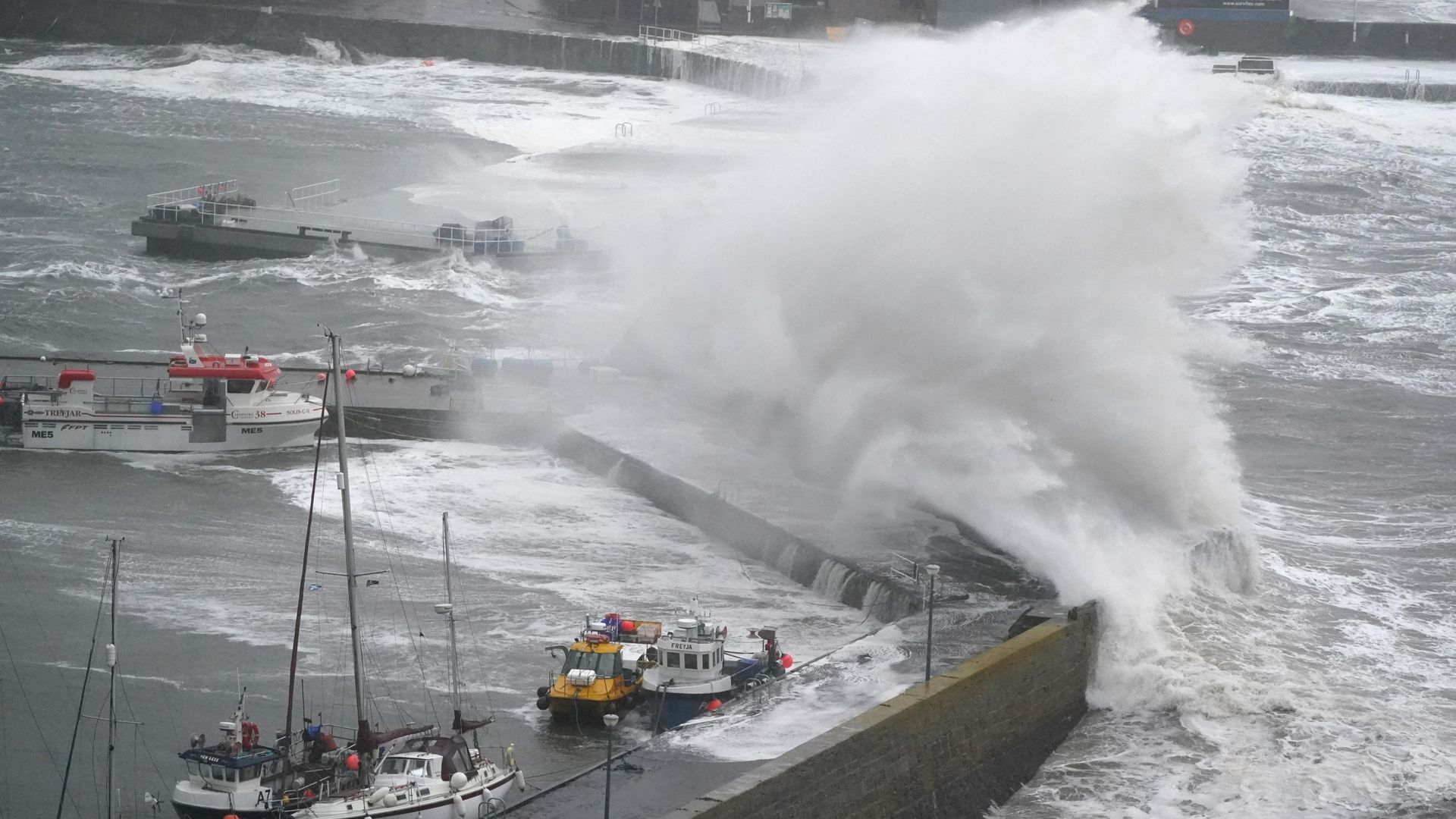
Listen.
Not to the anchor reading off a teleprompter with practiced calm, and not to the scrolling banner along the bottom of the screen, which turns a genuine threat into background wallpaper before you have even finished your coffee. Listen to the sound of a forty-foot oak tree in your neighbor's yard when air at seventy miles an hour hits its canopy like a freight train that never reaches a crossing.
Seventy miles an hour sounds like a highway speed limit. You drive seventy miles an hour on an interstate and feel in control, hands resting lightly on the wheel, radio murmuring, coffee in the cup holder. Flip that number around—put the car in park and send the air rushing past you at seventy miles an hour—and the physics stop feeling abstract. At that speed, wind exerts roughly twelve to fifteen pounds of pressure per square foot on a flat surface facing the gust. Across a single standard garage door or a broad side wall of a house, that adds up to hundreds, sometimes thousands of pounds of pushing force, arriving in surges that pulse rather than hold steady.
A weather warning coming into force is rarely dramatic at the exact minute it begins. Usually, the sky looks merely heavy, or the leaves twitch a little too fast along the ridge. People look outside, see dry pavement or a light sprinkle, and mentally downgrade the alert. They always exaggerate, someone says. It'll blow over by dinner.
I used to think that way. Once.
Years ago, I sat in a second-floor study during an autumn gale that peaked right around seventy miles an hour. Outside, the yard was full of maples that had spent sixty summers growing thick and proud. I remember the exact moment my skepticism cracked. It wasn't a crash. It was a long, tearing groan from deep inside the trunk of a tree thirty feet from the window, followed by the sudden, unnatural silence of branches snapping off and sailing horizontally across the lawn like spears. Five minutes later, the power blinked out—not a gentle flick, just a sharp snap in the transformer down the block—and the house grew cold faster than I expected a heated house could get.
That is the gap a standard weather bulletin leaves wide open. A bulletin tells you what the anemometer recorded at an airport or coastal station. It rarely tells you what happens inside a kitchen when the refrigerator stops humming, what happens on a bridge when crosswinds shove a box trailer sideways, or why the hour after the worst gust passes is often more dangerous than the gust itself.
The Hypothetical Neighbor and the Unsecured Yard
Consider a hypothetical character—let's call her Maya—living in a split-level house on a hillside edge where wind naturally accelerates as it climbs the slope. Maya isn't careless. She works hard, keeps her pantry reasonably stocked, and checks the forecast on her phone while brushing her teeth.
When the alert pops up predicting winds up to seventy miles an hour, Maya's first instinct isn't panic. It's annoyance. She has a presentation in the morning, a recycling bin overflowing with cardboard, and a stack of firewood on the back porch. If she thinks about the storm at all, she pictures rain.
Seventy-mile-an-hour winds don't need heavy rain to ruin a Tuesday. In fact, dry or lightly damp high winds are deceptive because they don't look like a storm from behind a pane of glass. Trees still carrying late-season foliage—or even bare limbs weakened by drought or rot—act like sails catching a sudden tack. Utility lines, already strung tight between poles, begin to gallop and slap together in the gusts, sparking and tripping breakers miles away from your street.
To understand wind shear and gust factors without getting lost in meteorology jargon, think of a gust like a heavy shoulder checking a door. Sustained winds are the steady push of someone leaning against the wood; gusts are the sudden lunge when their weight shifts forward. Weather stations often report sustained speeds or peak gusts separately, and local topography—valleys that funnel air like a nozzle, ridges that compress it, gaps between tall buildings—can turn a regional warning into a localized punch.
If you are using the highway speed comparison as a mental shortcut, keep in mind that it is strictly a metaphor for speed, not an equal test of force. Inside a car, you are belted into a steel cage moving forward through air. Standing outside or sitting inside a timber-framed home while seventy-mile-an-hour gusts hammer the structure is a completely different physical equation. Roof shingles lifted at the edge can peel back in strips. Loose patio furniture, trampolines, construction debris, and dead branches become airborne projectiles. Even a falling limb the thickness of your wrist, dropping from thirty feet up in crosswind, carries enough kinetic energy to dent a hood, shatter glass, or end a walk on a wooded trail.
Why People Ignore Warnings Until the Lights Flicker
Why do smart, capable people routinely shrug off severe wind alerts?
Part of it is psychological fatigue. Alerts arrive on phones for every squall, every coastal breeze, every marginal watch. When a warning cries wolf twice, people tune out the third siren—even when the third siren is backed by real atmospheric instability and steep pressure gradients.
There is also a quiet illusion of permanence built into modern domestic life. We flip a switch and light appears. We turn a knob and hot water runs. We tap a screen and the outside world arrives on demand. That reliability breeds an unconscious assumption that infrastructure is immovable. Yet overhead distribution grids were largely built for an era with fewer extreme convective events and aging wooden poles. When high winds whip branches into high-voltage lines or topple a single heavy pine across a main feeder road, ten thousand people can lose electricity in seconds.
Now think about what happens next when the grid drops.
A power outage isn't just sitting in the dark with a scented candle. If your home relies on electric heat or a heat pump and temperatures are dipping into the thirties or forties, indoor air cools steadily once walls lose their stored warmth. Sump pumps stop running if basement seepage is an issue. Well pumps go quiet. Cell towers on battery backup can strain or lose coverage if local distribution fails, leaving you wondering whether your neighbor has power or if the outage spans three counties.
And then there is the temptation that catches almost everyone off guard: going outside while the wind is still howling to "just grab that one thing." A trash can rolling down the street. A tarp flapping loose over wood. A dog barking in the side yard.
That is usually when accidents happen. Not from sitting quietly in an interior room away from windows, but from stepping out into flying debris or walking under trees whose root balls have begun to loosen in softened soil.
When the Wind Drops, the Hazard Shifts
Suppose the peak gusts pass around midnight. The roaring in the chimney softens to a low whistle. People exhale, turn over in bed, and assume the danger is finished.
Often, it isn't.
High wind leaves behind a messy aftermath that punishes anyone who rushes out at dawn without looking up. A tree partially uprooted during a seventy-mile-an-hour gust might stay upright through the night, held by tension in its remaining roots and neighboring branches, only to come down hours later when a mild breeze shifts the balance. Downed utility lines sometimes lie tangled in wet grass or draped across fences, looking dead when they are still energized—or looking harmless until a crew restores power remotely.
Driving in the wake of a severe wind event carries its own traps. Even after gusts ease, roads can be littered with broken limbs, downed wires, blown-over signs, and sudden crosswinds on open stretches or bridges. High-profile vehicles—suvs, vans, campers, semi-trucks—catch side wind like a broadside sail. A sudden gust on an overpass can tug a steering wheel hard enough to startle even an experienced driver.
I learned to respect the quiet hours after a storm the hard way too. After that autumn gale years ago, I walked out at first light expecting nothing worse than raking leaves. Instead, I found a thick limb resting squarely across the spot where I usually parked my car, and a live wire humming faintly against a chain-link fence fifty yards down the lane. Nothing bad happened that morning, mostly because luck was standing right beside me, quiet and uncredited. Luck is a terrible safety plan.
Practical Preparation Without Living in Fear
Preparing for seventy-mile-an-hour winds doesn't require turning your living room into a bunker or buying out every hardware store shelf in town. Most of what actually protects you costs little or nothing and takes twenty minutes before the wind picks up.
Start outside before the gusts build. Bring in anything light enough to fly—patio cushions, folding chairs, lightweight planters, sports gear, loose tools. Move vehicles away from tall, brittle, or leaning trees and clear of power lines if you have options. If you have a garage, close the door and keep it latched; a breached garage door lets high-pressure wind surge inside the structure, lifting upward on the roof framing from underneath.
Inside, shift your mindset from convenience to resilience. Charge phones and portable power banks while the wall outlets still work. Know where your flashlights are—candles are fine if handled carefully, but flashlights don't tip over when a door slams shut from a pressure change. Keep a small stash of bottled water, basic non-perishable food, and any essential medications somewhere easy to reach in the dark.
Pay attention to where you sit when the worst gusts hit. Stay away from large windows, skylights, and glass doors; wind-driven debris or a snapping limb doesn't care how thick the double-pane glass looks. An interior hallway, bathroom, or basement away from exterior glass and overhead tree hazards gives you far better protection if a gust takes down a limb or shatters a pane.
If you plan to drive during a warning, ask yourself honestly whether the trip can wait. If you must drive, keep both hands on the wheel, leave extra space around trucks and trailers, slow down well before exposed bridges or tree-lined roads, and never drive over or around a downed wire or across a road blocked by debris.
And if the power does go out, resist the urge to open the refrigerator every ten minutes just to check if the milk still feels cold. Every time you open the door, cold air spills out and warm air rushes in. A closed refrigerator generally keeps food safe for around four hours, and a full freezer can hold temperature for roughly twenty-four to forty-eight hours if left shut.
The Real Measure of a Warning
A weather warning isn't a promise that catastrophe will strike your exact street. It is a notice that the atmosphere has built up enough speed and force to test weak points—weak branches, loose roofs, aging wires, distracted habits, overconfident assumptions.
Sometimes the wind roars past at seventy miles an hour, rattles the window frames, bends the pines nearly double, and leaves your neighborhood intact by morning. You might feel slightly silly for charging your flashlight and moving the lawn chairs inside.
Take that feeling. Keep it. Because the alternative—standing in a dim hallway listening to something heavy hit the roof while your phone sits at four percent—makes twenty minutes of preparation look like the best bargain you ever made.
Outside, the wind doesn't argue, negotiate, or check your calendar. It simply pushes against whatever stands in its path until something gives, or until the air finally runs out of speed.