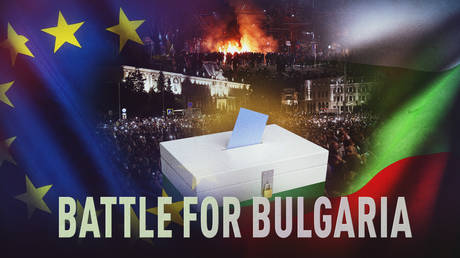
The air in Sofia during an election cycle doesn't smell like democracy. It smells like cheap tobacco, exhaust fumes from aging German sedans, and the cold, metallic scent of a coming Balkan winter. On the yellow cobblestones of Tsar Osvoboditel Boulevard, the grand buildings of power stand tall, but their shadows feel longer than usual. For the seventh time in just over three years, Bulgarians are being asked to walk to the polls.
They are exhausted.
Imagine a man named Georgi. He is fifty-five, a mechanic in Plovdiv with grease permanently etched into the lines of his palms. He has seen the Berlin Wall fall, the hyperinflation of the nineties, and the bright, flickering promise of the European Union. In the last forty months, Georgi has been told seven times that "this is the most important election of our lives." He doesn't believe it anymore. To Georgi, the ballot box isn't a tool for change; it’s a recurring bill he can’t afford to pay.
Bulgaria is trapped in a political loop that feels less like a functional republic and more like a scratched vinyl record, skipping over the same discordant note. This isn't just about party names or parliamentary seats. It is a fundamental breakdown of the social contract in the poorest corner of the EU.
The Ghost in the Machine
The primary protagonist—or antagonist, depending on who you ask—is Boiko Borisov. A former bodyguard with a black belt in karate and a populist streak that has defined Bulgarian politics for nearly two decades, Borisov and his GERB party remain the gravity well around which everything else orbits. He is the "stable" choice, yet his critics see him as the architect of a system where corruption isn't a bug, but a feature.
Opposing him is a fractured mosaic of reformists, most notably the We Continue the Change (PP) and Democratic Bulgaria (DB) alliance. They are the urban elite, the tech workers, and the diaspora-returned youth who speak the language of Brussels and Transparency International. They want to scrub the system clean. The problem? You can't scrub a floor while everyone is still walking on it with muddy boots.
The math is brutal. Under Bulgaria's proportional representation system, no one can get enough votes to rule alone. But the animosity between the reformers and the old guard is so toxic that building a coalition is like trying to weld ice to fire. They tried once. It lasted nine months before it shattered into a million sharp, bitter pieces.
The Russian Whisper
While Sofia bickers, a larger shadow looms from the East. Bulgaria’s relationship with Russia is not a simple political preference; it is a ghost that haunts the family dinner table. There is a deep, historical gratitude for the Russo-Turkish War that liberated Bulgaria in 1878, but it is constantly crashing against the reality of 21st-century NATO commitments.
Enter "Vazrazhdane" (Revival). They are the loud, unapologetic nationalists who want to pull Bulgaria out of NATO, scrap the Euro transition, and lean back into the arms of Moscow. They don't need to win the election to win the war. Every time the mainstream parties fail to form a government, the nationalists grow stronger. They feed on the apathy of people like Georgi. They tell him his poverty isn't a result of local graft, but of "Western dictates."
It is a seductive lie. When the heat goes up and the bank account goes down, a firm hand and a clear enemy are easier to digest than a 400-page white paper on judicial reform.
The Invisible Stakes
Why should someone sitting in London, Washington, or Berlin care about a small nation of 6.4 million people on the edge of the Black Sea? Because Bulgaria is the soft underbelly of the European project.
The country is currently a gateway. It is a gateway for energy pipelines, a gateway for migrants moving toward the heart of Europe, and a gateway for influence. If Bulgaria falls into a permanent state of "failed state-lite," the ripples move outward. The Eurozone's expansion stalls. NATO’s eastern flank becomes porous. The very idea that a post-communist nation can successfully transition to a transparent democracy takes a body blow.
But the real cost is measured in people, not geopolitics. Bulgaria has one of the fastest-shrinking populations on Earth. The brightest minds aren't waiting for the eighth or ninth election. They are buying one-way tickets to Frankfurt and Madrid.
Consider Maria, a twenty-three-year-old medical student in Varna. She wants to stay. She loves the Black Sea air and the way the sunlight hits the mountains in the autumn. But she looks at a hospital system starved of funding and a political class that spends more time trading insults than building infrastructure. To her, the "Battle for Bulgaria" isn't a headline. It’s a calculation of whether she can afford to have a family in the city where she was born.
The Magnitsky Factor
Add to this volatile mix the intervention of the United States. Through the Magnitsky Act, the U.S. has sanctioned several high-profile Bulgarian figures, including Delyan Peevski, a media mogul and politician who is often described as the most powerful man in the country.
Peevski is a phantom. He rarely gives interviews, yet his influence is felt in every courtroom and newsroom. The fact that a sanctioned individual continues to lead a major political party—the MRF, representing the Turkish minority—is a testament to the resilience of the Bulgarian "Deep State." It creates a surreal reality where the West is calling out the rot, but the rot is still sitting in the front row of Parliament, voting on the budget.
The reformers are caught in a pincer movement. If they work with the "corrupt" elements to provide stability, they lose their soul and their voters. If they refuse, the country remains leaderless, ruled by "caretaker" governments appointed by President Rumen Radev.
Radev is another piece of the puzzle. Often seen as pro-Russian or at least "neutral" in the Ukraine conflict, he has effectively ruled the country by proxy for much of the last three years. The longer the parties fail, the more power accrues to the Presidency. The parliamentary republic is slowly, quietly, being hollowed out from the inside.
The Cost of Silence
The most terrifying thing about the upcoming election isn't who might win. It’s who will stay home.
In the first of these seven elections, turnout was respectable. By the sixth, it had plummeted to record lows. There is a specific kind of silence that falls over a nation when its citizens stop believing that their voice matters. It’s not the silence of peace; it’s the silence of a house being emptied.
The "Battle for Bulgaria" is a misnomer. A battle implies two sides fighting over a prize. This feels more like a slow-motion demolition. The prize—the country itself—is being weathered away by the sheer friction of indecision.
Georgi, the mechanic, won't be at the rallies. He won't be waving a flag. He will be under the hood of a car, wiping grease from a manifold, wondering if his pension will exist by the time he’s too old to hold a wrench. He doesn't want a "definitive guide" to the election. He wants a reason to care.
The tragedy of the Bulgarian situation is that the solutions are known. Judicial reform, the decoupling of the prosecutor general's office from political influence, and a genuine commitment to the Euro. These aren't mysteries. They are simply impossible to implement in a room where everyone is shouting and no one is listening.
The Seventh Roll of the Dice
As the sun sets over the Vitosha mountain, casting a deep purple glow over the capital, the posters go up again. Faces of men who have promised everything and delivered nothing stare back from every lamppost. The slogans are the same. The promises are recycled.
We are told that this time, things will be different. That the "geopolitical choice" is clear. That the "red lines" have been drawn.
But out in the villages of the Rhodopes, where the schools are closing and the young have left, the political noise feels very far away. There, the only thing that matters is the price of bread and the heat of the stove. Bulgaria is a country of immense beauty and profound resilience, but even the strongest metal snaps if you bend it back and forth enough times.
The ballot boxes are being dusted off. The polling stations are being prepared in school gyms and community centers. On Sunday, the people will walk past the yellow bricks and the grand statues, perhaps for the last time before the system simply stops working altogether.
There is no "next move" in this game. There is only the same move, played over and over, until the players or the board give way.
A nation cannot live in a state of "caretaker" forever. Eventually, someone has to take care of the people. And if the democrats and the reformers cannot find a way to talk to each other, the people will eventually find someone who speaks a much simpler, much darker language.
The ink on the finger, the paper in the slot, the hollow thud of the lid closing.
Seven times.
The seventh shadow is the longest one yet.