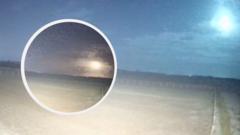
The security camera at a gas station in the middle of nowhere doesn’t usually witness history. It records the mundane: a flickering neon sign, a driver stretching their legs, the rhythmic hiss of a pump. But at 3:14 AM, the gravel lot transformed. The shadows, which had been stretched thin and long under the yellow streetlights, suddenly vanished. In their place came a light so aggressive and pure it felt less like a sight and more like a physical weight.
For seven seconds, the night simply ceased to exist. If you enjoyed this post, you should look at: this related article.
A streak of electric turquoise tore through the atmosphere, trailing a wake of burning orange embers. It wasn’t a slow burn. It was a violent, high-velocity intrusion. This was a meteor, a stray fragment of a shattered world from beyond the asteroid belt, making its final, screaming entrance into our oxygen-rich bubble.
Most people slept through it. They woke up to grainy door-camera footage shared on social media, watching a digital ghost of the event. But for the few who were awake—the long-haul truckers, the insomniacs, the nursing mothers—the sky didn't just change colors. It spoke. For another angle on this story, refer to the recent update from TIME.
The Physics of a Dying Star
We call them shooting stars because the truth is too heavy for casual conversation.
Scientifically, what we saw was a bolide. This isn’t your average grain-of-sand meteoroid that creates a faint twinkle. A bolide is a heavyweight. It hits the upper atmosphere at speeds exceeding 40,000 miles per hour. At that velocity, the air doesn't have time to move out of the way. It compresses.
When you compress air that fast, it gets hot. Violently hot. The front of the rock reaches temperatures hotter than the surface of the sun. The "glow" isn't actually the rock burning; it’s the air itself turning into plasma. The meteor is essentially a tiny, dying star held in the palm of our gravity.
Consider a hypothetical observer named Elias. He’s a night-shift security guard sitting in a booth on the edge of town. When the flash hits, his first instinct isn't "astronomy." It's "emergency." He thinks a transformer has blown. He thinks a plane is going down. His heart hammers against his ribs because the human brain is hardwired to fear sudden changes in the heavens. For thousands of years, a light in the dark meant fire, or it meant God. Even in our age of fiber-optic cables and space stations, that primal dread remains.
The light Elias saw was blue-green. That’s not an artistic choice by the universe; it’s a chemical signature. That specific hue tells us the rock was rich in magnesium and nickel. It was a metallic messenger, a piece of the solar system’s original construction debris that had been drifting in the freezing vacuum for four billion years, only to end its journey over a strip mall.
The Sound of a Memory
The most haunting part of these events isn't the light. It's the delay.
Light travels at 186,000 miles per second. Sound, by comparison, is a crawler. If the meteor is fifty miles up, the light hits your eyes instantly. But the shockwave—the sonic boom created as the rock outruns its own noise—takes minutes to reach the ground.
Imagine the silence after the flash. Elias stands outside his booth, looking up at a sky that has returned to its velvet blackness. He thinks it's over. Then, three minutes later, a low, guttural thud rattles the windows of his booth. It’s a sound you feel in your teeth. It’s the atmosphere's way of healing the wound the meteor just ripped through it.
We spend our lives focused on the ground. We worry about interest rates, the grocery list, the weird sound the car is making. We treat the sky like a ceiling, a static backdrop to our personal dramas. Then, a rock the size of a microwave oven reminds us that we are living on a pressurized marble hurtling through a shooting gallery.
The odds of being hit by a meteor are vanishingly small. You are more likely to be struck by lightning while winning the lottery. Yet, the footage of these events goes viral every single time because they trigger a collective realization. We are part of something much larger, much older, and much more indifferent than our daily schedules suggest.
The Invisible Stakes
Why does a grainy clip from a doorbell camera in Ohio or Australia captivate millions?
It’s the vulnerability.
There is no "meteor defense" for something this small. Our sophisticated telescopes are great at tracking the "planet-killers"—the behemoths miles wide that move with predictable orbits. But the small ones, the "city-shakers," often come from the direction of the sun, hidden in the glare. They arrive without a press release. They don't care about our borders or our politics.
When we watch that footage, we aren't just seeing a light show. We are seeing a reminder of the fragility of our infrastructure. A slightly larger rock, hitting at a slightly different angle, creates a pressure wave that can shatter every window in a twenty-mile radius. We saw this in Chelyabinsk in 2013. Thousands of people were injured, not by the rock itself, but by the glass that exploded inward when the sound finally caught up to the light.
Modern technology has turned us all into accidental astronomers. Twenty years ago, this meteor would have been a local legend told by a few confused witnesses. Today, we have a multi-angled, high-definition reconstruction of the event within hours. We can calculate the trajectory, estimate the mass, and predict the landing zone of any potential meteorites.
But data doesn't replace the feeling.
The Hunter's Obsession
For some, the flash is just the beginning of a different kind of story.
Once the light fades, the "hunters" arrive. These are the people who spend their weekends in muddy fields with high-powered magnets and metal detectors. They aren't looking for gold. They are looking for the "black crust"—the fusion crust that forms on a meteorite as it cools during its final descent.
To hold a meteorite is to hold something that has never belonged to Earth. It’s cold, heavy, and smells faintly of ozone or sulfur. It is the only physical object you can touch that wasn't born here. For the hunter, the footage isn't a spectacle; it’s a treasure map. They analyze the shadows in the video to triangulate the exact path. They look for the "fragmentation point," where the pressure became too much and the rock shattered into a "strewn field."
This is where the human element becomes almost poetic. We take these remnants of cosmic violence and put them on our mantels. We turn them into jewelry. We study them in labs to understand how water first arrived on our planet. We are a species that sees a terrifying fire in the sky and decides to go out into the dark to find the pieces.
A Quiet Shift in Perspective
The morning after the event, the sun rose as it always does. The gas station resumed its business. The drivers who had been momentarily blinded by the turquoise glare went home and slept.
But something shifted.
The people who saw it don't look at the night sky the same way anymore. They understand that the "emptiness" between the stars isn't actually empty. It’s full of motion. It’s full of history. It’s full of the raw materials of existence, occasionally dropping by to say hello.
We live in a world that demands our constant attention. Our phones buzz, our calendars fill, and our horizons shrink to the size of a screen. We lose the ability to look up. We forget that we are passengers on a craft.
Then, for seven seconds, the universe breaks through. It forces us to stop. It forces us to wonder. It reminds us that while our lives are small, they are happening in the middle of a grand, beautiful, and occasionally terrifying cosmic ballet.
Elias, the security guard, didn't report the light to his supervisor. He knew the cameras caught it, and he knew the internet would explain the "what" and the "how." Instead, he just sat on the hood of his truck for the rest of his shift, watching the horizon. He stayed there until the stars faded into the gray light of dawn, waiting for another spark, even though he knew it might never come again in his lifetime.
The rock is gone now. It’s a few charred fragments buried in the dirt or resting at the bottom of a pond. The light has traveled trillions of miles away into the deep dark. But the feeling remains—that sudden, sharp realization that we are not the masters of the sky. We are just lucky enough to watch it burn.
The next time the sky lights up, don't reach for your phone first. Don't worry about the resolution or the frame rate. Just stand there. Let the light hit your eyes. Wait for the sound to rattle your chest. Remind yourself that you are standing on a rock, watching another rock, in a universe that is far from finished.