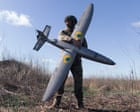
The sound does not mimic a jet engine. It lacks the terrifying, low-frequency rumble of a heavy bomber or the tearing-canvas shriek of incoming artillery. Instead, it sounds like a swarm of angry hornets trapped inside a plastic bottle. A high-pitched, metallic buzz that slices through the damp morning air over the eastern plains.
To an outsider, the noise is annoying. To anyone in a trench, it is the sound of absolute vulnerability.
For decades, military strategists calculated geopolitical power in tons of steel. They counted main battle tanks, aircraft carriers, and heavy artillery batteries. But the horizon shifted. The modern front line is governed not by the heaviest armor, but by lightweight plastic, lithium-ion batteries, and lines of code typed out by programmers huddled in poorly lit basements.
Behind the front lines, a parallel conflict unfolds. It is fought not with explosives, but with fountain pens, legal addenda, and international treaties. Kyiv is racing against a ticking clock to formalize "drone deals" with seven distinct NATO nations before the year draws to a close. It is a diplomatic sprint born of sheer necessity.
To understand why seven pieces of paper matter so much, you have to look at how a piece of consumer electronics became the ultimate arbiter of survival.
The Basement Inventors
Consider a hypothetical engineer named Mykhailo. Before the escalation of hostilities, he designed smart-home appliances in a comfortable office in Kharkiv. Today, he sits on a plastic crate in a damp cellar, surrounded by soldering irons, 3D printers, and stripped-down components from hobbyist racing drones. His fingers are stained with resin and silver solder.
Mykhailo is tweaking an algorithm. He is trying to teach a machine weighing less than a bag of sugar how to recognize a specific type of signal-jamming vehicle from two miles away. If the machine can recognize it, the machine can ignore the digital white noise meant to blind it.
This is not the industrialized warfare of the twentieth century. This is open-source, iterative combat. A modification made in a basement on a Tuesday is deployed on a battlefield on a Thursday. By Sunday, the adversary has updated their electronic warfare software to counter it. The cycle repeats. Every single week.
But Mykhailo’s cellar is running out of microcontrollers. The local supply chains are fractured. He cannot simply order a thousand carbon-fiber frames from an online wholesaler and expect them to clear customs without delay. He needs a steady, predictable influx of raw components, specialized optical sensors, and financial backing that does not rely on sporadic crowdfunding campaigns.
This is where the seven NATO countries come into play. The agreements Kyiv seeks are not charitable handouts of legacy hardware. They are industrial alliances designed to bridge the gap between Mykhailo’s basement innovation and the massive manufacturing capacity of Western Europe and North America.
The Friction of Peace
The primary obstacle is not a lack of political will. It is a fundamental clash of cultures.
Western defense procurement is built for stability, longevity, and meticulous risk aversion. It takes years to approve a new contract for a conventional missile system. Blueprints must be vetted, corporate committees must deliberate, and safety certifications must be meticulously documented. The process is deliberately slow to ensure accountability and prevent waste.
War, however, moves at the speed of light.
When Ukrainian officials sit across the table from representatives of NATO ministries of defense, they are asking for something those ministries are fundamentally unequipped to provide: agility. They do not want a five-year plan for a gold-plated drone system that costs a hundred thousand dollars per unit. They want hundreds of thousands of cheap, expendable, adaptable platforms right now.
They are asking Western bureaucracies to adopt the mindset of a Silicon Valley startup, to embrace failure as a data point, and to decentralize production. It is an excruciatingly difficult sell.
The seven pending agreements are essentially legal crowbars designed to pry open these rigid procurement systems. By signing bilateral drone pacts, these NATO nations are creating specialized legal pathways. These channels allow funds to flow directly into joint ventures, bypass standard export restrictions on sensitive dual-use technologies, and establish co-production facilities inside safer regions of Ukraine and neighboring allied territory.
The Math of the Modern Trench
The strategic urgency is driven by a brutal numbers game.
The conventional narrative of military dominance often focuses on grand strategy and satellite imagery. The reality on the ground is far more granular. It is defined by the cost-to-kill ratio.
A modern main battle tank costs several million dollars to manufacture. It requires an extensive logistical tail, thousands of gallons of fuel, specialized maintenance crews, and rare replacement parts. A first-person view (FPV) strike drone, equipped with a payload of plastic explosives and a rudimentary trigger mechanism, can be assembled for less than five hundred dollars.
If that five-hundred-dollar drone successfully disables or destroys that multi-million-dollar tank, the economic asymmetric balance of the conflict tilts dramatically.
But this asymmetry cuts both ways. The adversary understands this math just as well and has scaled up its own domestic production through state-directed industrial mobilization. Factories that once produced civilian goods have been repurposed to churn out standardized reconnaissance and strike loitering munitions by the tens of thousands.
Ukraine cannot match that state-mandated industrial output through volunteer donations and grassroots tech collectives alone. The scattered efforts of brilliant software engineers must be institutionalized. The seven drone deals represent the scaffolding required to scale up production from a boutique, artisanal scale to a true industrial output. It is an attempt to fight mass with velocity.
Beyond the Propeller
The conversations happening in European capitals are not just about the physical aircraft. The metal and plastic are the easiest parts of the equation to replace. The true battleground is invisible. It exists within the electromagnetic spectrum.
When a drone leaves its operator’s headset, it relies on a invisible tether of radio frequencies. If that tether is severed, the drone becomes a useless brick of plastic drifting aimlessly until its battery dies. The adversary has deployed some of the most sophisticated electronic warfare systems on earth along the frontline, creating vast domes of invisible interference that fry drone navigation systems and sever operator links.
To survive, drones must become smarter. They need the ability to navigate without GPS, using optical flow algorithms that track the ground below to calculate position. They need rudimentary artificial intelligence capable of recognizing targets on their own in the final moments of flight, when the connection to the human operator has been completely jammed.
Developing these capabilities requires massive amounts of data. It requires real-time telemetry from the battlefield to be analyzed, translated into software updates, and pushed out to the fleet.
The seven NATO pacts are critical because they govern the exchange of this data. They establish secure frameworks for sharing electronic warfare signatures and software patches. This is a profound level of trust. Kyiv is offering Western allies unprecedented, real-time data on how their technology performs against peer-adversary electronic warfare. In exchange, they are asking for the advanced computing architecture and engineering talent needed to keep their systems one step ahead of the jammers.
The Looming Deadline
The end of the year is not an arbitrary date picked by a communications team. It represents a psychological and logistical threshold.
Winter changes the physics of drone warfare. Leaves fall from the trees, stripping away the natural concealment that operators use to hide their launch positions. The cold saps lithium-ion batteries, cutting flight times in half and reducing operational range. The gray, low-hanging clouds of the winter sky create visibility challenges for optical sensors.
Furthermore, political calendars are shifting across the West. Elections, budget cycles, and shifting public attention threaten the continuity of unstructured aid. By locking these seven nations into formalized, binding industrial agreements before the calendar turns, Kyiv is attempting to insulate its tech supply lines from the unpredictable winds of political change.
These deals are designed to ensure that regardless of who holds office or what the headlines say next year, the factories in those seven nations will remain legally obligated to produce, test, and ship components to the drone assembly lines.
The Changing Definition of a Soldier
This diplomatic push also reflects a deeper, permanent transformation in the nature of military power itself.
Historically, military might was deeply tied to population size. The nation with the largest pool of young men to conscript generally held a massive advantage. But technology is decoupling mass from effect.
The person piloting a strike drone twenty miles behind the front line is often not a career soldier trained in conventional infantry tactics. They might be a nineteen-year-old who spent their adolescence playing competitive video games, or a thirty-five-year-old accountant who volunteered a year ago. Their primary skills are fine motor control, spatial awareness under intense pressure, and the ability to read a shifting digital map.
By shifting the burden of kinetic action from human bodies to expendable machines, Ukraine is trying to solve its most critical long-term constraint: human life. Steel can be replaced. Silicon can be manufactured. A trained human being cannot be replicated in a factory.
The seven drone deals are ultimately an attempt to substitute Western industrial capacity for Ukrainian blood. Every autonomous drone that can hunt on its own represents a soldier who does not have to look over the lip of a trench into a hail of machine-gun fire.
The Quiet Room in Brussels
Picture a conference room in a nondescript government building. The air is warm, smelling faintly of stale coffee and expensive wool suits. On the table sits a document, twenty pages of dense, bureaucratic prose filled with acronyms, clauses regarding intellectual property, and definitions of dual-use technologies.
A diplomat picks up a pen. The act of signing is quiet, unremarkable, and devoid of drama.
But thousands of miles away, in a cellar that smells of damp earth and burnt solder, Mykhailo waits for a notification on his phone. When the message arrives, confirming that another treaty has been finalized, he doesn’t celebrate. He simply reaches for another circuit board, picks up his soldering iron, and gets back to work.
The hum in the sky above the trenches isn't going away. It is only getting louder, and the seven pens are the only things keeping the batteries charged.