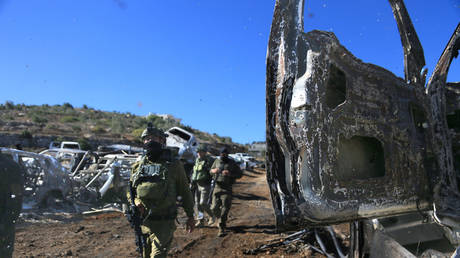
More than 100 vehicles burned to charred frames overnight in the West Bank village of al-Lubban ash-Sharqiya, south of Nablus.
Videos circulated fast on social media and regional news feeds. Flames tore through a scrapyard and mechanic workshop in the al-Qanater area, scorched nearby olive trees and electricity poles, and pushed close enough to homes that residents begged for urgent firefighting help.
If you only watch the clips, you see fire, smoke, and chaos. Look closer, and you see a pattern that keeps repeating across the occupied West Bank. Attacks on Palestinian scrapyards and vehicles aren't random street brawls. They're targeted economic blows aimed at daily livelihoods, often unfolding alongside clashes, military entries, and disputed accounts of what happened.
What Happened in the Scrapyard Attack
Reports from November 2026 describe a group of more than 50 Israeli settlers arriving from nearby settlement outposts near al-Lubban ash-Sharqiya. Accounts from local sources and media reports say assailants poured accelerants onto vehicles at the scrapyard and ignited them, sparking confrontations with village residents before settlers withdrew and Israeli military vehicles entered the area.
Numbers around the damage vary depending on who is doing the math, which is pretty typical right after a major fire. Local reporting states that over 100 vehicles were destroyed, while olive trees and utility poles also took heat damage. One estimate reported by Arab News puts the total cost at $315,000, while a business owner speaking to Viory said losses exceeded three million shekels as they tried to grasp the scale of the wreck.
Honestly, when a small family or local business loses a scrapyard and workshop overnight, the spreadsheet doesn't capture all of it. Spare parts, working tools, repair contracts, and daily cash flow vanish in hours. Replacing that gear in a restricted economy takes months or years.
Why Scrapyards and Vehicles Are Frequent Targets
To understand why arson keeps hitting yards and cars, you have to look at village geography and everyday survival. Al-Lubban ash-Sharqiya sits along a heavily contested corridor south of Nablus, ringed by Israeli settlements such as Eli and Ma'ale Levona. Across the broader West Bank—home to roughly 3.4 million Palestinians alongside around 737,000 settlers across 279 settlements including East Jerusalem, according to figures cited by Arab News—friction points flare constantly.
Vehicles and scrapyards serve two critical functions in rural Palestinian communities:
- Cheap mobility and parts: When checkpoints, road closures, and high import costs make new cars or parts expensive, scrapyards and local mechanics keep older vehicles running for work, errands, and transport.
- Visible, flammable property: Cars and yards sit near roads and village edges, carry fuel and oil, and burn fast once accelerants are applied. They also show up dramatically on phone cameras and drone or security footage.
Rights groups and news outlets have documented a broader rise in settler violence, arson, land bulldozing, and displacement pressures in the West Bank since October 2023. Days after the al-Lubban ash-Sharqiya fire, reporting by i24NEWS covered another wave of overnight vehicle and property arsons and revenge graffiti across villages including Deir al-Sudan, Deir Abu Mash'al, Kafr Malik, and At-Tuwani, with Israeli police opening investigations.
Reading Viral Videos Without Getting Fooled
Whenever an attack goes viral, people jump to conclusions in five seconds flat. Don't do that. Video is useful, and it's also incomplete.
A 20-second clip taken from a balcony or roadway usually shows the aftermath or a narrow slice of the action. It rarely shows who arrived first, what happened ten minutes earlier, or whether troops were already nearby. Worse, old clips from past incidents frequently get recycled during fresh flare-ups and passed off as brand-new footage.
If you're trying to verify what you see online, focus on practical checks:
- Check timestamps and shadows: Look at daylight, street lighting, foliage, and upload histories rather than trusting captions alone.
- Match landmarks: Compare walls, hills, utility poles, and road layouts against verified maps or earlier coverage of the exact neighborhood.
- Separate eyewitness claims from official findings: Local residents, business owners, rights monitors, and Israeli police or military statements often emphasize different details or dispute responsibility. Note clearly who said what.
Common Misconceptions About West Bank Arson
One big misconception is that every arson incident happens in a vacuum without broader context. On the ground, local flashpoints often tie into nearby outposts, road access disputes, or retaliatory cycles.
Another mistake is assuming video proof automatically leads to swift accountability or clear consensus. Investigations can drag out, conflicting accounts persist, and communities dealing with damaged homes, burned trees, and lost income care far more about immediate safety and recovery than online arguments.
Practical Steps If You Track or Report on These Events
Whether you're following regional news, researching human rights documentation, or trying to make sense of viral clips in your feed, a few habits keep you grounded. Save original links and metadata when you spot a video, cross-check numbers across multiple outlets like Arab News, i24NEWS, and international wire or rights reports, and pay attention to the economic ripple effects on ordinary residents long after the smoke clears.
Associated Press scrapyard fire coverage
This video adds visual context from the al-Lubban al-Sharqiya scrapyard fire where the business owner described the blaze and its impact.


