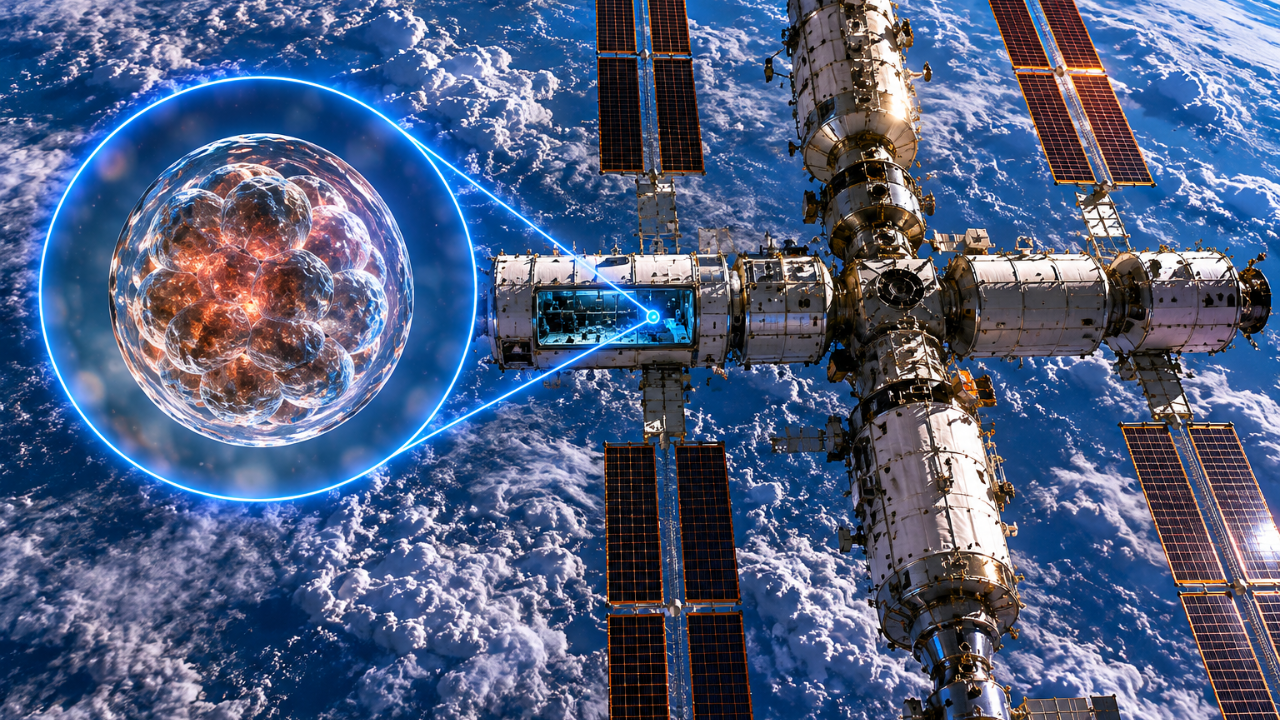
The mainstream media is losing its collective mind over China’s recent launch of human artificial embryos into orbit. The narrative writes itself. It is glossy, futuristic, and fundamentally broken. Headlines scream that microgravity is the secret key to unlocking human reproduction in the stars, that we are witnessing the first steps of a space-born species, and that manufacturing synthetic organs in low Earth orbit will soon become a trillion-dollar industry.
It is a beautiful fantasy. It is also a massive misunderstanding of developmental biology and orbital mechanics.
I have spent years analyzing biotech capital allocation and watching venture funds throw hundreds of millions at anything with "space" or "synthetic biology" in the pitch deck. The current hype surrounding orbital embryology is the pinnacle of this delusion. The breathless coverage misses a harsh, grounded reality. Microgravity is not a catalyst for complex cellular differentiation. It is a chaotic disruptor.
The rush to send stem cells into orbit is not driven by scientific necessity. It is driven by geopolitical theater and PR-hungry startups looking to pump their valuations before the physics catches up to them.
The Gravity Delusion: Why Cells Actually Need 1G
The lazy consensus asserts that removing gravity removes a "constraint" on cellular growth. The theory goes that without the crushing weight of Earth's gravity, synthetic embryos—or blastoids—can grow symmetrically, without distortion, allowing for more natural three-dimensional tissue formation.
This sounds plausible on a PowerPoint slide. It falls apart in a lab.
Mechanical forces are not arbitrary annoyances that biology seeks to escape. They are fundamental signaling mechanisms. Cells utilize mechanotransduction to sense their environment and determine what to become. When a stem cell differentiates into a cardiomyocyte, a neuron, or an osteoblast, it relies on physical stress, shear forces, and structural resistance to trigger specific gene expression pathways.
Imagine trying to build a skyscrapers-tall suspension bridge without knowing which way is down. That is what we are asking an artificial embryo to do in microgravity.
Without the constant vector of 1G, the delicate biochemical gradients that dictate anterior-posterior axis development become fundamentally destabilized. Fluid dynamics change drastically in space. Convection stops. Surface tension dominates. Diffusion becomes the primary mechanism for nutrient transport and waste removal.
This means that instead of a pristine, perfectly formed synthetic embryo, you get a necrotic ball of confused cells. The lack of convection causes metabolic waste to pool around the cellular cluster, suffocating the inner layers while the outer layers receive irregular signaling cues.
The peer-reviewed data bears this out. Decades of microgravity research on simpler cell cultures show severe dysregulation in the cytoskeleton—the structural scaffolding of the cell. Actin filaments misalign. Vinculin expression drops. The cell literally loses its sense of touch and direction. If a mature cell struggles to maintain its integrity in orbit, expecting a highly sensitive, self-assembling synthetic embryo to successfully execute a complex developmental program is sheer delusion.
The Real Threat: The Radiation Tax Nobody Talks About
Let’s pretend for a moment that we can magically solve the mechanotransduction problem with bioreactors that simulate physical stress. You are still trapped in a cage with the real killer of orbital biology: Galactic Cosmic Rays (GCRs) and Solar Particle Events (SPEs).
The public loves to focus on microgravity because it feels sci-fi and weightless. But the real enemy in low Earth orbit, and especially beyond it, is high-energy, heavy ions (HZE ions) like iron ($^{56}\text{Fe}$).
[HZE Ion Impact] ──> [Double-Strand DNA Breaks] ──> [Apoptosis / Chaotic Mutation]
                                                      │
                                                      └──> Result: Developmental Arrest
When an HZE ion tears through a spacecraft hull, it creates a secondary shower of radiation that obliterates molecular bonds. Mature human adults have robust DNA repair mechanisms, and even then, long-term orbital exposure dramatically increases cancer risk. Synthetic embryos, however, are composed of rapidly dividing pluripotent or multipotent stem cells. These cells are highly sensitive to genotoxic stress.
When a high-energy particle strikes a developing blastoid, it does not just cause a minor mutation. It induces complex, double-strand DNA breaks that are notoriously difficult to repair faithfully.
- Earth-bound labs: Radiation exposure is negligible; cells focus energy on replication and differentiation.
- Low Earth Orbit (LEO): Radiation levels are hundreds of times higher than on Earth. Cells divert critical metabolic energy toward constant DNA repair.
- The Result: The embryo enters developmental arrest or triggers apoptosis (programmed cell death). If it does survive, it survives as a chaotic, mutated cluster of tissues that is entirely useless for medical research or therapeutic applications.
To shield these biological payloads effectively, you would need to wrap the bioreactors in meters of water or lead. The launch costs alone would bankrupt any commercial venture attempting it.
Dismantling the People Also Ask Claims
Whenever this topic trends, the same set of questions bubbles up to the top of search engines. The answers provided by popular science outlets are almost universally wrong because they are trying to sell a dream rather than explain the biophysics.
Can we grow human organs in space for transplantation on Earth?
No. This is the ultimate venture capital grift. The argument is that microgravity allows us to 3D-bioprint organs without structural scaffolds that collapse under their own weight on Earth.
Here is the truth: printing the tissue is the easy part. Vascularization—the creation of a functional, microscopic network of blood vessels to keep the inside of the organ alive—is the bottleneck. Microgravity does not solve vascularization. In fact, because endothelial cells (the cells that line blood vessels) require shear stress from fluid flow to form proper tubes, microgravity actively hinders the creation of functional capillaries.
Even if you managed to print a non-collapsed liver in orbit, you then have to bring it back down. The high-G forces and intense vibrations of re-entry would turn your delicate, scaffold-free orbital organ into expensive, non-functional mush before the capsule even hit the Pacific Ocean.
Will space-born embryos help us colonize Mars?
This question puts the cart so far ahead of the horse it’s in another zip code. We cannot even maintain a healthy reproductive cycle in mice over multiple generations in microgravity.
To suggest that sending synthetic human embryos into orbit today provides a roadmap for Martian colonization ignores the vast gap between an early-stage blastoid in a temperature-controlled, nutrient-rich automated cassette and a full human gestation cycle. A human pregnancy relies on an incredibly complex, localized hormonal and physical dialogue between the maternal uterus and the placenta. A synthetic embryo floating in a plastic dish tells us absolutely nothing about how a placenta attaches, functions, or fails in fractional gravity.
Follow the Money: The Geopolitical PR Machine
If the science is so profoundly flawed, why are global superpowers and highly valued startups pouring capital into it?
Because it is excellent theater.
Space exploration has shifted from an era of flags and footprints to an era of biological dominance. Sending human artificial embryos into orbit is the ultimate flex of a nation’s dual-use technological capability. It signals to the world that you possess:
- Automated, automated microfluidic systems capable of keeping delicate biological systems alive autonomously for weeks.
- Advanced orbital retrieval systems.
- Breakthrough capabilities in synthetic biology and gene editing.
It is a marketing campaign designed to attract top-tier global talent and sovereign wealth funding. I have sat in rooms where executives openly admit that the "space angle" adds a 3x premium to their valuation during fundraising rounds, even if 99% of their actual research and viable product development happens in a boring suburban lab facility in Ohio or Shenzhen.
The commercial entities hyping these experiments are leveraging the "space halo effect." Investors see a rocket launch and assume the underlying science must be flawless, forgetting that rockets can launch junk science just as easily as they launch communication satellites.
The Earth-Bound Counter-Intuitive Truth
The absolute irony of the entire orbital biology movement is that the most valuable discoveries are happening by doing the exact opposite: simulating microgravity on Earth using random positioning machines (RPMs) or clinostats, and then immediately applying those insights to terrestrial medicine.
We do not need to go to space to see how cells behave when mechanical loading is removed. We can simulate it for a fraction of the cost in any university basement. When you look at the actual papers published from these orbital missions, the data points aren't revealing magical new pathways to immortality. They are showing us exactly how fast biology degrades when you remove it from the environment it spent 3.8 billion years evolving to exploit.
The real value of studying cells in simulated microgravity is that it accelerates the aging process. It models bone density loss, muscular atrophy, and immune system dysfunction at an accelerated rate.
The Terrestrial Pivot: The smartest companies in this space aren't trying to manufacture products in orbit. They are using simulated weightlessness on Earth to quickly screen drugs that fight age-related diseases here on the ground.
They are using the degradation data to cure osteoporosis and sarcopenia on Earth, not to build factories in the stars.
Stop looking at the stars for the future of human biology. The orbital embryo narrative is an expensive, radiation-soaked distraction designed to separate naive capital from its cash. The laws of biophysics are non-negotiable, and they are firmly anchored to the ground beneath your feet.