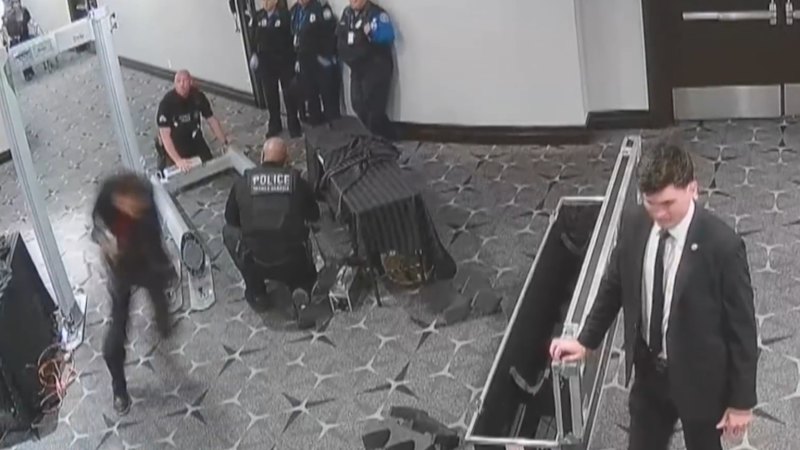
A 31-year-old man from California managed to bypass the outermost security layer of the White House Correspondents’ Association dinner on April 25, 2026, by simply booking a room at the venue weeks in advance. Newly released surveillance footage confirms that Cole Tomas Allen, armed with a shotgun and a pistol, exploited a fundamental gap in Secret Service "bubble" logistics: the internal guest list of the Washington Hilton. While official narratives initially focused on the heroics of the agents who subdued him, the visual evidence tells a more troubling story of a security apparatus that was functionally blind to a threat already inside the perimeter.
The security plan failed because it relied on a rigid, outward-facing shell that did not account for "stay-behind" threats. Allen had checked into the hotel on April 24, a full day before the event, allowing him to observe the setup of magnetometers and the rotation of guard shifts from the comfort of the hotel lobby. When the dinner began, he didn't need to fight his way in. He was already there.
The Illusion of the Hardened Perimeter
Standard protective operations for high-profile events involve a "clean sweep" of a venue, yet the Washington Hilton remained a functioning hotel leading up to the dinner. This creates a hybrid environment where elite security measures overlap with standard hospitality. The footage shows Allen running through a security checkpoint on the Terrace Level at approximately 8:40 p.m. He was carrying a long gun.
The Secret Service maintains that the "security plan worked," citing the fact that the suspect was apprehended before reaching the ballroom. However, the footage reveals a chaotic several seconds where agents were caught off guard by an individual moving from the interior of the hotel toward the secured zone, rather than trying to enter from the street. This directional lapse is a classic oversight in high-stakes protection. It assumes the enemy is always at the gate, never in the elevator.
The Mystery of the First Shot
One of the most contentious elements of the investigation involves the gunfire that erupted near the magnetometer. Initial reports from the Department of Justice suggested that a Secret Service officer, referred to in court documents as "V.G.," was shot in the chest but saved by a ballistic vest. Recent court filings and an analysis of the CCTV footage have blurred this timeline.
While a spent shell was found in Allen’s shotgun, the video does not clearly show him aiming or firing at the officer. In fact, some investigators are now scrutinizing whether the injury to the agent was a result of friendly fire during the rapid-response swarm. The suspect, despite being the target of five rounds fired by the Secret Service, suffered only minor injuries and was not actually hit by any of the bullets. This discrepancy between the volume of fire and the actual result raises questions about the tactical execution under pressure in a crowded, high-stress environment.
Logistics of an Assassination Attempt
Allen’s preparation was not the work of a sophisticated operative, yet it was effective enough to reach the inner sanctum of American political power. He traveled across the country by train, likely to avoid the stricter firearms scrutiny found at airport TSA checkpoints. By Aug. 17, 2025, he had already purchased the 12-gauge pump-action shotgun used in the attack.
Technical planning factors discovered in his hotel room included:
- A shoulder holster and ammunition bag.
- Pliers and wire cutters, presumably for breaching internal barriers.
- A "manifesto" email sent minutes before the attack, where he used the alias "coldForce."
The use of buckshot instead of slugs, mentioned in his writings as a way to "minimize casualties" through walls, suggests a chillingly methodical approach to a high-capacity environment. He wasn't just looking to cause chaos; he was calculating the physics of the room.
The Intelligence Gap
The FBI has confirmed that Allen made his hotel reservation on April 6, 2026. This means the name of a future would-be assassin sat on a digital ledger for nearly three weeks within the very building where the President of the United States would be speaking. The Secret Service frequently vets guest lists for such events, but the sheer volume of "civilian" data in a massive hotel often leads to signal-to-noise problems.
If the Secret Service is to prevent a repeat of this breach, the vetting process must move beyond the guest list of the event and into the guest list of the infrastructure. The failure to flag a cross-country traveler with a history of extremist digital footprints—who just happened to book a room overlooking the presidential entrance—is a failure of modern intelligence integration.
The footage of Allen rushing the checkpoint serves as a stark reminder that the most advanced weapons and the bravest agents are secondary to the quality of the "invisible" security: the data, the vetting, and the recognition that a hotel room key is the most effective bypass for a million-dollar security gate.


