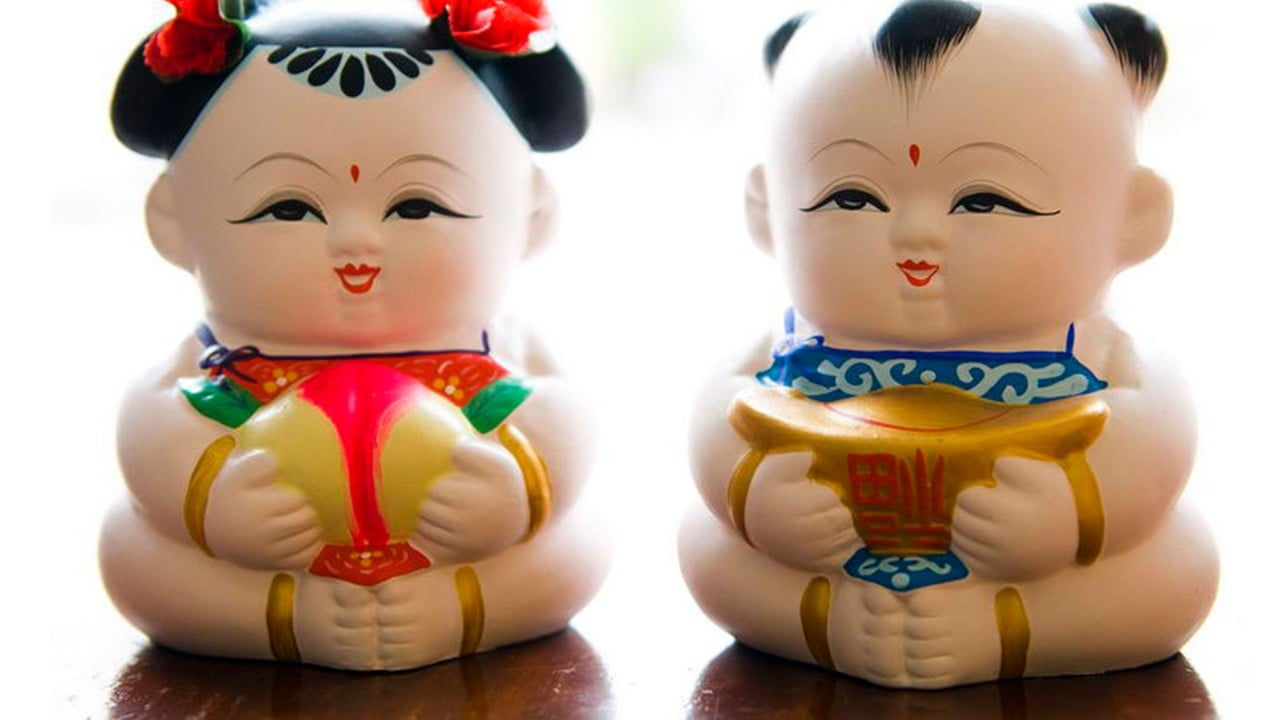
The smell of wet earth in Wuxi always brings back the same memory. It is the scent of the Grand Canal after a heavy summer rain, mixed with the sharp, metallic tang of the charcoal braziers used to bake clay. If you wander through the old narrow alleys near Huishan, you will see them sitting on every windowsill and store counter. They are squat, impossibly chubby clay dolls painted in blinding shades of crimson, emerald, and gold.
To the casual traveler rushing to catch a high-speed train, these figures—known across China as Da A Fu, or "Great Good Fortune"—are nothing more than traditional kitsch. They look like overfed infants hugging giant green fish or squeezing mythical beasts. They look cheerful. They look simple.
They are an illusion.
Years ago, I sat across from an old craftsman named Master Chen. His hands were permanently stained with the grey-brown silt of the local hills, his fingernails split from decades of kneading earth. He held a half-formed clay boy in his palms, smoothing out the rolls of a disproportionately thick neck.
"People buy these because they want wealth," Chen said, his voice a low rasp over the scraping of his wooden carving tools. "They think it is just a folk charm for money. They do not see what is staring them right in the face."
He turned the doll toward me. In the dim light of his workshop, away from the neon glare of the tourist streets, the expression on the toy’s face changed. The bright, cartoonish smile faded into something else. The eyes were heavy-lidded, cast downward in a gaze of profound, immovable stillness.
That was the moment I realized the truth. These dolls are not just toys. They are ancient spiritual camouflage.
The Art of Hiding a God in Plain Sight
To understand why a holy symbol had to wear the skin of a fat child, you have to understand the terror of the mid-Tang dynasty. Imagine living in an era where an imperial decree could obliterate your entire way of life overnight. In the year 845, Emperor Wuzong launched a massive persecution of Buddhism. Temples were razed to the ground. Bronze bells and copper statues were melted down into currency. Monks and nuns were forced back into secular life or driven into hiding.
Faith did not vanish. It merely changed its shape.
Consider the problem facing a devout peasant artisan in the Yangtze River delta during those bloody years. You cannot keep a statue of the Buddha in your home; doing so invites execution. But the human heart demands a focal point for its devotion.
The solution was brilliant in its audacity. The artisans took the core iconographic markers of Buddhist divinity and melted them into the form of a traditional Chinese child. If an imperial official walked into a peasant's mud-brick cottage, he would see only a harmless folk toy, a symbol of domestic abundance and fertility. He would walk away satisfied.
But the peasant knew. When they looked at the doll, they were not looking at a baby. They were looking at the enlightened mind.
The Geometry of Enlightenment
Master Chen set his carving knife down and pointed to the ears of the figurine. On a normal child, the ears are small, tucked neatly against the skull. On the Da A Fu, they are grotesque. They are elongated, heavy lobes that stretch almost down to the doll's plump shoulders.
"This is not a mistake in anatomy," Chen whispered, tracing the curve of the clay lobe with a wet thumb. "The old masters knew exactly what they were doing."
In Buddhist iconography, long earlobes are one of the thirty-two physical marks of a Great Man, a Buddha. They signify an individual who has renounced the wealth of the world—symbolizing the heavy, expensive earrings worn by princes that stretch the skin over time. More than that, they represent the capacity to hear the cries of suffering from all corners of the universe.
When you look at a Da A Fu, the ears are the first major giveaway. The artisan has intentionally stripped away the aristocratic jewelry but kept the physical consequence of spiritual listening.
Then there is the posture. The figurines are almost always depicted sitting down, their legs crossed or tucked in a manner that feels unnaturally stable for an infant. It is a modified lotus position. The lower half of the body forms a solid, triangular base, a physical manifestation of perfect equilibrium.
I watched Chen press his thumbs into the chest of a new doll, creating a subtle, rounded protrusion right at the solar plexus.
"The breath goes here," he explained. "Not in the throat. In the deep center."
This brings us to the facial expression itself. If you look closely at the mouth of an authentic, hand-carved Da A Fu, the smile is not one of manic glee. The lips are parted just a fraction of a millimeter, the corners curved upward in a subtle, inscrutable line. It is the exact smile of Maitreya, the future Buddha, or the serene countenance of a Chan master who has achieved sudden realization. It is a smile born of internal peace, completely detached from the chaotic dramas of the external world.
The Lion and the Scroll
The symbols are not confined to the anatomy of the children. They are woven into the objects they hold.
Most modern reproductions show the Da A Fu clutching a massive carp. This is a later secular corruption, a play on words where "fish" sounds like "surplus" in Chinese. But the older, more authentic regional variants tell a completely different story.
In the classic Wuxi tradition, the child is often shown holding down a ferocious, green-skinned beast. To the uninitiated, this is the Qingshi, a mythical lion-dog from local folklore meant to ward off evil spirits. But to anyone versed in the sutras, the green lion is the specific mount of Manjushri, the Bodhisattva of Transcendent Wisdom.
Manjushri rides the lion to symbolize the taming of the wild, unbridled human ego through the power of sharp intellect and clear seeing. By placing a chubby child on top of this roaring beast, the ancient sculptors were making a profound theological statement: true wisdom looks like innocence. The enlightened mind does not conquer through violence or brute force; it subdues the wildness of existence through a gentle, unshakeable purity.
Other figurines hold a scroll or a ruyi scepter. The scroll is not a schoolboy's text; it represents the Dharma, the ultimate teachings that survive even when the grand stone monasteries are burned to ash.
But why a child? Why not a hidden warrior or an old man?
The answer lies at the very heart of Chan Buddhism, which flourished in the region around Wuxi and Suzhou. The school of thought placed immense value on what it called the "child's mind" or the "beginner's mind." An adult is full of biases, anxieties, and rigid categories. An adult looks at a mountain and sees timber or property.
A child simply sees the mountain.
By representing the highest spiritual achievements through the body of an infant, the artisans were reminding themselves—and us—that the path to ultimate truth is a process of unlearning. To find the Buddha within, you must strip away the armor of adulthood and return to a state of radical openness.
The Preservation of the Mud
On my last evening in Wuxi, the rain returned, drumming a steady rhythm against the corrugated tin roof of Chen's workshop. The air grew cold, but the small room stayed warm from the heat of the drying kiln.
I looked at the rows of completed figurines waiting to be painted. In their unglazed, raw state, made entirely of the dark, iron-rich mud of Mount Huishan, they looked like they had grown straight out of the earth itself.
There is an inherent vulnerability in clay. It cracks if it dries too fast. It shatters if it is dropped. Yet, this fragile medium managed to carry an illegal, revolutionary spiritual tradition through centuries of war, dynastic collapse, and ideological purges.
The people who made these did not write long theological treatises. They did not leave behind names that ended up in history books. They were peasants who spent their days with wet mud under their fingernails and smoke in their eyes.
But they possessed a quiet, stubborn genius. They understood that power is not always found in massive stone structures or grand proclamations. Sometimes, the most resilient things in the world are the things that look completely harmless.
A soldier can smash an altar. A bureaucrat can burn a library. But nobody arrests a child's toy.
As the kiln fire flickered, casting long, dancing shadows across the workshop walls, the chubby clay faces seemed to watch the dark room with total indifference to the passage of time. They had survived emperors, floods, and the slow erosion of their true meaning by modern consumerism. They would survive this night, too.
The true secret of the Da A Fu is that the treasure was never really buried. It was placed on the shelf, painted in loud colors, and left out for everyone to see. It is still there, waiting for anyone willing to look past the bright paint and see the silent god waiting beneath the clay.