The steel hull of a bulk carrier groans under the weight of forty thousand tons of Ukrainian wheat. It is a sound that carries across the dark, choppy expanse of the Black Sea, a sound as old as trade itself. But today, that groan is different. It carries the weight of a planet’s hunger and the chilling realization that these waters, once a bridge for civilizations, have become a tripwire for global stability.
When the Ukrainian Foreign Minister speaks of the Black Sea, he isn't just talking about naval charts or territorial limits. He is talking about the jugular vein of the world. For a different look, read: this related article.
Think of a small bakery in a crowded neighborhood in Cairo. The baker, Ahmed, wakes up at four in the morning. He doesn't track drone strikes in Crimea. He doesn't analyze the displacement of the Russian Black Sea Fleet. He only knows that the price of flour has doubled, then tripled, and that the long line of people waiting for bread at sunrise is growing more desperate. To Ahmed, the war isn't a geopolitical puzzle. It is a ghost in his oven.
The Geography of a Chokepoint
The Black Sea is a unique geographical trap. It is almost entirely enclosed, a watery cul-de-sac connected to the rest of the world by the narrow needle-eye of the Bosphorus Strait. For centuries, this was a blessing. It was a sheltered workshop for trade, a place where the Silk Road met the sea. Now, that enclosure is a curse. Further coverage on this trend has been provided by The Washington Post.
When Russia launched its full-scale invasion, the Black Sea transformed overnight from a commercial highway into a minefield. The "grain corridor" became a phrase we all had to learn, a fragile diplomatic thread that allowed food to escape the war zone. But threads snap.
Modern warfare has rewritten the rules of maritime security. We used to think of naval power in terms of massive cruisers and aircraft carriers—the giants of the deep. Ukraine, a country without a functional traditional navy, changed that. They used "sea babies"—low-profile, explosive-laden drones that look like something out of a garage workshop—to challenge a superpower’s fleet.
This is the central irony of our current moment. The world’s food security rests on the ability of these small, high-tech mosquitoes to keep the giants at bay. If the Black Sea becomes a "Russian lake," the price isn't just paid in blood on the shores of Odesa. It is paid in every grocery store in London, every food stall in Jakarta, and every government ministry trying to prevent bread riots.
The Invisible Stakes of the Deep
We often view war through a telescope, focusing on the front lines and the trenches. But the economic shocks of the Black Sea conflict are more like a slow-acting poison. It seeps into the global supply chain, invisible until the symptoms become terminal.
Consider the insurance industry. It sounds dry. It sounds like a world of spreadsheets and gray suits. But insurance is the silent engine of global trade. No captain will sail a ship into a war zone without it. When a missile hits a civilian port or a sea mine drifts into a shipping lane, the "war risk" premiums skyrocket. Suddenly, even if the grain is sitting in a silo ready to go, it is too expensive to move.
The Ukrainian Foreign Minister’s warning is a plea for the world to look beneath the surface. He is arguing that if the Black Sea is lost to international law, the very concept of "freedom of navigation" dies with it. If one nation can unilaterally close a global transit point, then no sea is safe. The South China Sea, the Persian Gulf, the English Channel—they all become subject to the whims of the strongest neighbor.
A Harvest Under Fire
I spoke once with a farmer near Mykolaiv. Let’s call him Viktor. Viktor’s fields are within earshot of the artillery. He told me that his greatest fear wasn't the shells. It was the silence.
"If I grow this wheat and it stays in the barn to rot because the ships cannot come," Viktor said, "then I am just growing a funeral for my country."
Viktor’s wheat is meant to feed hundreds of thousands of people he will never meet. The logistical chain that connects his tractor to a dinner table in Lebanon is a miracle of modern efficiency, now being dismantled by old-world aggression. This is the human element the dry news reports miss. Each ship that clears the Bosphorus is a victory for Viktor, and a reprieve for someone like Ahmed in Cairo.
The Black Sea is also the site of an unprecedented environmental disaster. The acoustic trauma of naval sonar and underwater explosions is killing thousands of dolphins, their bodies washing up on the shores of Turkey, Romania, and Bulgaria. The sea is literally screaming, but the sound is at a frequency we choose to ignore.
The New Architecture of Security
Security is no longer just about borders. It is about flow.
The Ukrainian strategy has shifted from defense to "asymmetric denial." They realized they didn't need a hundred ships to secure the sea; they just needed to make the sea too dangerous for the enemy to occupy. This is a terrifying, brilliant evolution in technology. It means that in the future, any coastal nation with a few million dollars and some talented software engineers can hold a global trade route hostage.
The "security of the world" being played out in these waters is a test case for the twenty-first century. If the international community allows the Black Sea to remain a zone of lawless blockade, we are signaling the end of the globalized era. We are returning to a world of fortresses and famines.
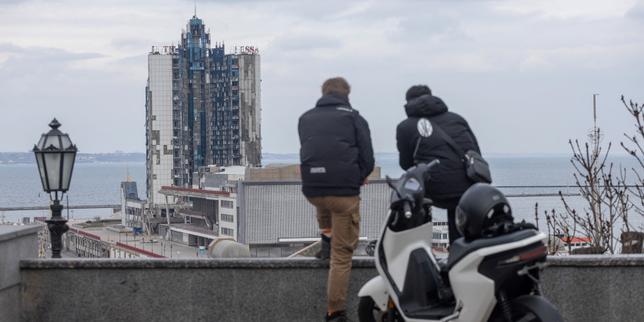
There is a specific kind of salt air in Odesa. It smells of history, of trade, and, lately, of smoke. Standing on the famous Potemkin Stairs, looking out toward the horizon, you realize that the horizon is much closer than it looks. The distance between those waves and your own dinner table is shorter than you think.
The grain ships continue to move, for now. They move through a corridor guarded by drones and diplomacy, by courage and cold calculation. They are the most important vessels on the planet.
Each one is a defiance of the gravity of war. Each one is a promise kept to the hungry. And as the sun sets over the dark water, casting a long, golden path toward the west, the world waits to see if that path remains open, or if the darkness will finally claim the sea.
The bread in Ahmed's oven is still rising. But the heat that bakes it is coming from a fire burning thousands of miles away.