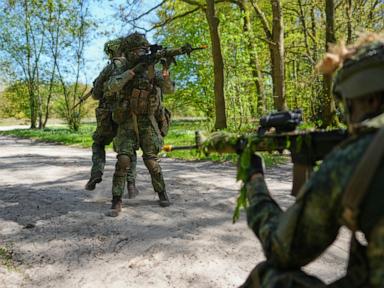
Princess Alexia of the Netherlands recently spent her days visiting the Dutch Air Force and Army, firing weapons and touring bases. The media treats this as a masterstroke of recruitment—a royal endorsement to spark a flame of patriotism in a generation that views "service" as something a delivery app provides.
It is a lie.
The belief that celebrity endorsements or royal "working visits" can fix the structural rot in European military readiness is a fantasy. We are watching a PR campaign attempt to solve a hardware and human capital crisis. While news outlets gush over the "royal boost" to volunteer numbers, they ignore the math. You cannot fight a high-intensity conflict with a handful of inspired influencers and a backbone of part-time weekend warriors.
Europe is currently obsessed with the idea of "voluntary service" models as a middle ground between the political suicide of conscription and the reality of empty barracks. It won't work. Here is why the current strategy is failing and what the cold, hard reality of 21st-century warfare actually demands.
The Myth of the Influencer Soldier
The Dutch model relies on the Dienjaar, or "Year of Service." The idea is simple: entice young people with a gap-year experience that looks good on a resume. They get to shoot some guns, drive some trucks, and feel part of something bigger.
But an army is not a summer camp.
Modern warfare has moved past the era of the "citizen-soldier" who can be trained in twelve weeks to be effective on a peer-to-peer battlefield. Look at the data coming out of recent high-intensity conflicts. The learning curve for electronic warfare, drone integration, and advanced anti-tank systems is steep.
By the time a Dienjaar volunteer becomes even marginally proficient, their year is up. They go back to university or their desk job. The military is left with a massive training bill and zero retained capability. We are essentially subsidizing a high-adrenaline vacation for Gen Z while the professional core of the military continues to hollow out.
Why Quality Is a Trap
Military analysts love to talk about "quality over quantity." They argue that a small, highly tech-savvy force is superior to a mass of conscripts. This is a comforting thought for European treasuries because "small" is cheap.
It is also wrong.
Mass still matters. In a war of attrition, you lose equipment and people at a rate that would make a "quality-focused" European army disappear in three weeks. The Dutch military, for all its royal glamour, is a micro-force. When you have only a few dozen functional tanks and a handful of brigades, your "quality" is irrelevant once the enemy decides to trade three of their cheap units for one of your expensive ones.
The royals aren't boosting the military; they are masking its insignificance. We are prioritizing the feeling of being protected over the actual mechanics of defense.
The Professionalism Paradox
I have watched defense departments spend millions on "lifestyle" marketing. They try to sell the military as a place for personal growth and "finding yourself."
This creates the wrong culture.
If you recruit people based on what the military can do for them, you get a workforce that leaves the moment the cost-benefit analysis shifts. True military effectiveness is built on a foundation of professional violence and endurance. By softening the image to attract "volunteers," you dilute the very grit required to survive a real war.
If we want a serious military, we have to stop treating it like a social program.
The Economic Delusion of Voluntary Service
Let’s talk about the money. The "voluntary" model is an economic black hole.
- High Churn: You spend the same amount training a one-year volunteer as you do a four-year professional, but you get 75% less "utility" out of them.
- Infrastructure Bloat: To house and train a rotating door of volunteers, you need a massive training command that doesn't actually contribute to the front-line "tooth" of the army.
- Opportunity Cost: These volunteers are often the most capable young people in the economy. Pulling them into a superficial military role for a year without a path to long-term service is a net drag on GDP with no strategic payoff.
A Thought Experiment in Reality
Imagine a scenario where a NATO member faces a localized incursion. The "Royal-inspired" volunteers are called up. These are people who haven't touched their equipment in eighteen months. They are integrated into units with professional soldiers who don't trust them because they haven't bled together in training. Communication breaks down. The "tech-savvy" gap-year kids realize that real electronic warfare isn't like playing a video game; it’s being hunted by loitering munitions while your radio screams static.
The result isn't a "boost" to numbers. It's a liability on the battlefield.
The Real Solution Nobody Wants to Admit
If Europe is serious about defense, it needs to stop looking at the Dutch model and start looking at the hard truths of geography and history.
First: Industrialize, Don't Just Recruit
A million volunteers are useless if you don't have the artillery shells to give them. Europe’s defense industry is a fragmented mess of national protectionism. We need a unified production base that treats 155mm shells like a commodity, not a luxury boutique item.
Second: The Professional Premium
Instead of spending money on "Year of Service" programs, we should be doubling or tripling the pay of the professional NCO (Non-Commissioned Officer) corps. These are the people who actually win wars. We need to make military service a high-status, high-paying career that competes with Silicon Valley, not a "charity" project for royals to visit.
Third: Specialized Reserves, Not Generalist Amateurs
The only "volunteer" model that works is one based on specific skills. We don't need more "riflemen" who can't aim. We need civilian cyber-security experts, logistics managers, and engineers who are integrated into the reserve force on a permanent, high-readiness basis.
The Sovereignty Tax
We have been living under the "Peace Dividend" for so long that we think defense is an optional line item. We think we can "nudge" our way to security with clever branding and royal photo ops.
Defense is a tax on sovereignty. If you aren't willing to pay it in cash and professional commitment, you will eventually pay it in territory and blood.
The Dutch royals mean well. They are doing their duty as symbols of the state. But don't confuse symbolism with strength. A princess in a flight suit is not a deterrent. A thousand more gap-year volunteers will not stop a cruise missile.
Stop asking how we can make the military "appealing" to the youth. Start asking how we can make it terrifying to our enemies. Those two goals are rarely the same. If the army looks like a fun place for a royal visit, it’s probably not an army that can win a war.
Get real or get conquered.