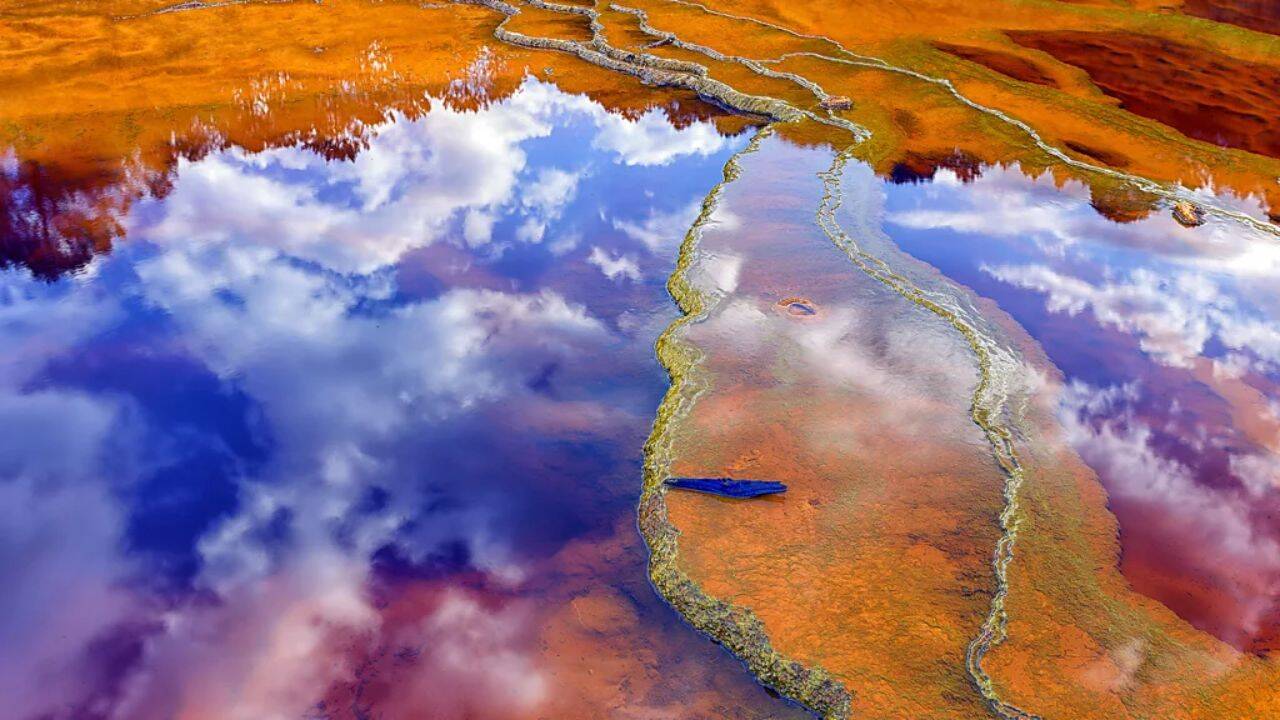
Water is supposed to clear your thirst. It is supposed to reflect the sky, catch the morning sun, and offer a cool, safe sanctuary for life. But walk into the southwestern corner of Spain, step close to the banks of the Río Tinto, and you will find a liquid that looks like liquid rust.
It flows heavy. It flows crimson.
When I first stood on those iron-stained banks, the air smelled sharp, metallic, and heavy with a sulfurous bite that caught in the back of my throat. My boots crunched on crusts of ochre and yellow minerals, the earth painted in brutal strokes of orange and amber. It felt less like walking on a living planet and more like stepping onto an active film set for an alien world.
Yet, this isn't science fiction. This is Huelva, Spain. And for centuries, humans looked at this blood-red water and saw a dead thing. A curse. A poisonous scar left behind by ancient copper miners who ripped the belly of the earth open three thousand years ago.
They were wrong.
The Myth of the Dead River
For generations, local lore painted the Río Tinto as an environmental tragedy. Acidic. Heavy with toxic metals. Devoid of breathing, pulsing life.
Consider what happens when you pour raw acid into a normal stream. Fish vanish. Plants rot. The ecosystem collapses into a silent, muddy grave. That is what scientists assumed happened here. They saw a pH level that could dissolve an iron nail in days, laced with staggering concentrations of copper, iron, and arsenic, and they checked the box marked sterile.
They didn't look close enough.
(Note: When scientists speak of extreme environments, they use terms like "extremophiles," but let's drop the jargon. We are talking about microscopic survivors.)
Down in the dark, churning current, far beneath the rust-colored foam, things are eating the poison. Tiny, single-celled organisms thrive in this chemical nightmare. They don't just tolerate the acid; they feast on the dissolved iron and sulfur, breathing out more acid as a byproduct. They turn heavy metals into energy.
Imagine living in a house filled with toxic gas, breathing it in, and growing fat and happy on the fumes. That is the daily reality for the extremophiles of the Río Tinto.
When researchers from NASA first packed their gear and drove out to these Spanish hills, they weren't looking for local swimming holes. They were hunting ghosts. Specifically, the ghost of an ancient, watery Mars.
Red Dirt and Rusty Clues
Look up at the night sky. Or better yet, look at the high-resolution photographs beaming back from the surface of the Red Planet. You see vast, rust-colored plains. You see sulfate-rich mineral deposits carved by ancient, vanished fluids. You see iron oxides staining the craters.
Now, look down at your boots on the banks of the Río Tinto.
The color palette is identical. The mineral signatures match with an eerie, textbook precision. For years, planetary scientists argued fiercely over how Mars could have formed its signature red dust and sulfate deposits without widespread, friendly oceans. They needed a terrestrial laboratory. They needed a place on Earth where iron-rich rocks, subterranean microbes, and extreme acidity collide to create a living planetary portrait.
They found it here.
(To be clear: No one is claiming that Spain secretly harbors little green men or swimming martian fish. The astrobiological connection is microscopic, metabolic, and profoundly structural.)
When the Viking landers touched down on Mars in the nineteen-seventies, and later when rovers like Curiosity and Perseverance began drilling into the Martian crust, the data they sent back pointed directly to environments just like this one. The sulfate minerals discovered in the rocks of Meridiani Planum on Mars formed in watery settings remarkably similar to the basin of the Río Tinto.
If life could claw its way into existence in a boiling, metal-choked river in Spain, eating rocks to stay alive, why couldn't it do the exact same thing three billion years ago on a wet, young Mars?
That is the hidden stake of this red water. It isn't just about a weird river in Andalusia. It is about rewriting the census of the cosmos.
What the Microbes Know
To understand how life works here, you have to shrink down to a scale the human eye refuses to process.
Picture a bacterium no larger than a speck of dust, armored in proteins that refuse to denature in acid. It doesn't care about the toxic soup around it. To this organism, copper and iron are not poisons; they are a hearty breakfast.
We often make the arrogant mistake of thinking life requires comfort. We look for the Goldilocks zone—not too hot, not too cold, just the right amount of gentle sunlight and pure H2O. We build our cities in temperate valleys. We plant our crops in soft, neutral soil. We assume that if a place looks like hell to us, it must be empty.
The Río Tinto shatters that arrogance.
Life is stubborn. It is opportunistic, greedy, and relentlessly inventive. Given a scrap of chemical energy, a splash of water, and a few minerals to chew on, life will find a crowbar, wedge it into the crack of an impossible environment, and force the door wide open.
When NASA astrobiologists take samples from the red riverbed, they are testing instruments that will eventually scan the subsurface ice of Mars or the freezing oceans of Europa. They are asking a simple question: Can our sensors recognize life when it doesn't look anything like us? When it doesn't breathe oxygen, doesn't chase prey, and lives deep underground in the dark?
The river becomes a training ground. Every test tube filled with crimson water is a rehearsal for humanity's greatest upcoming question: Are we alone?
The Echo in the Red Dust
Standing by the water as the evening sun dips low behind the Andalusian hills, the red mud catches the light and glows like hot embers. The wind picks up, whispering through the sparse pine trees that line the valley.
Thousands of miles away, a robotic rover the size of a car is rolling across the desolate, rust-colored dunes of Gale Crater, firing lasers at rocks, sniffing the thin carbon dioxide atmosphere, and tasting the dust. It is searching for the exact same chemical footprints left behind in the mud at our feet.
The Río Tinto bleeds into the Atlantic Ocean miles away, its fiery signature slowly diluting into the vast, indifferent blue of the sea. But the secret it carries—the stubborn, defiant whisper of life holding on by its fingernails in the most brutal conditions imaginable—remains locked in the stone.
It tells us that wherever water once pooled in the dark corners of the universe, no matter how harsh, how acidic, or how violently red, we should never assume the story ended before it ever had a chance to begin.