The air smells of wet asphalt, river mud, and toasted sesame leaves. On the banks of the Shing Mun River, the rain does not fall so much as it hangs, a heavy, gray gauze that blurs the jagged skyline of Shatin. By all accounts of the morning weather broadcast, this should be a day for staying indoors. The sky is the color of a bruised plum. The moisture is absolute, sticking to the skin and turning cotton shirts into heavy, damp armor.
Yet, thousands of people are standing shoulder to shoulder along the concrete railings.
They are not here despite the weather. They are here because the weather is entirely beside the point. To understand the Dragon Boat Festival—the Tuen Ng Festival—you have to look past the tourist brochures that paint it as a sun-drenched spectacle of color and speed. At its core, it is a negotiation with the elements. It is an annual defiance of the damp, heavy uncertainty of the changing season.
A sudden crack splits the air. It is not thunder. It is the skin of a cowhide drum being struck with two heavy wooden mallets.
Boom.
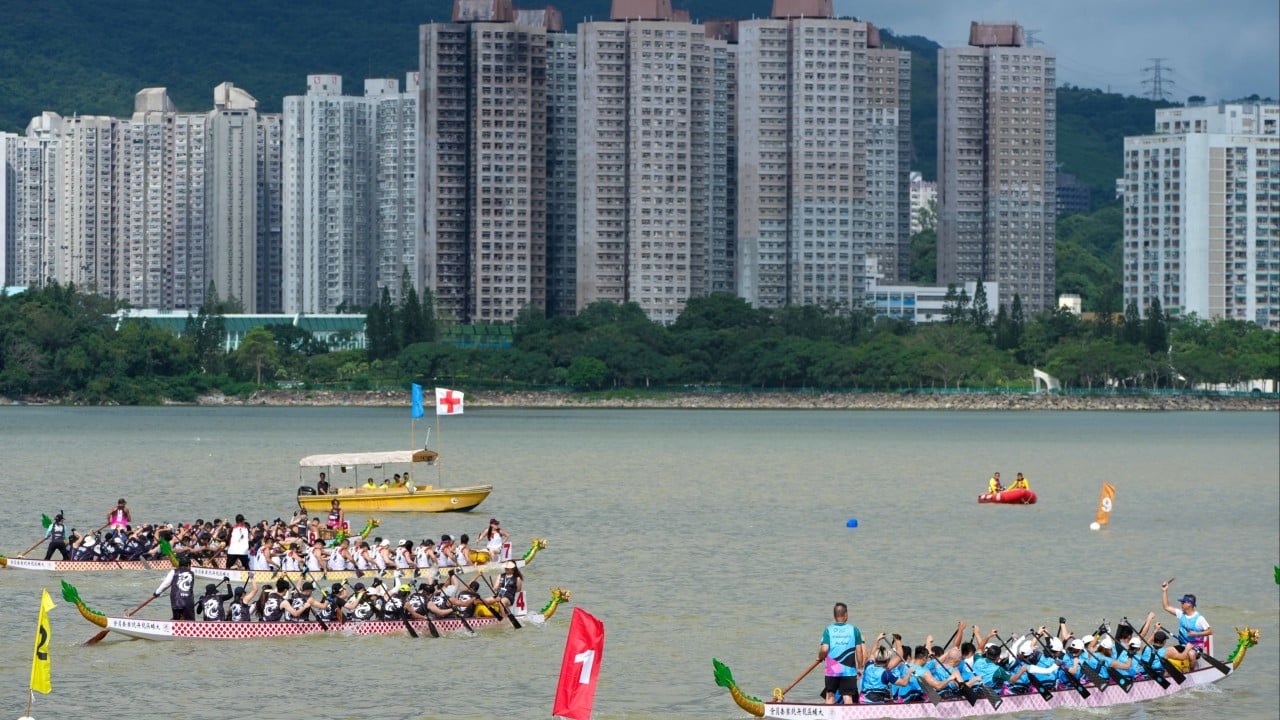
The sound vibrates in the sternum before it reaches the ears. In the narrow fiberglass hull of a fifty-foot boat, twenty paddlers dig their blades into the murky water at the exact same millisecond. The boat lifts. It doesn't merely move forward; it jumps, throwing up a spray of white water that mixes instantly with the falling rain. For the next three minutes, twenty distinct lives are compressed into a single, agonizingly simple imperative: keep the rhythm or sink.
The Choreography of Suffocation
To appreciate what is happening on the water, you have to look at the person in the middle of the boat who isn't holding a paddle. This is the drummer.
Imagine, metaphorically, a corporate team where everyone is pulling as hard as they can, but everyone is listening to a different song. That boat spins in circles. The drummer is the literal heartbeat of the vessel. If the drum slows by even two beats per minute, the paddles behind them collide, wood clacking against wood, momentum dying instantly. If the drum accelerates too quickly, the muscles of the crew fill with lactic acid fifty meters before the finish line.
Consider the physical reality inside the boat. The seats are narrow wooden benches. There are no backrests. Your feet are wedged under the strap of the stretcher in front of you. Every time you lean forward to bury the paddle, the person behind you is leaning over your shoulder. The air is thick, hot, and thin on oxygen, trapped beneath the low cloud cover.
By the halfway mark of the three-hundred-meter course, the lungs begin to burn. The human brain, wired for survival, screams at the arms to slow down, to preserve oxygen, to protect the heart. This is the moment where races are lost. It is not a test of lung capacity; it is a test of collective submission. You have to trust that the person behind you is hurting just as badly as you are, and that they are choosing not to stop.
When the boats pass the grandstand, the noise is deafening. The crowd is a sea of umbrellas—monochrome black, neon pink, clear plastic—shaking in time with the commentary blaring from the loudspeakers. The rain picks up, turning into a steady, driving downpour that stings the eyes of the competitors.
From the shore, it looks like a beautiful, ancient tradition preserved for the cameras. But on the water, it is an ugly, beautiful brawl against gravity and fluid dynamics.
The Weight of the Rice Leaf
Away from the roar of the finish line, beneath the concrete overpasses and inside the cramped kitchen tents lined up along the promenade, another version of the festival is taking place. Here, the noise is different. It is the hiss of industrial gas burners and the constant, rhythmic slapping of bamboo leaves.
An elderly woman named Xiu-ying—a composite of the grandmothers who have anchored these neighborhoods for seven decades—sits on a low plastic stool. Her fingers are knotted with arthritis, the skin tough and stained a faint greenish-brown from hours of handling zongzi. These are the glutinous rice dumplings wrapped in reed leaves, tied with kitchen twine, and boiled for hours until the ingredients melt into a dense, savory brick.
To the uninitiated, a zongzi is a heavy, slightly confusing lump of starch. To Xiu-ying, it is a structural engineering project.
The architecture of a dumpling requires precision. Two leaves must be overlapped just so, creating a pocket that can hold the raw, wet rice without leaking. In the center goes a piece of pork belly heavy with fat, a single salted duck egg yolk that looks like a trapped setting sun, and a handful of split mung beans. If the twine is tied too loosely, the water enters during the five-hour boil, turning the interior into a flavorless porridge. If it is tied too tightly, the expanding rice bursts the leaf, ruining the batch.
"The young people buy them from the supermarkets now," she says, not looking up as her fingers loop the string around a fresh leaf with the speed of a magician. "They come in plastic wrappers. They taste like nothing because they are made by machines that don't know how much fat is in the pork this week."
There is a vulnerability in this preservation. The festival is anchored by a dark piece of folklore—the suicide of the poet-statesman Qu Yuan, who drowned himself in the Miluo River to protest government corruption. The legend says the locals threw rice packets into the water to stop the fish from eating his body.
Today, the ritual has transformed into comfort food, but the underlying anxiety remains the same. We wrap these small, fragile packages of tradition to keep them from dissolving in the vast, fast-moving current of modern life. The rain outside the tent keeps falling, threatening to wash away the chalk markings on the wet pavement, but inside, the smell of boiling bamboo leaves creates a temporary, impenetrable sanctuary.
The Mechanics of the Slipstream
There is a common misconception that the fastest team wins a dragon boat race. In reality, the team that understands how to manage the water wins.
When a boat moves through the river, it creates a V-shaped wake. The water inside that V is turbulent, aerated, and heavy with drag. If a boat falls behind by half a length, its nose enters the wake of the leader. Suddenly, the paddles are striking water that feels like foam; there is no resistance, no leverage. The boat begins to wallow, heavy and unresponsive.
To win from behind requires an immense explosion of collective will. The crew must lift their stroke rate above the turbulence, dragging the boat out of the competitor's draft by sheer, unvarnished strength.
On this gray afternoon, two local corporate teams—one from an international investment bank, the other made up of neighborhood firefighters—are locked in the final heat of the community cup. The contrast is stark. The bankers are wearing matching, high-tech athletic shirts that wick away sweat; the firefighters are in faded cotton t-shirts, their skin dark from outdoor work.
For the first two hundred meters, they are dead even. The two drums beat in a chaotic, overlapping syncopation that sounds like a printing press running out of control.
Then, the firefighters' drummer changes the rhythm. It is a subtle shift—a hard, double-beat on the rim of the drum rather than the center. The crew responds. Their paddles drop deeper into the grey river, pulling with a long, slow, agonizing stroke that utilizes the full weight of their torsos rather than just their arms.
The bankers' boat catches the edge of the firefighters' wake. You can see the exact moment the resistance disappears under their blades. The rhythm stutters. The long fiberglass hull hesitates, its dragon head dipping into the gray swell, and in that fraction of a second, the race is decided.
The firefighters cross the line a clear length ahead. There are no wild celebrations. They don't pump their fists or shout at the sky. They simply lean forward over their paddles, their heads bowed, their shoulders heaving as they try to draw the thick, wet air back into their lungs.
The Ephemeral Dragon
By five in the afternoon, the rain finally tapers off into a fine, ghostly mist. The Shing Mun River is quiet again, though the water remains churned up, a soup of brown mud and discarded plastic cups.
The wooden dragon heads, which were bolted onto the prows of the boats with such ceremony this morning, are being unscrewed and packed into cardboard boxes. Without those fierce, painted faces, the vessels look ordinary—just long, hollow shells of resin and glass, sitting low in the dark water.
The crowds are thinning now, moving toward the subway stations and the brightly lit malls of Shatin. Their shoes click on the wet concrete, leaving faint prints that dry within minutes as a warm, humid wind blows in from the harbor. They carry the smell of the river with them, wrapped in plastic bags containing leftover zongzi and wet towels.
The festival is over for another year. The drums will be stored in corrugated iron sheds under the highway bridges; the paddles will warp slightly in the summer heat.
But for a few hours, on a day when the sky tried its best to wash everything clean, several thousand people agreed to look at the same stretch of water and believe in something ancient. They agreed that a rhythm held together by nothing more than skin and wood could overcome the weather, the mud, and the heavy, quiet exhaustion of the city.