Political commentary on democratic governance routinely confuses narrative theatricality with systemic mechanics. A striking example emerged during recent high-level diplomatic exchanges, where comments evaluating executive tenure metrics—specifically contrasting the multi-decade structural stability of certain global leaders against short-lived administrative cycles—triggered widespread pushback across digital communication channels. The commentary focused on a conceptual contrast: the perceived efficiency of long-term executive dominance versus the friction-heavy turnover characteristic of fluctuating parliamentary majorities.
Evaluating the structural components of executive survival reveals that comparing a highly institutionalized executive with historical micro-administrations relies on a fundamental category error. To understand why this comparative model broke down under scrutiny, one must examine the institutional engineering that dictates modern state leadership.
The Structural Mechanics of Executive Tenure
Democratic governance operates on two distinct structural models for executive tenure: fixed-interval presidential frameworks and flexible-tenure parliamentary systems. Populist rhetoric frequently misinterprets these models by treating tenure duration as a direct proxy for administrative strength.
The assertion that short-lived governance structures represent a failure of leadership ignores the mathematical reality of parliamentary coalition mechanics. When an administration survives for only six months to a year, it is rarely due to a vacuum of individual capability. Instead, it is the direct output of a coalition cost function.
Coalition Stability = f(Seat Margin, Ideological Dispersion, Institutional Veto Players)
In highly fragmented legislatures, the cost of maintaining a governing majority rises exponentially with each additional coalition partner. When the ideological distance between partners exceeds a critical threshold, the structural integrity of the executive collapses, triggering a vote of no confidence or a snap election. This is a deliberate feature of constitutional engineering designed to prevent majoritarian overreach, not a systemic malfunction.
The Myth of the Short-Term Executive
The critical pushback generated on digital platforms highlights a glaring historical mischaracterization. Describing historical executive cycles as universally volatile ignores the long-term stabilization trends seen in major democracies over the past half-century.
While early constitutional experiments or mid-century transitions in various republics did yield high-frequency leadership turnover, contemporary executive systems have developed sophisticated institutional dampeners. These include constructive votes of no confidence—where an executive cannot be removed unless a successor majority is already formalized—and minimum electoral thresholds that filter out hyper-fragmented fringe parties.
By analyzing executive longevity through a purely quantitative lens, three distinct structural pillars emerge that dictate whether a leader achieves multi-term endurance or faces early termination.
- The Legislative Margin Pillar: The absolute percentage of parliamentary seats held by the executive’s primary party. A single-party majority eliminates the transactional friction of coalition maintenance.
- The Bureaucratic Insulation Pillar: The degree to which the civil service and state apparatus operate independently of executive turnover. High insulation ensures policy continuity even during rapid executive transitions.
- The Electoral System Architecture: Proportional representation naturally maximizes coalition requirements, shortening executive cycles. Conversely, first-past-the-post systems artificially manufacture stable legislative majorities, extending executive lifespans.
Digital Network Dynamics and the Amplification of Pushback
The rapid, hostile response across social media networks to superficial historical comparisons demonstrates the evolution of decentralized fact-checking mechanisms. Online discourse no longer processes geopolitical assertions in a vacuum. Instead, it operates as a real-time peer-review network.
When a public figure introduces a flawed historical narrative, the network architecture of modern platforms ensures rapid counter-mobilization. Information cascades form within minutes, driven by key node accounts that specialize in data verification and historical archival retrieval.
This creates an immediate reputational bottleneck for the speaker. The cost of introducing low-fidelity historical data into the public record has risen sharply. Where vague generalizations once survived due to delayed media cycles, algorithmic distribution now accelerates the correction phase, matching the initial statement with counter-evidence before the narrative can solidify.
The Strategic Reality of Personal Chemistry Versus Institutional Realpolitik
A recurring error among political observers is overindexing on the personal rapport between heads of state. The operational reality of bilateral relations is governed by institutional realpolitik, not rhetorical alignment.
While personal praise can lower transactional friction during high-stakes summits, it cannot override structural policy divergences. For instance, trade tariffs, immigration caps, and maritime security mandates are bound by deep-seated domestic economic priorities. An executive's internal mandate is strictly bounded by their domestic growth requirements and legislative constraints.
Consequently, analyzing global partnerships through the lens of executive longevity alone misses the underlying economic variables. A state's strategic value to its allies is determined by its long-term supply chain resilience, demographic trajectory, and institutional predictability—variables that persist independently of whoever occupies the executive office at any given moment.
The final strategic play for international analysts and state strategists is to look past the rhetorical noise of executive comparisons. True systemic stability is measured by institutional resilience under stress, not the nominal duration of a single administrative cycle.
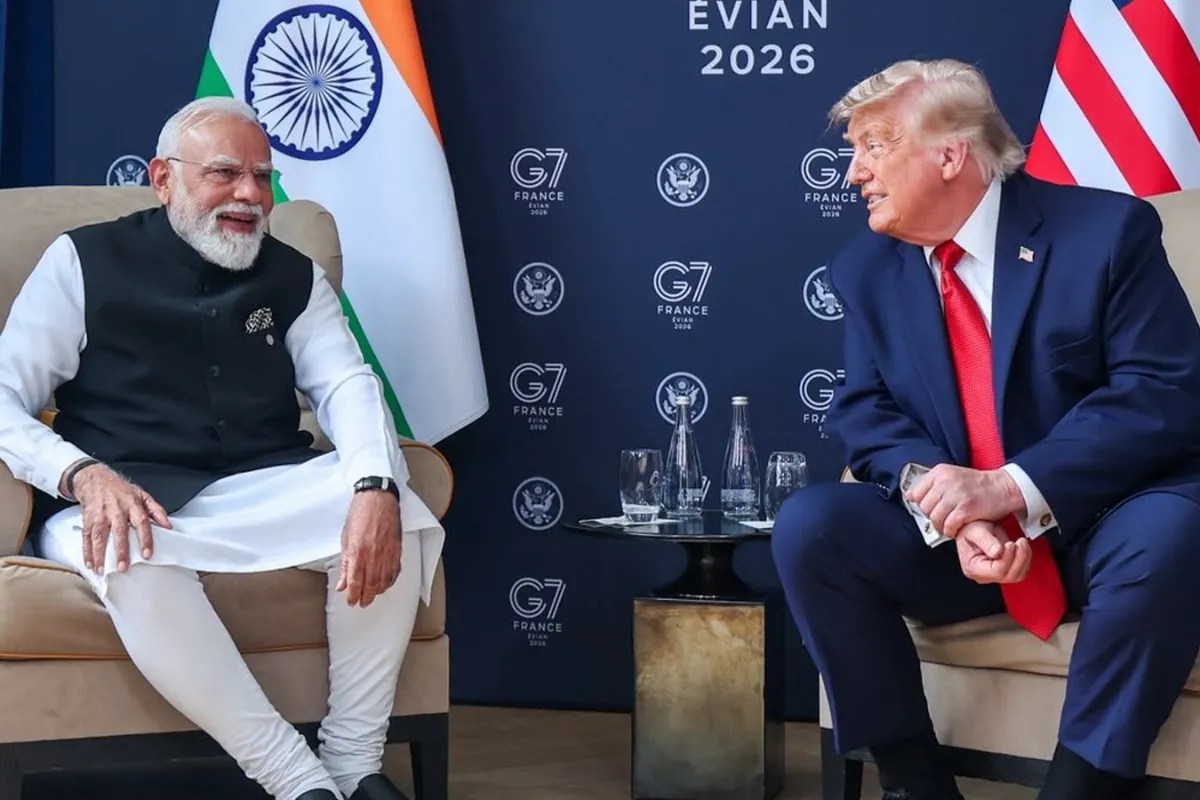
Unpacking the nuances of global leader interactions provides direct visual context on how strategic disagreements over maritime safety and trade policy persist even alongside public displays of personal warmth.